
Welding
Fronius' CMT technology in use at Voestalpine
The so-called cold arc has reached its further development stage. Fronius recently added the TPS/i welding power source to its portfolio. As the basis of CMT technology, it can be used in many applications for robot-assisted welding. The well-known steel producer and automotive supplier Voestalpine was the first user to decide to use the advanced technology in series production.
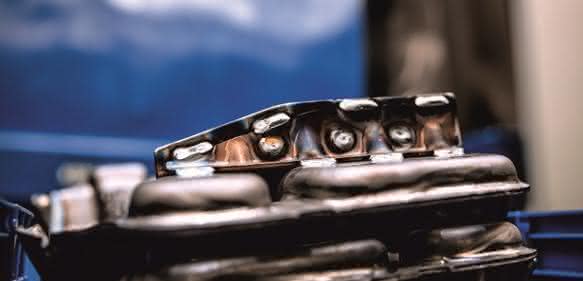
Voestalpine has been using the CMT process for years to manufacture a wide variety of automotive structural components from galvanized and high-strength sheet metal, as well as aluminium sheet metal. Most recently, six of the twelve robot welding cells at the Schmölln site worked with the CMT process, which was ultimately also included in the specifications for new welding systems. Those responsible at Voestalpine therefore reacted positively to the second generation of CMT technology presented at the beginning of 2016 and the proposal from Fronius to test its use in series production. "We chose an A-pillar made of high-strength galvanized steel for the first welding tests. This complex component is ideal for putting the new process through its paces, not only because of the challenging material, but also because of the limited accessibility and the large gap dimensions due to the production process," explains Michael Nowasz, Head of Joining at Voestalpine Automotive Components Schmölln.
In the summer of 2016, the first welding tests with the new CMT process and the TPS/i were carried out in the technical center at Fronius' headquarters in Wels. "I visited the laboratory together with our Head of Development and saw the new CMT process in action," reports the Division Manager. "What we saw there was simply brilliant. It was immediately clear to us that Fronius had achieved another great success."
The basis for the technological leap is the TPS/i, which is not a simple further development of the predecessor model TPS, but a completely redesigned welding power source. The manufacturer has redeveloped all components from the control unit, the communication bus and the wire feeder to the user interface, the cooling system and the hosepack. In this way, the company was able to use modern technology throughout and thus trim the overall system for maximum precision and performance.
To ensure that the CMT process can benefit as much as possible from the TPS/i, the algorithm has been redesigned and expanded to the second generation. The push-pull torch, which had already undergone a complete redesign for the TPS/i series, was not left out and was equipped as a CMT variant with a digitally controlled, gearless AC servo motor for even higher frequencies of the oscillating wire electrode movement. "One advantage of the new Robacta Drive robot torch is immediately apparent," says Michael Nowasz. "It is more compact than the previous model and therefore guarantees better accessibility, which we increasingly need for more complex components."
Use in series production
The results of the welding tests on the real component were so convincing that those involved immediately set about transferring the new CMT generation to series production at Voestalpine. The time had already come in the fall of 2016. Within a single day, Fronius employees converted the first of the six robot cells, on which holders made of bright, two to three millimeter thick sheet steel are produced underCO2 shielding gas. This involves laying around one meter of weld seam, which is made up of 48 individual seams with a maximum length of 35 millimetres. "We taught the robot together the very next morning and welded the first parts on the same day," recalls Michael Nowasz. "It turned out that the new system made it much quicker and easier to find the right parameters." On the third day, only minor adjustments had to be made to achieve the optimum work values.
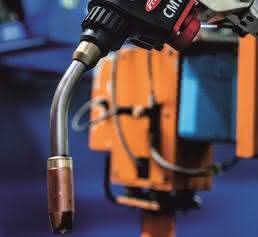
The division manager was also able to see the functionality of the new magnetic crash box for himself: "We had the robot move the torch against a sheet of metal - the protective device triggered so quickly that no damage could occur to the torch, robot, fixture or workpiece." After a collision, the magnetic lock only needs to be re-engaged, whereby the reference point is retained so that welding can continue immediately. The tedious replacement of the crash box and the reference run thus become obsolete.
After the tests, Voestalpine was able to restart series production with the new CMT configuration on the same day. "I was absolutely delighted that the changeover went so smoothly and that to date - three months and 3,000 parts later - there has been no downtime and we have not had to request any further support from Fronius," says Michael Nowasz. ee


You might also be interested in
Friction stir welding as a key technology for future industrial joining solutions?
At the DMG MORI in-house exhibition, Hufschmied Zerspanungssysteme presented friction stir welding with process-optimized tools and series production potential for the industry.
 read more...
Tox Pressotechnik at the Blechexpo
Connecting sheet metal and electrically conductive components safely
Joining sheets of different thicknesses easily and reliably without additional elements - Tox Pressotechnik will be demonstrating how this can be achieved at Blechexpo with its clinching and eClinch technology.
read more...Production, machine tools and robots
High-precision welding for perfect sawing
Stihl uses Nimak's portal projection welding systems to manufacture guide rails for chainsaws.
read more...Tox servo press for clean room
The coast is clear here now
In sensitive sectors such as medical technology, the optical industry or electronics, cleanroom-compatible components are required for all processes. This also includes drives. With the servo presses from the Electricdrive Core series, Tox...
read more...Air purity class 5 according to ISO achieved
Tox has servo press certified for the cleanroom
In sensitive sectors such as medical technology, the optical industry or electronics, cleanroom-compatible components are required for all processes. This also includes drives. With the servo presses from the Electricdrive Core series, Tox...
read more...Manufacture of metal bellows couplings
Joining instead of gluing
When manufacturing metal bellows couplings, the connections between the bellows and hub are a critical point. The flared press-fit process can be used here.
read more...ArtiMinds presents automation solutions at automatica
ArtiMinds Robotics is presenting automation solutions from the field of advanced robotics at Automatica in Munich. The applications were programmed using the in-house software solutions ArtiMinds Robot Programming Suite (RPS) and ArtiMinds Learning...
read more...Plug-and-produce with smart subsystem
The mechanical engineering company KMS Automation standardizes pressing and joining applications with the Smart Function Kit from Bosch Rexroth. The mechatronic subsystem simplifies machine design, increases process quality and shortens...
read more...Integrated ERP system for watertight processes
Rubber-based seals are used in window frames and escalators. They are also a must in tunnel projects to prevent water damage. Sealable, a specialist in sealing and insulation solutions, relies on an ERP system from Pro Alpha, which covers everything...
read more...