
Predictive maintenance
What does the IoT mean for the smart factory?
Exponential technological progress has ushered in the "fourth industrial revolution", forcing employers and employees to adapt their mindset to the new possibilities. Redefining the corporate structure and culture can lead to an agile, intelligently managed company.
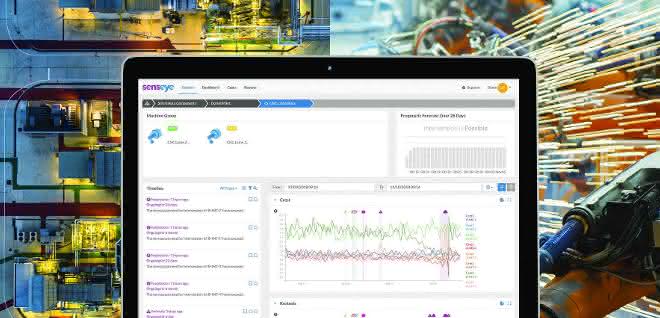
The Internet of Things (IoT) has brought science fiction into our homes: from refrigerators that reorder their own food to selecting music or TV programs by voice rather than remote control. Industrial IoT (IIoT) has also established itself in manufacturing companies, where it can increase productivity. At the same time, it also poses a challenge for IT security, which must protect the company network without interrupting ongoing production.
"We need to bring the online world and the world of industrial production together quickly. In Germany, we call this Industry 4.0," explained Chancellor Angela Merkel. The smart factory is the goal. Smart refers to networked thinking throughout the entire company. For example, customer feedback can be incorporated into a current product more quickly, a production error can be rectified immediately or even anticipated before it happens. Machine downtimes can be predicted and managed. The advent of big data, predictive analytics and cloud storage, as well as advances in automation and the popularization of connected devices, means that factories are moving from purely mechanical operations to agile, intelligently controlled, IT-driven process organizations.
OT and IT have different goals
Securing a smart factory poses challenges for both OT and IT departments, as they have different objectives: OT's main task is to keep production running, to ensure constant turnover. IT, on the other hand, has the task of securing the company network and closing security gaps.
If production machines are to be secured in the course of IIoT, a conflict often inevitably arises, as the installation of new or updating of existing security mechanisms is accompanied by a halt in production. The production machines have to be taken out of operation, which leads to production downtime and therefore loss of revenue. This is obviously not in the interests of OT.
Advantages of a smart factory
Networked thinking is good, but the benefits of any business investment should be greater than the input. What are the benefits of creating a smart factory environment?
1. greater flexibility with less environmental impact: Linking production and information allows manufacturing plants to move towards optimal performance. This shortens time-to-market and significantly reduces waste.
2. higher quality, lower costs: Thanks to the development of self-configuring machines, increasingly difficult tasks can be performed by machines. This enables cost savings and the provision of higher quality goods and services.
3. remain competitive: With the rapid advances in technology that companies of all sizes can benefit from, there is a risk that without investing in the digital revolution you will soon fall behind.
4. collect data: Machine sensors, customer experience management systems, health and safety regulations; all of these things can produce data that can be continuously monitored and effortlessly processed. Weekly machine checks are avoided, as are customer service issues and delayed responses to feedback.
Security through predictive analytics
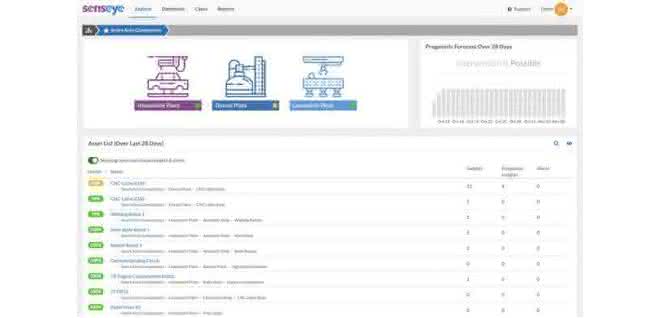
In response to demand, component and machine manufacturers are therefore equipping new machines with IoT-enabled sensors. Connecting production devices such as machine sensors, motors and switches to send data in real time enables constant monitoring and analysis to gain meaningful insights. The aim is to better understand the condition of the machine and enable a real-time approach to maintenance and management. This predictive maintenance approach underpins the smart factory and enables efficient inventory control, delivery and time-to-market, increased quality and the flexibility to respond to changing requirements.
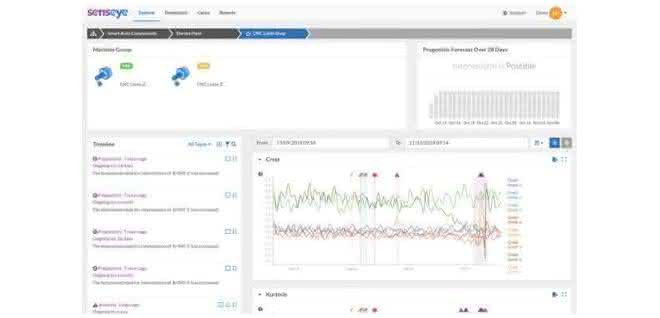
Intelligent security solutions for OT can use data collected by sensors to automatically increase security by analyzing the resulting data streams for suspicious actions. For example, if a production robot sends the data from its sensors to a server outside the company rather than a predetermined one, this may indicate data theft. Attacks on the company can also be prevented: If a machine's sensors record loads that are above the normal range, this may be an attack aimed at damaging the machines.
The IIoT offers many opportunities for production companies to avoid downtime, unforeseen wear and tear and therefore loss of revenue. The flip side of the coin is an increased vulnerability of corporate security if smart production machines are not adequately protected.
Despite their different objectives, OT and IT must therefore work together in order to maintain production (and thus secure sales) on the one hand and ensure the security of the company network on the other.
Robert Russell, co-founder and CTO of Senseye / ag


You might also be interested in
ESTIA aims to strengthen Europe's cloud
New tech alliance for EU sovereignty
Twelve companies, including Dassault Systèmes, are founding the European Sovereign Tech Industry Alliance (ESTIA). The initiative aims to strengthen Europe's technological independence and define requirements for sovereign cloud services. The start...
 read more...
Deutsche Telekom and Nvidia launch one of Europe's largest AI factories
With the Industrial AI Cloud in Munich, Deutsche Telekom and NVIDIA are creating one of the largest AI factories in Europe. Companies can train AI models, carry out simulations and access 10,000 GPUs.
read more...Leveraging data potential with AI and streaming
Huge data treasures are still lying dormant in many manufacturing companies. And yet it is high time that these treasures were unlocked. There is often a lack of resources and capacity to make data usable in real time. Streaming production data can...
read more...More awareness of noise
Dematic offers solutions that are tailored to different cloud environments and reduce environmental impact through reduced material consumption and improved energy efficiency.
read more...Generative AI in the automation environment
The mechanical engineering and automation industry is undergoing profound change. This transformation is being driven by more volatile global trade, geopolitical crises and increasing market pressure, which demands greater agility, technological...
read more...Rigid data structures have had their day
The traditional data center is no longer the center of data. A hybrid cloud storage approach enables manufacturing companies to both meet the current requirements of data-intensive processes and future-proof their infrastructure.
read more...Software as a service in three stages
CIM Database Cloud is a new out-of-the-box solution from Contact for end-to-end digital product development.
read more...How production can benefit from AI
Together with AI technology, IIoT networking makes it possible to better control machine parameters and optimize quality with predictive quality. Downtimes and set-up times can also be further minimized. Cloud platforms also make these technologies...
read more...More expertise for digital engineering
Altair, a computational science and artificial intelligence (AI) company, has acquired OmniV, a technology from Michigan, USA-based software company XLDyn.
read more...