
Carbon processing
Tailor-made monocoques for racing bikes
Until now, conventional bicycle frames have not been able to match the rigidity of monocoque frames. With Siemens, the Italian start-up Exept combines different manufacturing processes to produce customized monocoque frames. By Julie Dörr
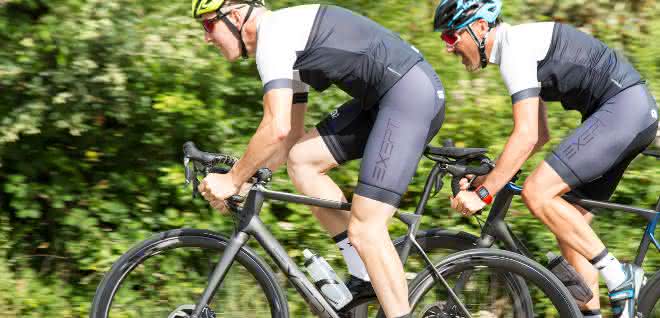
"In bicycle production, it all comes down to the cost of the tools," says Alessandro Giusto, co-founder of Exept and Head of Innovation and Simulation. The development of a frame mold costs up to 60,000 euros. As a result, only the big brands have been able to produce a mold for every frame size so far. "We have developed a method to produce all sizes with a single adjustable mold."
From aviation to the bicycle
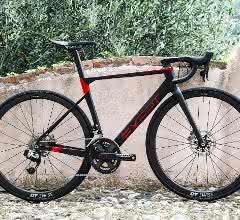
Exept designed its own bike according to a new concept right from the start. Initially, they did not focus on carbon fibers, says Giusto, because the construction of composite materials is complex and takes up the whole day. When the funds to finance the innovative idea became available, everyone was able to devote themselves fully to the project and give up their previous jobs.
Before founding Exept, Giusto worked in the aerospace and sporting goods industries. There he already worked with Siemens PLM Software's Simcenter Nastran software, in particular the finite element modeling and the pre- and post-processing environment with Femap software. "Nastran has established itself in the aerospace industry. Femap was also used. In my six years there, I was able to learn a lot about the tools."
When the Exept project started, Giusto contacted Siemens again. "We didn't need any evaluation or benchmarking," he explains. "It was clear to me that we would need Simcenter Nastran, and the price-performance ratio for Femap was also excellent. All I had to do was contact the Siemens partners SmartCAE and Francesco Palloni and explain our requirements. In the end, we accepted the offer without hesitation."
Exept opted for a so-called Node Locked Bundle, which combines Femap with NX Nastran Basic in an integrated solution. Step by step, the Exept team increased the complexity during development. This made it possible to identify the loads acting on the frame structure. This was followed by the development of the first simplified FEM model.
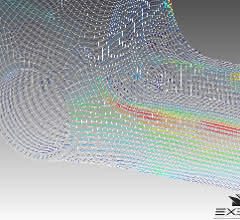
Exept created a simple model, known in the aerospace industry as a global FEM. It consists of one-dimensional elements, in Exept's case pipes. The load properties of the tubes were tested under various driving, braking and impact conditions. "We then moved on to a model made of isotropic material. We then simulated an aluminum frame with a constant thickness. This allowed us to use the information from the FEM model to analyze where we needed to reduce or increase the cross-sections to optimize stiffness and weight. Finally, our team worked on the geometry, which was re-meshed using four modifications. This allowed us to increase the stiffness by 27 percent."
Carbon Challenge
After optimizing the frame stiffness, the engineers at Exept focused on the carbon construction. To determine the lamination sequence, Giusto and his team adjusted the structure no less than 82 times. They achieved extraordinary results.
"Compared to the first prototype, we were able to increase the torsional rigidity by 150 percent, while the weight of the monocoque had only increased by twelve percent," says Giusto. In this phase, Femap brought enormous time and economic advantages. The layer formation and alignment of the fibers was tested and analyzed in the virtual realm without having to increase the amount of material used."
Exept conducted a comparative performance analysis of more than 800 stock frames developed and sold over the last three to four years to determine and achieve stiffness and weight targets. "We found a good compromise between stiffness and rideability."
At the end of June 2018, the performance of Exept's bespoke monocoque and the reliability of the Femap simulations were confirmed and certified by tests carried out by an independent German laboratory: The deviation between the real test and simulation was less than five percent.
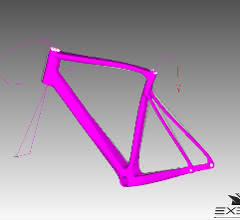
"We acquired Femap with Simcenter Nastran in September 2017. We started laminating carbon in January 2018. By the end of March, the layer book was ready. With Femap, it took less than three months for more than 80 passes," Giusto recalls. The average delivery time for a branded bike is two years. Exept managed to bring a model onto the market in less than a year. "All of this was only possible thanks to simulation technology. Physical runs were not necessary. No one in the Italian bicycle industry currently has comparable tools."
Combination of software and services
Giusto is convinced by Femap: "The decisive success factor is post-processing. Femap is ideally suited for this. Femap with Simcenter Nastran has the appropriate infrastructure for the linear stress analysis of composite structures, which suits our tasks. The Siemens software enables us to query the model properties and extract as much information as possible from structures such as our frames."
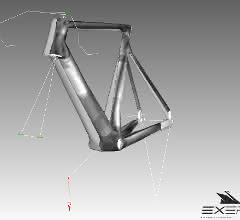
Femap's clear and intuitive visual representation helps the user to understand the model while providing sophisticated reporting tools for data extraction. This makes model creation intuitive, fast and straightforward. The benefits of the software are enhanced by SmartCAE, the Siemens partner that has supported the startup from the very beginning.
"I've known SmartCAE and Palloni since 2001," says Giusto. "When I started working entirely with Femap and Simcenter Nastran, I didn't start from scratch, but I still needed some training. Whenever I had a question, I picked up the phone. The SmartCAE engineers were there to help and advise."
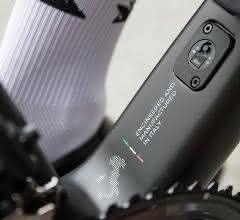
With the expert advice of SmartCAEs, the expertise of the three founders and the advanced FEM functions of Femap, Exept can now even run sophisticated simulations and tests for complex mechanical events such as falls and impacts.
The author: Julie Dörr, freelance journalist from Munich


You might also be interested in
Conrad continues to grow
Conrad Electronic now generates 80% of its sales with business customers and has successfully developed from a traditional technology retailer into a B2B procurement platform. The company aims to become Europe's leading procurement platform for...
 read more...
AI finds its way into automotive customer service
In addition to computer solutions for vehicle diagnostics, Getac now also offers AI-based digital tools that support customer contact in service operations.
read more...SMC: "Preferred Supplier" from Bosch
The technology and service company Bosch has recognized SMC for the performance of its automation technology in factory and process automation and awarded it the status of "Preferred Supplier" in the material group "Standardized Pneumatic Devices".
read more...Combined ERP forces
The medium-sized ERP providers Step Ahead Software, Godesys and Informing merge to form the Step Ahead Group.
read more...Cybersecurity for asset-intensive companies
Forge Cybersecurity Platform, the new software platform from Honeywell, has been developed for the cybersecurity of asset-intensive companies and critical infrastructures. The platform is available in three versions.
read more...Automated machine tool as a success factor
Industry 4.0 is the hot topic of the moment. For small and medium-sized companies and contract manufacturers, it holds great potential for increasing production efficiency step by step. The focus here is on efficient and user-specific automation...
read more...Nemo hand vacuum lifts all materials
A new addition to the Eurotech portfolio is the battery-operated Nemo vacuum cleaner, which is suitable for handling almost all surfaces.
read more...Future-oriented cobot projects
Three pillars of successful cobot initiatives
What is important if cobot projects are to be future-oriented? Automation and robotics expert Omron has identified three aspects for human-machine collaboration.
read more...Short-stroke linear actuator instead of pneumatic cylinders
The new short-stroke linear actuator from Ketterer Antriebe and halstrup-walcher is characterized by high dynamics and a large stroke in a compact size. Thanks to the integrated electronics, the drive is easy to control compared to pneumatic...
read more...