
Flexible solutions
Software for switch cabinet construction
Globalization, digitalization, Industry 4.0 and Always Availability pose major challenges for software development.
These new specific requirements, strongly interlinked structures and dependencies as well as new technologies demand maximum flexibility, responsiveness and quality from the software solutions. Phoenix Contact meets this challenge with a modular software architecture.
A traditional monolithic software architecture is usually built as one large system and is based on exactly one source code. It is designed as independent software and is provided as a whole. The components of the program are interconnected and interdependent. This means that if details are changed, the entire architecture must be edited. If a function or component of the monolith contains an error, this has a negative effect on the entire application. Furthermore, programs with such an architecture are generally tied to specific hardware and operating systems.
Monolithic architectures also have advantages: As a rule, they have better performance and are easier to test and debug, as they are operated with fewer elements and fewer variables. Monolithic software architecture is a good solution for applications that map individual business processes. However, it reaches its limits when several functional processes with different requirements are to be combined in one application. In addition, product life cycles are getting shorter and shorter, individual customer requirements and technological developments are becoming more and more important.
To meet these requirements, modular software structures such as SOA (service-oriented architecture) and microservices are ideal. Ideally, a modular service-oriented architecture is based on functional processes whose individual levels of abstraction serve as the basis for concrete service implementations. The functional processes are developed as individual modules with the most suitable technology and can also be used independently in some cases. In these software structures, service interfaces are used to define how two independent instances interact with each other. The most important advantages of a modular software architecture are
- the reuse of services,
- Possible parallel development of services by different development teams,
- greater flexibility - if individual functional processes change, the software can be adapted more easily,
- the optional use of distributed applications via the Internet,
- a reduction in costs when adapting the systems and
- simplified collaboration.
From monolithic to modular software structure
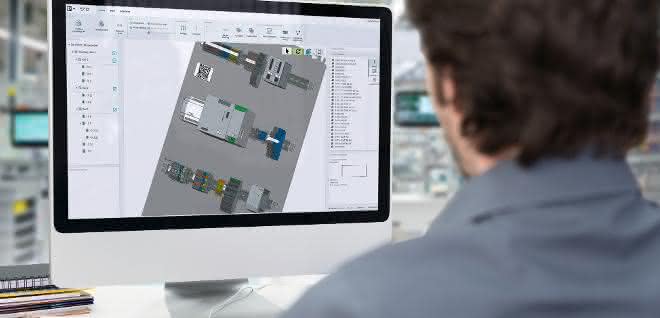
The Project Complete Planning software from Phoenix Contact is designed as monolithic software. Here too, the disadvantages of monolithic structures described above have hindered the further development of the application. The new Clipx Engineer planning software from Phoenix Contact is based on a modular software structure and a new technology. Thanks to the modular structure, individual functional processes can be developed in parallel as individual modules by different teams and then integrated into the software. One module is particularly noteworthy: functional engineering. This makes it possible to obtain a partial solution for a project by entering just a few parameters.
If, for example, a power supply is required for a machine, functional engineering provides support in selecting the right items. After entering the number of circuits required, the maximum current per circuit and the type of fuse protection, Functional Engineering creates a combination of articles that covers the required function. The user then only has to place the individual items on one or more mounting rails in their project. The online configurators from Phoenix Contact are also integrated into Clipx Engineer. This means that the user can also use articles configured according to customer requirements. The extensive functions make Clipx Engineer a project planning platform that can be used to process all Phoenix Contact components relevant to control cabinets.
Another advantage of the software is its availability on different platforms, namely as a cloud, desktop and on-premise version. Each user is free to decide which type of installation they want to use. The cloud version eliminates the need for installation and updates - the user can use Clipx Engineer from any computer with Internet access and always works with the latest version. The desktop version is installed on a local computer and can be used independently of Internet access. The on-premise version is installed once in a company's network and distributed from there to the workstations. Project management allows users to save projects locally, in a local network or in the Proficloud. Access and rights management allows read or edit rights for the projects to be shared with partners.
Thanks to its modular software structure and future-oriented technology, Clipx Engineer meets the current requirements of the rapidly growing and flexible market for enclosure construction. Users can build their optimum solution using both standard items and individually configured control cabinet items from Phoenix Contact.
Peter Isaak, Senior Project Manager Planning & Engineering, Business Unit Industrial Cabinet Solutions, Phoenix Contact


You might also be interested in
ESTIA aims to strengthen Europe's cloud
New tech alliance for EU sovereignty
Twelve companies, including Dassault Systèmes, are founding the European Sovereign Tech Industry Alliance (ESTIA). The initiative aims to strengthen Europe's technological independence and define requirements for sovereign cloud services. The start...
 read more...
Deutsche Telekom and Nvidia launch one of Europe's largest AI factories
With the Industrial AI Cloud in Munich, Deutsche Telekom and NVIDIA are creating one of the largest AI factories in Europe. Companies can train AI models, carry out simulations and access 10,000 GPUs.
read more...Leveraging data potential with AI and streaming
Huge data treasures are still lying dormant in many manufacturing companies. And yet it is high time that these treasures were unlocked. There is often a lack of resources and capacity to make data usable in real time. Streaming production data can...
read more...More awareness of noise
Dematic offers solutions that are tailored to different cloud environments and reduce environmental impact through reduced material consumption and improved energy efficiency.
read more...Generative AI in the automation environment
The mechanical engineering and automation industry is undergoing profound change. This transformation is being driven by more volatile global trade, geopolitical crises and increasing market pressure, which demands greater agility, technological...
read more...Rigid data structures have had their day
The traditional data center is no longer the center of data. A hybrid cloud storage approach enables manufacturing companies to both meet the current requirements of data-intensive processes and future-proof their infrastructure.
read more...Software as a service in three stages
CIM Database Cloud is a new out-of-the-box solution from Contact for end-to-end digital product development.
read more...How production can benefit from AI
Together with AI technology, IIoT networking makes it possible to better control machine parameters and optimize quality with predictive quality. Downtimes and set-up times can also be further minimized. Cloud platforms also make these technologies...
read more...More expertise for digital engineering
Altair, a computational science and artificial intelligence (AI) company, has acquired OmniV, a technology from Michigan, USA-based software company XLDyn.
read more...