
Requirements for autonomous vehicles
On the road to autonomous driving
The race for fully autonomous cars is in full swing. However, the vehicle testing required to prove safety is extremely time-consuming, which is why simulations have become increasingly important as a more cost-effective alternative to real-world driving tests to successfully complete autonomous vehicle programs. By Scott Stanton, Director of Engineering Solutions atAnsys
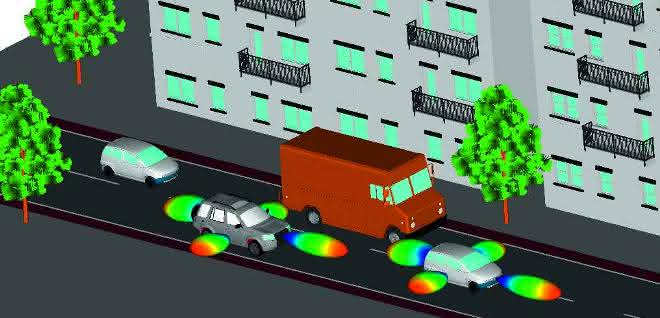
The number of autonomous vehicles is constantly increasing - and not just in the automotive sector. There are also mobile autonomous robots and drones, which are not only used by the military, but are also planned by companies such as Amazon for the delivery of goods. Semi-trailer trucks are also being developed that can transport products quickly and cheaply over thousands of kilometers 24 hours a day. There is no doubt that the future belongs to autonomous vehicles - but there are major technological challenges along the way.
Critical technologies for autonomous vehicles
It is estimated that billions of kilometers of practical road testing are required to prove the safety of an autonomous vehicle. At the current rate of progress, it would take centuries to complete the road tests. This is where technical simulation comes into play. It allows autonomous vehicles to be tested and analyzed in a risk-free, cost-effective and time-efficient virtual environment. These simulations must be able to capture the behavior of the vehicle in its environment at the highest level: This can be characterized as a "closed-loop simulation" - how does the vehicle "see", "think" and "act", controlled by artificial intelligence.
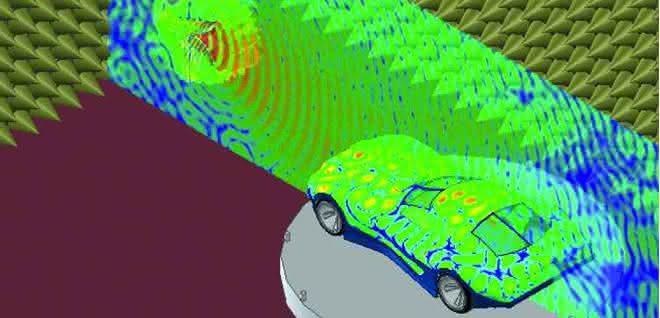
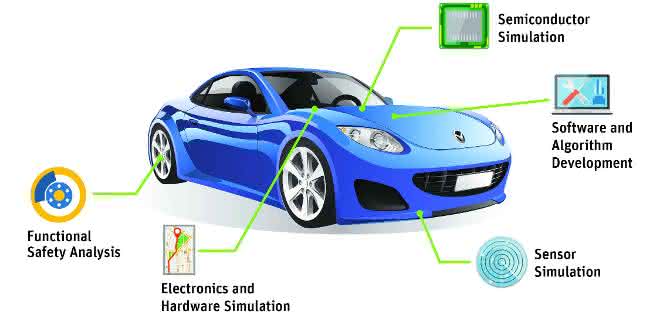
The simulation includes virtual cities and roads as well as sensors that act as the "eyes and ears" of the vehicle, control software and algorithms that make critical decisions. Driving dynamics also play an important role, based on the instructions of the software and algorithms. This simulation represents a continuous closed-loop process of what the vehicle senses, performs and how it maneuvers while driving. Of course, these closed-loop simulations can only be considered reliable if they contain accurate representations of all relevant components of the vehicle and its environment. Therefore, there are five important technical functions that support accurate virtual road testing:
- Sensor design,
- Optimization of the semiconductors,
- reliable electronics,
- safety-critical embedded software and
- the analysis of functional safety.
Sensors perceive the real world
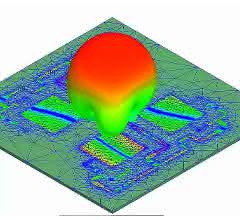
Sensors are among the most critical components of an autonomous vehicle: they record and process large amounts of environmental data in real time and transmit it using signal processing. Common sensor types include radar, lidar, cameras and ultrasound. Testing and analyzing the performance of sensors is a major technical challenge: Radar sensors, for example, are usually mounted behind the bumper of a car, where their radiation behavior is distorted by the material properties and geometric configuration of the front end. In order to work reliably in different car models, the radar systems must be designed in such a way that they function smoothly under a wide variety of geometries and material properties. However, building and testing for each individual model is not feasible for reasons of time and cost.
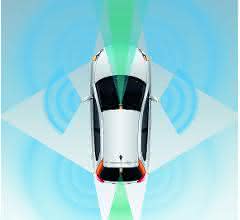
Ansys offers a suite of radar and antenna simulation solutions designed to reproduce real-world performance with a high degree of accuracy. The software can predict sensor performance, whether the sensor system is mounted on a vehicle, in a static environment or being studied during a fast closed-loop simulation. There are also solutions for other sensor technologies such as ultrasound, which is used not least for parking assistance.
Optimization of semiconductor performance
Ansys enables the simulation of the semiconductor devices that underpin radar systems and support signal processing. Semiconductors underpin much of the functionality of autonomous vehicles, but the mass of electronics required can also cause performance issues. Power loss, electrostatic discharge, electromagnetic interference and thermal and structural stresses can all negatively impact the reliability and integrity of a product. For example, a temperature rise of 25 °C generally leads to a 3 to 5-fold deterioration in the expected service life of electronic devices.
Ansys' RedHawk 3DIC and PowerArtist can optimize the design of integrated circuits. They help engineers regulate electronics density and make smart trade-offs between product size, heat dissipation and overall product performance.
Developing reliable hardware and safety-critical embedded software
Electronic hardware is one of the most critical components of autonomous vehicles; it supports key functions such as communication, image and data acquisition, system control, artificial intelligence and mobility. Therefore, the hardware must be sufficiently robust to withstand electrical, thermal, vibrational and mechanical stresses. Instead of subjecting hardware prototypes to physical testing, tools such as Icepak, SIwave and Mechanical can be used to analyze IC packages, boards, housings and systems in a virtual design space.
Simulations allow important aspects such as power integrity, energy absorption, electrostatic discharge, electromagnetic interference and compatibility, thermal performance and structural robustness to be identified. Based on the analysis results, corrective measures can be taken at an early stage of the development process before costs are determined.
Although invisible, the computer software and associated algorithms are the foundation for the safe and reliable performance of all autonomous vehicles. Every numerically based function, from signal processing to object recognition, must work flawlessly for the vehicle to be able to collect data and make intelligent decisions at all. This also means that the underlying software code must be absolutely error-free. To eliminate human error, Ansys offers the SCADE family for software development and verification. Through numerical modeling and control of code generation activities, software developers are able to meet industry performance and safety standards. It also increases the reliability of software code and reduces development time and costs compared to manual methods of code generation.
Winning the race
The question is no longer how autonomous vehicles will change our lives, but who will be the first to offer them. Simulation plays a central role in the race to find answers to remaining technical challenges and in the development of innovative and practical solutions. Ansys offers a comprehensive simulation solution for testing autonomous vehicles. Regardless of whether a complete vehicle or just a component needs to be developed, simulation is the right answer to the many technical challenges.


You might also be interested in
Alternative to optical positioning methods
Solutions for workplace and intralogistics systems
With the SensorBoard for detecting the position and orientation of components, RK Rose+Krieger is integrating a technology commonly used in television studios into its modular system for customized system solutions.
 read more...
Schubert System Elektronik at the embedded...
Industrial computer technology "Made in Germany"
This year, Schubert System Elektronik (SSE) will once again be exhibiting at embedded world in Nuremberg. From March 14 to 16, 2023, SSE will be presenting innovative, industrial computer technology "Made in Germany" for various sectors and...
read more...The tiger among processors
Since the move towards the Industrial Internet of Things (IIoT) and Industry 4.0 has picked up speed, processor boards and modules must be able to process exponentially growing amounts of data.
read more...IFR publishes "World Robotics R&D Programs"
Countries around the world are investing in robotics to promote the further development of the technology for industrial and social applications. But what are the current goals of the official funding programs in Asia, Europe and America? The...
read more...App ensures safety during maintenance
The "5i.Maintenance" application improves transparency and occupational safety during machine maintenance.
read more...Compact computer for industry
As a versatile and compact computer, the Raspberry Pi is also interesting for industry. However, appropriate adaptations to the harsh production environment are necessary to bring the Raspberry Pi world into factories.
read more...Changes to the Executive Board
The Supervisory Board of Schaeffler has appointed Claus Bauer (55) as Chief Financial Officer (CFO). At the same time, Sascha Zaps (46) will become Regional CEO Europe.
read more...Work safely on the machine
The most dangerous workplace accidents occur outside of normal machine operation - for example during maintenance and cleaning. The cause is usually residual energy in the system that has not been switched off.
read more...Isra Vision with a new management team
Isra Vision has entered into a strategic partnership with the Swedish industrial group Atlas Copco, forming the core of the new Machine Vision Solutions division. With a new management team, the course is now being set for further business...
read more...