
Manufacturing Execution System
MES as the key to Industrial IoT
The rapid developments in industry are bringing with them a wealth of new opportunities and paths. After Industry 4.0, another term, Industrial Internet of Things (IIoT), has now become firmly established in people's minds - and is already providing concrete examples of implementation.
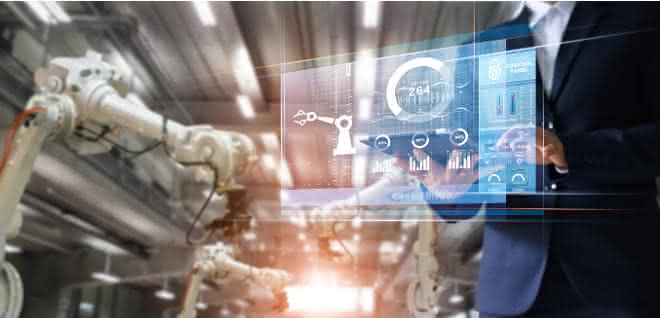
An important foundation has already been laid with established communication standards such as OPC UA. Powerful software systems such as a Manufacturing Execution System (MES), which takes care of the intelligent processing, interpretation and preparation of the data, are required in order to optimally incorporate the machine data collected in this way into a digital manufacturing process.
In addition to this data collection and processing, the standardized transfer and distribution of data plays an essential role in the implementation of IIoT. Web services provide an opportunity for semantically correct communication within the entire system landscape - including cloud applications. Here, too, a powerful MES can demonstrate its advantages as a central "administration point".
Above all, web services can help with the consolidation of various related data packages into valid information. Order, personnel and process information and current production statuses on a line can be condensed into valuable information. For example, Cronetwork MES can be used to create a homogeneous database in order to implement a simple connection to the machine level using OPC UA. In addition to simply storing process information, it can also be linked to PDA data, aggregated using statistical functions and processed individually. Web services do the rest to make the new information available throughout the entire system landscape in the sense of open communication.
With MES: Digital manufacturing processes in the IIoT
An MES can therefore already help companies today to digitally network production in the IIoT - taking all production processes into account. All production data, such as measurement and process data, can be recorded, merged, linked, stored and validated with a powerful MES. The software thus ensures transparency, higher quality and consistent documentation in production.

Dipl.-Ing. Bernhard Falkner, CTO Industrie Informatik: "In this context, it is also very positive that communication-capable sensors are becoming ever cheaper and are therefore increasingly being installed as standard in machines and systems, which in turn makes access to data and information much easier." Entire production plants can thus communicate with each other permanently via M2M communication. It is essential that parts of the automation technology migrate to the MES. The automation world must grow together with the existing software systems. A higher-level MES that is networked with the automation level becomes the central data hub of every production facility thanks to compliance with standards, redundancy-free master data management and the lowest possible number of interfaces. MES solutions such as Cronetwork are much more flexible during operation than individual solutions at the automation level, as they can rely on data-driven, flexible processes in line with the IIoT. Fixed programmed functions are therefore a thing of the past. An MES enables flexible production in which workstations are aligned, for example, based on the recognized serial number and the requirements of the individual product - provided that the machine changeover is fully automated. This makes batch size 1 a reality in digitalized production.
Keep processes efficient and cost-effective with MES
"However, the real strength of an MES lies in the connection and linking of data from the store floor (PDC and MDC) with the master data management and commercial ERP system," says Falkner. "The newly acquired information can be used to automatically record commercially relevant facts." Based on this recorded detailed data, companies receive highly valid information directly from production and uncover new optimization potential along the entire value chain.
In general, the collaboration of MES with ERP or cloud and automation solutions in an IIoT environment should be characterized by standards and the openness of the individual systems towards the entire system landscape. The "best-of-breed approach" is a recommended option here: companies configure an optimal, individually orchestrated solution from all providers and systems using the "Lego principle". Industry 4.0, smart factory and IIoT initiatives have been aiming for such developments for a long time. However, the most important task of an MES must always be to correctly evaluate the data collected from planning and production in order to keep all processes transparent, efficient and cost-effective.
Be and remain fit for the future
Data collection and processing from production has always been the sovereign task of the MES. "A future-oriented and efficient IIoT has the best chance of success if an MES system can fully exploit its flexibility in data collection and information processing and at the same time harmonize with the commercially leading ERP system," says Falkner. Standards such as OPC UA and web services provide an important basis for this. Comprehensive interaction with the automation level will also be decisive for success. "An MES such as Cronetwork is perfect for such architectures, as it maps the semantic background and turns difficult-to-understand data into valuable information for companies, thus contributing to the success of the IIoT."
Tino M. Böhler, Editorial Office Dresden / ag


You might also be interested in
ESTIA aims to strengthen Europe's cloud
New tech alliance for EU sovereignty
Twelve companies, including Dassault Systèmes, are founding the European Sovereign Tech Industry Alliance (ESTIA). The initiative aims to strengthen Europe's technological independence and define requirements for sovereign cloud services. The start...
 read more...
Deutsche Telekom and Nvidia launch one of Europe's largest AI factories
With the Industrial AI Cloud in Munich, Deutsche Telekom and NVIDIA are creating one of the largest AI factories in Europe. Companies can train AI models, carry out simulations and access 10,000 GPUs.
read more...Leveraging data potential with AI and streaming
Huge data treasures are still lying dormant in many manufacturing companies. And yet it is high time that these treasures were unlocked. There is often a lack of resources and capacity to make data usable in real time. Streaming production data can...
read more...More awareness of noise
Dematic offers solutions that are tailored to different cloud environments and reduce environmental impact through reduced material consumption and improved energy efficiency.
read more...Generative AI in the automation environment
The mechanical engineering and automation industry is undergoing profound change. This transformation is being driven by more volatile global trade, geopolitical crises and increasing market pressure, which demands greater agility, technological...
read more...Rigid data structures have had their day
The traditional data center is no longer the center of data. A hybrid cloud storage approach enables manufacturing companies to both meet the current requirements of data-intensive processes and future-proof their infrastructure.
read more...Software as a service in three stages
CIM Database Cloud is a new out-of-the-box solution from Contact for end-to-end digital product development.
read more...How production can benefit from AI
Together with AI technology, IIoT networking makes it possible to better control machine parameters and optimize quality with predictive quality. Downtimes and set-up times can also be further minimized. Cloud platforms also make these technologies...
read more...More expertise for digital engineering
Altair, a computational science and artificial intelligence (AI) company, has acquired OmniV, a technology from Michigan, USA-based software company XLDyn.
read more...