
Challenges for production logistics
Modernize in five phases
In 2020, the warehouse is proving to be in need of modernization in many manufacturing companies. A shortage of skilled workers and integration into the company's digital processes are particular challenges. We asked Daniel Dombach, Director EMEA Industry Solutions at Zebra Technologies, about this.
What challenges are bearings currently facing in industrial production?

Due to the coronavirus pandemic, warehouse facilities in industrial production are also facing major challenges. Nevertheless, the majority of jobs in warehouses are still carried out manually by warehouse workers. On average, a new employee needs 90 days of training before they can be deployed efficiently - we know this from the 2024 Warehouse Vision Study conducted by our customers.
We also have a shortage of qualified warehouse staff in Germany, and indeed throughout Europe. Due to the constantly high demand, we are working at the limit. In order to be able to continue to offer the same level of service under such conditions, we have no choice but to modernize and digitalize our business processes.
Manual workflows and processes are usually not so well connected. Without real-time data collection, it becomes increasingly difficult to plan properly, to recognize upcoming problems in time or to know exactly what your assets and inventory are. This is currently a huge challenge for many manufacturing companies!
How can manufacturing companies determine how efficient their warehouse operations are and how should they best plan a modernization?
In our experience and that of our customers, the modernization process takes place in five specific phases. To illustrate this, we have developed the Warehouse Maturity Model Framework to show warehouse managers where they are on their journey.
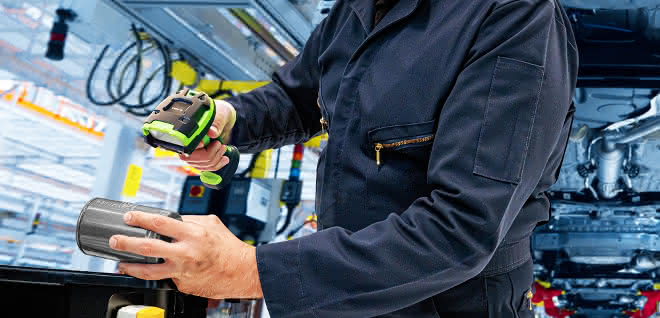
Phase 1 is data transmitted by humans. Companies use barcodes and scanners to record data manually. For example, a worker uses a forklift truck to unload a truck delivering components. To do this, he scans the barcode on the pallet. This information is then sent to the warehouse management system. This enables employees to do their work faster and more efficiently.
Phase 2 adds new technology such as wearables and voice. So-called wearables, i.e. mobile devices that can be worn on the arm or as a belt, keep warehouse workers' hands free while they carry out their tasks. This also includes voice-controlled technology, both pick-by-voice and internal communication with each other. Our solution in this area is called "Workforce Connect powered by Zebra Savanna".
Sensor-controlled real-time data then follows in phase 3. This means that the companies now use sensors for data collection, with RFID being the main option here. When the truck in our example is unloaded, workers no longer need to read the barcode by hand with a scanner. Instead, a gate with sensors scans the pallet as it is unloaded and sends it to the correct storage location.
In the penultimate phase, real-time tracking systems come into play. With this technology, companies can locate inventory, forklift trucks and other vehicle fleets, goods on pallets or employees in real time. The tracking systems also enable automatic alarm settings and the implementation of new business processes.
The final phase will be intelligent automation. Autonomous mobile robots (AMRs) will not replace humans, but will work side by side with them. This will help to significantly reduce the idle and travel times associated with the transportation of goods. This leads to higher productivity and employees have more time for more important tasks that require flexible problem solving.
Does Zebra also offer a solution to ensure safety regulations in the warehouse during the coronavirus pandemic?
Yes, "MotionWorks Proximity" from Zebra Technologies is a proximity analysis and contact logging software solution for mobile computers. It creates contact tracing evidence, dashboards or employee logs. The data is tied to an employee ID or anonymized user ID to allow employers to take action while protecting employee privacy. This accurate automated contact tracing helps companies quickly identify affected employees so they can get tested.
In this way, it is possible to counteract a more extensive closure of the company.
How can warehouse workers use their mobile devices safely during the pandemic?
In normal warehouse operations, most devices are shared or exchanged with other colleagues. It is therefore very important that they are disinfected with the right cleaning agents. Our Motion Works Proximity solution also takes this task into account and makes it possible to see when and where employees have logged on to their devices.


You might also be interested in
Plagiarius 2024 negative prize
On January 26, 2024, the Plagiarius campaign awarded its dreaded "Plagiarius" negative prize for the 48th time to manufacturers and retailers of particularly brazen counterfeits and fakes.
 read more...
Ivalua honors winners of the Generative AI...
AI-supported "add-ons" for buyers within 48 hours
Ivalua, provider of cloud-based spend management solutions, announced the winners and innovations of the first Generative AI Innovation Cup. The competition took place in December 2023. It was open to all Ivalua partners and employees - more than...
read more...Efaflex celebrates 50 years of high-speed...
The emphasis is on "fast"
Since day one, Efaflex has wanted to use new technologies as early as possible and drive progress in the industry. This year, the family business is celebrating its 50th anniversary under the motto "Fast Forward".
read more...Security of supply even during power outages
In the winter of 2022, Germany was worried about energy shortages. The drugstore retailer dm did not paint any horror scenarios, but nevertheless saw the possibility of controlled, temporary, regional power cuts (brownouts).
read more...Safety technology in mechanical engineering
Modules with new functions
Euchner's product highlights at EMO 2023 include the communication-capable solenoid interlocks.
read more...Transforming the paper industry towards climate neutrality
Together with partners from industry and research, Voith is developing a project for the optimization of energy and material flows in paper production. The aim of the research project is to develop a digital framework that enables effective process...
read more...Up to 95 percent less flue gas thanks to direct extraction
The requirements for occupational safety measures and safety technology are also constantly increasing in welding technology. The Technical Rules for Hazardous Substances (TRGS) stipulate that welding fumes and harmful substances must be extracted...
read more...Competitive advantages with large machines
Whether 3D-printed components for machines and systems, prototypes or aids for design: additive manufacturing is almost indispensable for modern companies in mechanical and plant engineering and automation if they want to play in the premier league.
read more...Transport technology from the modular system
Many transport tasks can be realized with the help of linear technology. Pre-configured solutions are available to simplify the interaction between the linear unit, motor, gearbox and controller. This minimizes the effort required for research and...
read more...