

3D models
Develop prototypes faster
Augmented reality is also an interesting technology for industrial environments and applications. Virtual 3D models, which are projected into the room as holograms, enable collaborative work on prototype design development - the joint development of prototypes in real time, regardless of location and in individual teams.
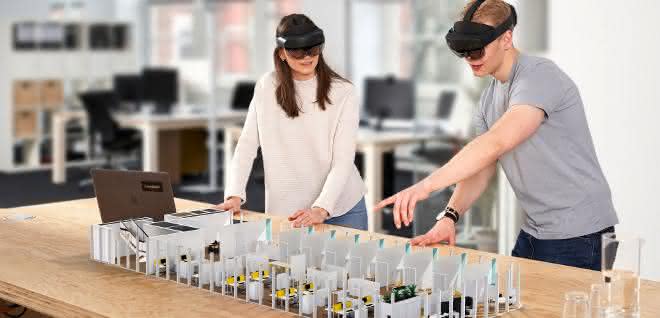
Augmented reality combines the real world with the virtual world. Its use cases and advantages in the end customer business are well known - complex products can be displayed clearly and even personalized. The technology is also highly interesting for B2B. One problem, however, is that software solutions often do not fully exploit the potential of existing 3D models. They are displayed statically on 2D screens and interaction is not possible or only possible to a limited extent. It is better to integrate models and process information where they are relevant and where they are used. Teamwork on the 3D model is the game changer. A collaboration platform for augmented reality makes it possible - via the web browser, a tablet or with data glasses on site in real time.
HoloDesk from the company Plansysteme is one such software solution in the form of a web portal and app. Existing 3D models can be uploaded and used immediately with augmented and virtual reality glasses or other end devices. The 3D object is projected into the room as a hologram. Users can view it with data glasses and interact with it. The Microsoft HoloLens, for example, has sensors and cameras that can track eye movements and recognize gestures and speech. The glasses capture the rooms in three dimensions and calculate the position and location of the objects and models in them.
A good tool allows the provision of 3D model files that can be uploaded from various CAD or 3D authoring tools and in a variety of industry-standard exchange file formats. The platform should also allow projects to be created and video and model conferences to be held jointly. HoloDesk shows where the other participants in the session are in relation to the object. Users can view the models from all sides, mark and highlight parts and add information. Annotations are possible via voice input and control, for example, and can be stored as notes on components. Control elements and buttons allow virtual operation. The prototypes can also be managed and documented in the AR environment if the platform allows content to be stored centrally.
The advantages of design collaboration
With these 3D model assets, companies can simplify remote collaboration, especially in industrial environments. Teams and necessary information are networked and end-to-end communication on the model is guaranteed. This can also greatly accelerate the development process - feedback is provided immediately and processing loops are eliminated or significantly shortened. Collaboration provides an overview of change requests in a short space of time.
As the models are placed in the real room, the planning can also be compared with the actual situation. Errors in design processes can be identified at an early stage or avoided altogether. Overall, the decision-making paths are short and the coordination effort is reduced. At the same time, communication is improved as everyone is sitting at the same table virtually. There are fewer misunderstandings as everyone can talk about and see the same object at the same time. Explanations on the phone or in writing become superfluous.
By working on the model and the clear visualization, everyone is also on the same page and there is no longer a multitude of plan variants that could potentially cause chaos. Collaborative design thus enables work to be shared in real time - internally or with cross-company teams. Security is provided by intelligent rights and access management.
Higher quality and safety
Thanks to integrated document management, all information on details or processing statuses, circuit diagrams and construction plans are available centrally - projects and processes become visible and transparency is created. Recorded discussions and digital notes on the model are also available. There is no need to search for information as it is available digitally with just a few clicks. The time required for uploading or transferring large files or synchronization is also eliminated. This optimized process flow indirectly improves the quality and safety of the products. This results in faster processing and development, less rework and higher productivity. Review cycles can also take place more quickly.
Thanks to location-independent collaboration, companies can also save on travel costs for their employees, who can use their travel time for productive work. And last but not least, holistic collaboration strengthens the team structure. As a side effect, interdisciplinary work on the model results in a transfer of knowledge - people acquire knowledge and are enabled to solve problems themselves.
The HoloDesk tool is particularly interesting for prototype development in industry, as the platform has been optimized for performance and short loading times rather than an attractive appearance. A separate engine was written to display the 3D models.
Nadja Müller, freelance journalist


You might also be interested in
Basler acquires 76% of Indian image processor
Basler, supplier of image processing components for computer vision solutions, has acquired 76% of the Indian sales partner Alpha TechSys Automation.
 read more...
Process monitoring and fault detection
Cameras ensure quality during laser melting
Powder bed-based laser melting (PBF-LB/M) opens up new possibilities in additive manufacturing. Modern camera systems provide crucial process data to further increase quality and efficiency.
read more...Vision Sensor is three times faster than its predecessor
The 'CS-62' vision sensor from di-soric is around three times faster than its predecessor, the 'CS-60'. In combination with the 'nVision-i 25.1' software, it enables image processing solutions that were previously reserved for smart cameras.
read more...Thermal imaging cameras for quality control
Automated thermal imaging cameras are often suitable for quality control applications where temperature plays a role. However, while there are various solutions on the market for slow processes, it is challenging to select a camera that reliably...
read more...Easy entry into industrial VGA thermography
Reliable temperature measurement is a prerequisite for the success of many industrial processes. Berlin-based manufacturer Optris presents the Xi 640 infrared camera, a new member of its Compact Line, which enables non-contact temperature...
read more...Powder bed-based laser melting optimized
Aconity3D has set itself the goal of optimizing the stability of the manufacturing method of powder bed-based laser melting and thereby promoting its use in a wide range of industries. By using high-speed industrial cameras from SVS-Vistek, the...
read more...INDUSTRIAL Production Products of the year...
2nd place, category handling, assembly and production logistics: SICK
safeVisionary2 is the first 3D time-of-flight camera with Performance Level c safety certification. It enables safe three-dimensional environmental detection and won 2nd place in the competition for Product of the Year 2024 in the handling, assembly...
read more...Nomination Products of the Year 2024
SICK: Camera systems safeVisionary2
safeVisionary2 is the first 3D time-of-flight camera with Performance Level c safety certification. It enables safe three-dimensional environmental detection and has been nominated in the 2024 Product of the Year competition in the handling,...
read more...AI vision brings additional opportunities
The seamless integration of AI into the consumer sector has helped to improve our quality of life and make interactions with technology more efficient. In industry, AI vision with machine learning opens up new possibilities that are not covered by...
read more...