

Interview on prototyping
The construction of the future
Karl Osti, Senior Industry Manager Manufacturing at Autodesk, talks in an interview about prototypes, simulation software, the role of the designer and current trends in manufacturing.

In the classic design process, a prototype is the test of whether the design will stand up to reality. Can this be replaced by simulation?
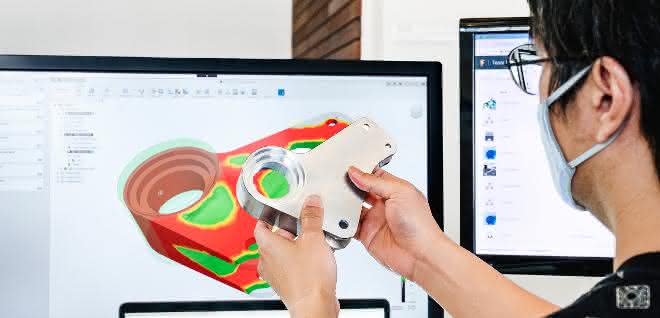
Prototypes will continue to play a key role in the series production process in the long term and will not be completely replaced by the software-based simulation process. However, simulation is a key element in speeding up production and makes an important contribution to reducing the number of prototypes required for series production. This is because designers are faced with new challenges and complex workflows when it comes to material availability, quality and validation as well as the development of process parameters for a design. These include the preparation of 3D models and the seamless orchestration of workflows. The integration of advanced additive functions such as process simulation directly into the CAD environment is central to this. Cumbersome data conversions are a thing of the past. In addition, robust simulation tools not only uncover potential problems during the simulation, but also suggest appropriate solutions. An example from the software sector: Fusion 360 recognizes deformations that occur during 3D printing and simultaneously provides solutions. This is done even before the product is printed in order to avoid faulty prints and thus material loss. The simulation therefore saves time and material - and ultimately money.
So will physical prototypes one day become superfluous in the manufacturing industry - even for more complex products?
Technologies such as generative design and additive manufacturing or 3D printing make it possible to increase the consolidation of parts in manufacturing. Fewer individual construction parts mean a lighter, less complex and less failure-prone and simpler design. Reducing the complexity and number of parts in a unit usually leads to a simplification of prototyping. However, this does not mean that prototyping is no longer necessary. We see the trend that simulation helps to identify problems before moving on to prototyping. This means that there are fewer problems when creating the prototype and with the prototype itself. But: A complete elimination of the prototyping phase is not likely. Just think of the complexity of the production process or of complex, interdisciplinary machines, which would also require correspondingly complex, networked and mutually influencing simulation models. This is also where a compromise comes into play from a commercial perspective in terms of time-to-market.
To what extent are humans still needed at all to assess the quality of a simulated or even a real prototype?
In design, manufacturing, prototyping and production, the computer is a tool that supports humans in carrying out simulations, in generative design or in generating design scenarios. It is useful for making suggestions, identifying trends and efficiently developing the optimum solution thanks to its measurement technology and computing power. Powerful and accurate computer models, such as simulations, take the burden of calculation off the designer. The result: the designer has more time for creative and innovative work. Humans are still needed - think of haptics, aesthetic assessments or even just dealing with tolerances of any kind, which represent the striking difference between the perfect, virtual world and the real, actual world.
Are production processes conceivable in which the end customer orders and ultimately receives a product that has been automatically designed, tested and produced according to certain specifications?
Future design and manufacturing process technologies such as automation, additive manufacturing, 3D printing, generative design and simulation will make it possible for customers to order precisely tailored products that are also unique due to the individual combination of parameters. More sustainable materials support these scenarios. They all contribute to intelligent manufacturing. In order to keep the customer's individual, possibly varying requirements for the product up to date at all times, devices and machines with intelligent sensors upload the product data to the cloud for analysis so that feasibility and parameters are constantly checked and sources of error are identified and eliminated.
One example: Decathlon's concept bike, which was developed using generative design in Autodesk Fusion 360. It has the potential to be produced individually for each customer from aluminum using 3D printing to conserve resources. Generative design can solve various extremely complex challenges here in order to guarantee the quality and safety of the racing bike.
Let's talk about product lifecycle management. How can experience with a finished product be automatically fed back into the design process?
Product lifecycle management promotes company-wide collaboration for everyone involved in the product lifecycle. This is particularly important when it comes to the reuse of experience already gained with a product: the digital twin. And its DNA, the Product Line Engineering (PLE) framework.
The concept of the digital twin in manufacturing enables manufacturers to monitor the performance of a product in real time using a digital model that reacts identically to the real product. PLE is an engineering process that encompasses specific products in a product line and enables communication between them. An example from the automotive industry: different teams work on different vehicle models. Communication between the teams is crucial for achieving the overall design goal. With PLE, all components of a product line are fed into a management software that creates a portfolio for each product. This helps to avoid redundant design processes.
The overarching framework of PLE shows that a digital twin of a product is necessary. Imagine a physical product that uses IoT and cloud data to inform its digital twin. PLE planning is a necessary step in the creation process: it collects the design data and creates a framework of design models that show their connections. This framework is used to develop digital twins of specific products to better understand their function in the real world.
PLE and digital twins make it possible to receive feedback from the real world that can be incorporated into the redesign or improvement process. The result: experience with a finished product can be automatically fed back into the design process. Nevertheless, it will be the human being who puts this automated feedback into the right context and decides how to deal with it. In other words: whether and which design change is implemented.
The coronavirus crisis has also put supply chains to the test. Is it conceivable to simulate the replacement of a component with delivery difficulties with an alternative in an automated production process?
The coronavirus has accelerated the transformation processes in the supply chain and in manufacturing. These include: streamlined collaboration across practices and distances, remote working, substitution of materials, hybrids of local and remote suppliers, prototyping and manufacturing.
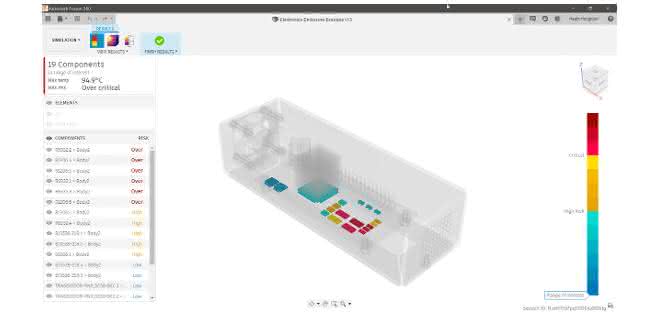
When it comes to replacing a component by simulating an alternative, it is clear that additive manufacturing is already providing design options that make it possible to simulate a replacement component. Parts that are not available in the supply chain could be manufactured independently of the supply chain, for example using 3D printing. Or: with the help of artificial intelligence, comparable parts offered by other suppliers can be found in the PDM, as with the "duplicate search" in Autodesk Vault. This can take the stress out of the supply chain. Despite their great advantage of cost efficiency, just-in-time supply chains have the systemic disadvantage of increasing dependency. Since none of us expected a pandemic, we naturally didn't build in any buffers or safety nets. This point will certainly be reconsidered in the future.
How can design systems be merged with supply databases and management systems in order to make complex decisions - for example, where and how a product can be produced for a specific customer at a specific location in the most cost-effective and fastest way?
Computers take different variables into account as part of convergent working and merge several data sets. The use of digital tools opens up new insights into the data. Not only are costs reduced (design to cost), but requirements are also comprehensively fulfilled or even in-house production capabilities prioritized (design to capabilities), so that engineering and design teams only need to fine-tune. The aspect of sustainability is also relevant: Early on in the design process, it becomes clear what impact the choice of a material, manufacturing process or production site will have on the product'scarbon footprint. Autodesk has already made great progress here with the Fusion platform when it comes to making such options available to the masses.
How has the coronavirus crisis changed work at Autodesk?
We have become even more digital in the way we work together - but we always have been. In terms of work routines, collaboration with colleagues within the company and across locations is now even easier.


You might also be interested in
ESTIA aims to strengthen Europe's cloud
New tech alliance for EU sovereignty
Twelve companies, including Dassault Systèmes, are founding the European Sovereign Tech Industry Alliance (ESTIA). The initiative aims to strengthen Europe's technological independence and define requirements for sovereign cloud services. The start...
 read more...
Deutsche Telekom and Nvidia launch one of Europe's largest AI factories
With the Industrial AI Cloud in Munich, Deutsche Telekom and NVIDIA are creating one of the largest AI factories in Europe. Companies can train AI models, carry out simulations and access 10,000 GPUs.
read more...Leveraging data potential with AI and streaming
Huge data treasures are still lying dormant in many manufacturing companies. And yet it is high time that these treasures were unlocked. There is often a lack of resources and capacity to make data usable in real time. Streaming production data can...
read more...More awareness of noise
Dematic offers solutions that are tailored to different cloud environments and reduce environmental impact through reduced material consumption and improved energy efficiency.
read more...Generative AI in the automation environment
The mechanical engineering and automation industry is undergoing profound change. This transformation is being driven by more volatile global trade, geopolitical crises and increasing market pressure, which demands greater agility, technological...
read more...Rigid data structures have had their day
The traditional data center is no longer the center of data. A hybrid cloud storage approach enables manufacturing companies to both meet the current requirements of data-intensive processes and future-proof their infrastructure.
read more...Software as a service in three stages
CIM Database Cloud is a new out-of-the-box solution from Contact for end-to-end digital product development.
read more...How production can benefit from AI
Together with AI technology, IIoT networking makes it possible to better control machine parameters and optimize quality with predictive quality. Downtimes and set-up times can also be further minimized. Cloud platforms also make these technologies...
read more...More expertise for digital engineering
Altair, a computational science and artificial intelligence (AI) company, has acquired OmniV, a technology from Michigan, USA-based software company XLDyn.
read more...