

Ansys platform functions
Accelerate product development
The new technologies and platform functions from Ansys support product development in companies of all sizes.
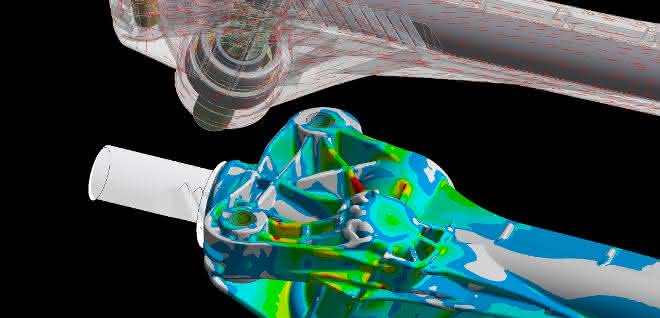
Ansys 2021 R1 combines improvements in simulation technology with the immense processing power of high-performance computing to expand the horizons of possibilities for engineering teams worldwide. Ansys simulation solutions optimize cross-departmental and cross-discipline collaboration and provide insights into product safety, reliability and performance.
Companies of all sizes and industries are challenging traditional ways of working to achieve breakthrough innovation. The simplified workflows and product enhancements in Ansys 2021 R1 empower engineers to achieve new design and product development goals.
Ansys 2021 R1 offers further developments for large electromagnetic system simulations. Predefined components from different manufacturers can be included in these simulations with greater efficiency and scalability. These components can be encoded so that other companies can use these proprietary 3D component designs for their high-fidelity simulations.
The software provides comprehensive analysis of signal integrity, power integrity, thermal and mechanical stress of 3D multi-die systems. The use of Ansys technology enables users to increase the lifetime and reliability of their products and avoid thermomechanical stresses and deformations that can damage 3D IC packages.
The enhancements in Ansys 2021 R1 combined with Ansys Cloud provide faster simulations, simpler workflows and additional solver capabilities. This makes simulation accessible to companies of all sizes. Thanks to the enhancements in Ansys Cloud, Ansys customers in fluids, structures and electronics can scale quickly to solve computational problems.
Leading companies are driving the development of autonomous vehicles (AV) and electric vehicles (EV) ever faster. Safety is a top priority. Ansys 2021 R1 provides a comprehensive sensing solution for AVs, including real-time physics-based radar sensing combined with closed-loop simulation validation to improve AV safety. New scanning and rotational lidar models also increase the reliability of AV simulation.
In addition, Ansys embedded systems and software solutions improve communication between team members and reduce certification costs. This leads to improved flexibility in modeling and code generation for automotive Autosar software components and provides support for the FACE 3.0 technical standard for military avionics. In addition, Ansys' state-of-the-art system safety solution helps improve EV and AV safety analysis by graphically showing where potential system failures may occur. This significantly simplifies the software safety testing process.
The new version allows the holistic development of EV components. A new battery design tool helps engineers optimize material selection for next-generation battery development, while a new EV powertrain library accelerates system simulation of electrified components. New software enhancements also add alert tones to advanced driver assistance systems that improve EV driving safety. New battery models enable engineers to tackle different scenarios, including battery crush, cooling, nail tests and module crush.
Growing customer requirements and ever shorter product development timescales are presenting engineering teams with new challenges. These range from system-level problems to fundamental physics at the component level. Following the acquisition of Analytical Graphics, Ansys now also offers a comprehensive solution that can map everything from the component level to the entire task-specific simulation (mission-driven simulation). Ansys 2021 R1 also pushes the boundaries at the detailed physics level, enabling teams to make smarter decisions earlier in the product development process and avoid costly mistakes that can negatively impact product quality and reliability.
In addition, Ansys 2021 R1 makes it easier for flexible engineering teams to collaborate through the latest advances in simulation process and data management enabled by Ansys Minerva. Improved workflows help even inexperienced engineers quickly learn how to use this software while improving data sharing among experienced users.
This release brings new capabilities to the design process with features such as automated liquid-solid thermal analysis to easily predict the thermal behavior of liquids and solids for the design and evaluation of electronic cooling and thermal management devices. To create their 3D printers, Qualup SAS uses Ansys Discovery to visualize thermal and cooling design variants.
Ansys 2021 R1 also helps manufacturing companies bridge the gap between injection molding and structural simulation for short-fiber reinforced composites, which are increasingly used in automotive components and consumer products. Thyssenkrupp Presta is using these advances in simulation technology to steer the short fiber workflow into the future of mobility.


You might also be interested in
ESTIA aims to strengthen Europe's cloud
New tech alliance for EU sovereignty
Twelve companies, including Dassault Systèmes, are founding the European Sovereign Tech Industry Alliance (ESTIA). The initiative aims to strengthen Europe's technological independence and define requirements for sovereign cloud services. The start...
 read more...
Deutsche Telekom and Nvidia launch one of Europe's largest AI factories
With the Industrial AI Cloud in Munich, Deutsche Telekom and NVIDIA are creating one of the largest AI factories in Europe. Companies can train AI models, carry out simulations and access 10,000 GPUs.
read more...Leveraging data potential with AI and streaming
Huge data treasures are still lying dormant in many manufacturing companies. And yet it is high time that these treasures were unlocked. There is often a lack of resources and capacity to make data usable in real time. Streaming production data can...
read more...More awareness of noise
Dematic offers solutions that are tailored to different cloud environments and reduce environmental impact through reduced material consumption and improved energy efficiency.
read more...Generative AI in the automation environment
The mechanical engineering and automation industry is undergoing profound change. This transformation is being driven by more volatile global trade, geopolitical crises and increasing market pressure, which demands greater agility, technological...
read more...Rigid data structures have had their day
The traditional data center is no longer the center of data. A hybrid cloud storage approach enables manufacturing companies to both meet the current requirements of data-intensive processes and future-proof their infrastructure.
read more...Software as a service in three stages
CIM Database Cloud is a new out-of-the-box solution from Contact for end-to-end digital product development.
read more...How production can benefit from AI
Together with AI technology, IIoT networking makes it possible to better control machine parameters and optimize quality with predictive quality. Downtimes and set-up times can also be further minimized. Cloud platforms also make these technologies...
read more...More expertise for digital engineering
Altair, a computational science and artificial intelligence (AI) company, has acquired OmniV, a technology from Michigan, USA-based software company XLDyn.
read more...