

Video analysis with machine learning
Edge analytics for agile automation
Manufacturers are increasing the number of product variants or offering specifically configured products to meet individual customer needs. This can give them a competitive advantage, but it comes with a cost-benefit trade-off: increasing complexity and costs at all stages of the manufacturing process, from product development to planning, production and service. The idea of customized series production is to overcome this hurdle by achieving the same level of automation for batch size one as in the mass production of standardized goods. This requires extremely agile automation that is able to react immediately to changes in the planning system and the production environment.
HPE Pointnext provides a solution that eliminates this conflict: video quality assurance that uses machine learning as a basis. Among other things, the solution is currently being used in production for HPE systems at the Foxconn site in Kutna Hora, Czech Republic.
Complexity of the production of IT systems
The production of IT systems is particularly susceptible to complexity collapse. One reason for this is the number of possible product variants. For example, a particular server model can theoretically be equipped with two to 16 memory modules, which in turn comprise 16, 32, 64 or 128 gigabytes. Consequently, memory options can already take several hundred product variants into account - and these in turn have to be multiplied by the number of available options for processors, fans or hard disks. In addition, the IT industry is known for its high pace of innovation, with short product renewal cycles and resulting product updates, which further increases the variability of the production environment.
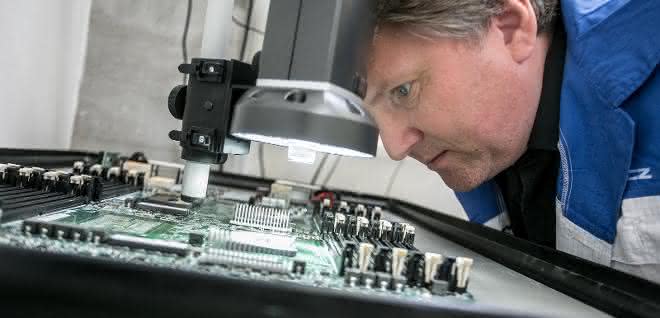
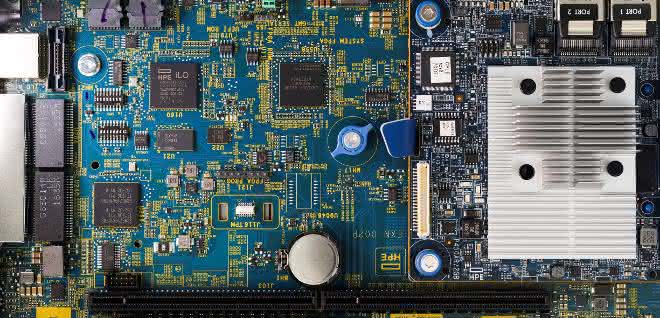
The quality assurance of such products requires not only checking the number and position of such system components, but also their correct implementation. For example, a cable must be connected to the correct port and plugged in correctly at the same time. All other product defects, such as scratches on the surface of the server housing, must also be checked.
Given these circumstances, it is clear that it can take a specialist several minutes to carry out a proper quality check on a complex IT system. For a manufacturer like Foxconn, whose factories produce tens or hundreds of thousands of IT devices every day, this means a considerable amount of time and money.
Automate quality assurance with video analysis
An obvious solution for this task is the use of video analysis for quality assurance in order to automate the process. Cameras capture high-resolution product images on a conveyor belt and pass them on to an embedded or connected IT system, where the images are analyzed using machine learning algorithms. Similar to humans, machine learning (ML) compares the image of the actual product with reference images that show correct and incorrect implementations. In this way, the machine learns whether a cable is properly plugged into a port, whether a memory module is correctly seated in the socket or whether a housing is scratched.
However, product diversity also poses a challenge for ML-based video analysis. In order to teach the analysis application to recognize errors in configuration, implementation or other product damage, several thousand reference images may be necessary to match the analysis application with the actual product image from the conveyor belt. This has two major disadvantages: First, it can take weeks for the ML algorithms to learn to accurately and reliably detect product defects. Secondly, this approach is inflexible and requires a new training cycle for each new configuration, product renewal or update.
Together with Relimetrics, a company specializing in quality audits for Industry 4.0, HPE Pointnext has implemented a solution to solve these problems. One key to this is the disaggregation of product images. The solution does not store reference images of complete HPE servers, for example, but of individual components, such as the memory modules in their slots, the processor socket with fan or the hard disk. The Manufacturing Execution System (MES) provides the analysis application with the parts list for each product that comes onto the conveyor belt, so that it can assemble the relevant reference image components into a complete reference image. This approach has a twofold effect. Firstly, the ML algorithms learn much faster and more efficiently as reference image components are frequently reused. At Foxconn's plant in Kutna Hora, HPE Pointnext was able to train the ML model for a new server model with around 1,000 configuration variants in just two days, fully automating the process of error detection. Secondly, the approach offers high flexibility by combining the image components according to the actual product configuration as per the bill of materials.
Edge analytics for quality management in real time
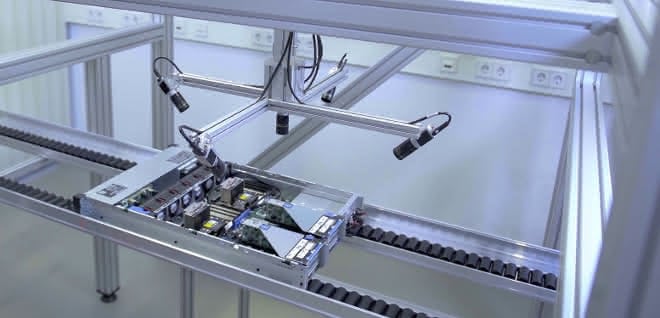
If ML is used to control a production process such as quality assurance, the amount of data generated by the video cameras poses a further challenge. In Foxconn's server production, for example, ten video cameras are used for each individual conveyor belt to capture extremely detailed images of every server detail. These cameras generate three gigabytes of image data per hour. The rapid transfer of this data to ML-based video analytics systems is critical for highly productive factories. It would be impractical to transmit this data over internal or external networks to be processed on remote servers - the latency would be too high, networks would be overloaded with this amount of data and production systems would grind to a halt in the event of network outages.
That's why HPE Pointnext deploys the ML-based video analytics solution on HPE converged edge systems - rugged, compact systems that deliver enterprise-grade IT capabilities at the network edge, close to the data source. These systems are designed for production environments and also integrate Operational Technology (OT) such as data acquisition systems, control systems and industrial networks to deliver seamless bi-directional and deterministic communication and control of OT systems such as video cameras, production machines or conveyor belts.
With this solution, the constant video camera data stream is first processed on convergent edge systems running in close proximity to the conveyor belt to extract images of the current product. The data is then analyzed in real time using ML algorithms for defect detection. Only a portion of the analyzed images are transmitted over the network for archiving purposes to ensure traceability and compliance.
In order to avoid complexity and increased costs with high production variability, manufacturers must convert their processes from static to agile automation. Key factors for this are artificial intelligence methods such as machine learning. However, as the example of machine quality assurance illustrates, implementation requires solutions that take into account the specifics of the respective production process. In addition, manufacturers should set up new edge infrastructures in order to implement video streams intelligently. According to Gartner, 75% of the data generated by companies will be collected and processed outside the traditional, centralized data center or cloud by 2022 as a result of digital business projects. In 2018, this figure was less than 10 percent. Video analysis in quality assurance is just one of many examples that show why this prediction is valid.
Norbert Reil, Director Global IoT Services, HPE Pointnext at Hewlett Packard Enterprise / am


You might also be interested in
Helu makes its first trade fair appearance under a new brand name
Helu Kabel will be presenting itself as Helu for the first time at Hannover Messe 2026, showcasing system solutions, Heluchain cables and new industrial luminaires.
 read more...
Strategic realignment with brand relaunch
In future, Helukabel will trade as Helu
The Helukabel Group is parting with part of its name: in future, the company will only operate under the Helu brand. With this step, the specialist for electrical connection technology is underlining its strategic development from a classic cable...
read more...Modular plant construction for corrugated board
Insight into the production of corrugators at BHS Corrugated: Automated, modular and equipped with Helukabel components.
read more...Best quality for the steel
Conditions in the steel industry are harsh and inhospitable. The machines used must be able to withstand the demanding environmental conditions in order to deliver the best quality at all times.
read more...If the standard cable is not sufficient
Lapp offers cables for countless applications - but not for all of them. From time to time, the developers have to modify a standard cable or develop a special cable.
read more...Slight decline in sales, strong investments
The Lapp Group has not been spared from the weakening global economy. However, the company only recorded a slight loss in the past 2024 financial year.
read more...Electrical connection technology
Cables and wires for industrial automation
Heukabel offers system solutions for cable routing from a single source. The subsidiary EKD Systems specializes in tailor-made cable drag chains made of steel, stainless steel and plastic, which are used in moving machines and systems as well as in...
read more...Lapp relies on Ultramid from BASF
Mobile charging of electric vehicles
The automotive industry is currently undergoing the biggest transformation in its history. The boom in battery electric vehicles in particular is presenting the industry with major challenges. Lapp, as a supplier of cables and connection...
read more...Cable handling application
At this year's Motek, ArtiMinds Robotics is showcasing a robot-based automation solution for the sensor-assisted assembly of flexible cables in connector housings.
read more...