

Helium leak test
The sustainable industrial leak test
Until now, an important limiting factor for industrial leak testing systems has been the maximum size of the test chamber. For test gas-based methods such as the accumulation method, the chamber ideally had to be as small as possible in order to keep test times as short as possible.
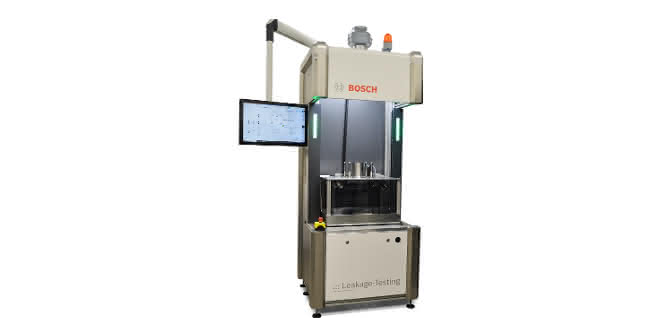
Bosch Manufacturing Solutions has now achieved a breakthrough in terms of the size of the accumulation chambers - even huge test chambers can now be used. The currently largest of these accumulation chambers has an internal volume of 10,000 liters and allows tests on very small components of just a few liters as well as very large ones with a volume of several cubic meters. The new, modular test system also offers maximum flexibility for different test specimens: different products or product generations can now be tested for leaks using the same test chamber without any problems.
A few years ago, the leak testing experts at Bosch Manufacturing Solutions in Stuttgart asked themselves whether it would be possible to develop a modular system that could be used to assemble systems to suit most testing tasks. This should give users the freedom to test basically any test specimens, even of different sizes, with the same test system. The basis for the development was the accumulation method. In the accumulation method, the test specimen is first evacuated and then filled with a test gas. In an accumulation chamber, a gas sensor is then used to measure how much test gas escapes from the test specimen into the remaining empty volume of the test chamber within a defined period of time and accumulates there. During this time, the accumulation chamber is under normal atmospheric pressure, must only avoid gas exchange with the outside air and may be designed accordingly. Helium is a suitable test gas because its detection is only slightly affected by other gases in the air and there are hardly any cross-influences. By measuring the accumulation of helium in the test chamber, it is possible to determine whether the test specimen is tight enough and complies with the required limit leakage rate.
New evaluation method brings the breakthrough
The starting point for the development of the testing system with the huge accumulation chamber were leak testers from the Cologne-based manufacturer Inficon. Bosch's development goal was to modularize and industrialize this system for accumulation testing. The developers have therefore dispensed with the entire evaluation technology and control panel supplied. Instead, the new testing system uses the raw sensor data provided by the mass spectrometer over the course of the accumulation period. A completely different evaluation method and new process control led to the breakthrough. For the new evaluation method, the developers optimized the complex interaction of valve technology, sensors and software routines. As a result, the new test system is able to measure in accumulation chambers of different sizes with a measurement process capability. The smallest system currently available has a test chamber volume of 100 liters and can accommodate any test specimens up to an edge length of 20 cm x 35 cm x 25 cm. The largest test chamber to date has external dimensions of 210 cm x 260 cm x 220 cm and an internal volume of 10 cubic meters. Both systems work with the same flexible testing technology and can be fed either manually or automatically. Only the size of the chambers is different. Any individual chamber sizes can also be used without any problems thanks to the newly developed, modular evaluation technology.
Fast in the stable measuring range
The new technology evaluates the raw data provided by the mass spectrometer and ensures that the measuring device is always operated under ideal conditions. The measuring method developed by Robert Bosch Manufacturing reaches its stable measuring range much faster and is also more sensitive than before. As a rule, an evaluation time of just five to ten seconds is now required until the mass spectrometer signal is sufficiently stable. This allows a testing system to be optimized either for the shortest possible cycle times or for the lowest possible limit leakage rates. Basically, the smaller the residual volume in the test chamber, the lower the limit leakage rates that the system can detect. Because the newly developed evaluation method for the raw data is always precisely optimized for the individual system and the size of the accumulation chamber, helium leak rates of down to 10-6 mbarl/s can be detected with the accumulation method for very small test volumes, albeit with a sufficiently long measurement duration. In the 100 liter test chamber, the detection of limit leak rates of up to 10-5 mbarl/s is possible. And in the large 10 cubic meter test chamber, limit leakage rates of up to 10-3 mbarl/s can be measured without any problems, with cycle times of six to seven minutes per test.
Leak tests on very large test specimens
There is a simple correlation between the empty volume of the test chamber and the evaluation time: the larger the residual volume in the chamber, the slower any escaping tracer gas accumulates in it. If the empty volume in the accumulation chamber is halved, the evaluation time for the test is also approximately halved. Nevertheless, there are of course numerous application scenarios in which a tracer gas-based leak test in a huge, 10 m³ accumulation chamber opens up completely new possibilities. For example, it is an invaluable advantage to be able to test large fuel cell systems for modern truck drives for leaks during production in less than ten minutes. Another application scenario is cubic meter-sized switchgear for power grids. Here, too, reliable leak testing is essential - with the 10 cubic meter chamber, this is now possible in record time.
Differentiation from the vacuum method
The new technology now makes it possible to test items that could not be tested using the vacuum method for physical reasons. Vacuum testing also uses helium as the test gas, which it detects using a mass spectrometer. However, the method is based on a measurement in a vacuum. This method therefore requires a sophisticated and very complex test system with a vacuum chamber. Not only does this chamber have to be highly leak-proof, it is also important to be able to evacuate the air before each measurement using suitably powerful pumps and at an appropriate speed. However, some test specimens are unsuitable for the vacuum method. For example, they are too moist or cannot be evacuated at all due to their material or outgassing effects. Large test specimens also require large vacuum chambers. Due to the correspondingly large empty volumes, the vacuum method very quickly reaches its limits in such a scenario. Converting a vacuum testing system to new test specimens, whether they are larger or smaller, would also involve considerable effort. The newly developed evaluation technology for the accumulation method opens up unprecedented flexibility here. Testing different products and product generations with the same system is extremely easy with the new evaluation method. The new testing technology is also characterized by a longevity and sustainability that the vacuum method cannot compete with. Even test specimens that cannot be evacuated can now be tested for leaks using the new method.
The overstrained sniffer leak search
Another method for detecting leaks in large components is the so-called sniffer leak detection. Here too, the component is first exposed to a tracer gas. A sensor or sniffer tip is then moved over the surface of the test specimen to identify areas where tracer gas is escaping through leaks. However, the size of complex, already assembled components quickly becomes a problem here: there are simply far too many points that would all have to be checked individually for any leaks with the sniffer tip. An integral test method such as the accumulation method has clear advantages here - in terms of speed and reliability.
New possibilities for industrial leak testing
The new evaluation method not only overcomes previous limits in terms of the possible size of test parts and accumulation chambers, it also opens up unprecedented flexibility in industrial applications. Not only does it allow short cycle times for leak tests in series production and can be connected to production control systems (MES), it also functions as a universally applicable solution for testing tasks in product development and prototyping. Testing different product generations in the line is no longer a problem. This is because the test application can be easily adjusted to changed values for new test specimen and empty volumes. The new modular leak testing system thus covers a wide range of possible test specimens, with accumulation chambers of almost any size. The new evaluation technology opens up completely new possibilities for industrial leak testing.
Ruwen Glück, Product Manager Leak Testing, Bosch Manufacturing Solutions


You might also be interested in
Atlas Copco takes over long-standing sales partner
Atlas Copco has taken over Heide-Pumpen. The specialist for mobile pumps has been working closely with Atlas Copco in sales and service for a long time, especially for surface pumps for construction site dewatering and wastewater detour or in the...
 read more...
Lutz Pumpen at the Achema 2024
New mobile drum pump with battery drive
The new B3 Battery from Lutz Pumpen promises mobile and safe working with aggressive liquids without having to compromise on pumping performance compared to wired versions. The battery-powered drum pump will be on display at Achema, the world's...
read more...Maintenance and Pumps&Valves in February
Final preparations are underway in Dortmund: On February 21, 2024, maintenance will start as the leading trade fair for industrial maintenance and with it Pumps&Valves as the trade fair for industrial pumps, fittings and valves.
read more...Liquid separator keeps pumps dry
Vacuum clamping minimizes distortion and enables five sides to be machined in one clamping operation. The use of cooling lubricants poses a challenge: If they get into the vacuum generator, they can cause serious damage.
read more...Spring clutches for construction machinery
Spring clutches from Torsion Control Products (TCP) are ideal for use in construction machinery where modern diesel engines are used.
read more...Protection against cooling lubricant
Liquid separator from Schmalz keeps pumps dry
Anyone clamping with a vacuum during CNC machining must protect the pump from cooling lubricant. The NLS liquid separator from Schmalz separates the cooling lubricant and returns it to the running process - without interrupting the vacuum.
read more...Which clutch for what?
Mechanical engineering and its applications are multifaceted. Every application is special and requires a perfect machine design. Individual components in the system must also be optimally designed.
read more...Energy efficiency needs electrical engineering and IT
The energy crisis makes one thing clear: it is not enough to simply screw a photovoltaic system onto your roof or purchase green electricity. Industry is faced with the challenge of reducing consumption in order to counter the rise in energy prices,...
read more...Solutions for a networked and climate-neutral industry
At the world's leading trade fair for industry, around 4,000 companies from the mechanical engineering, electrical and digital industries as well as the energy sector will be showcasing solutions for the production and energy supply of the future.
read more...