

Clamping elements
Test head in the clamp
A versatile testing unit should also work efficiently and cost-effectively. In order to optimize such a device, Sonplas, as a manufacturer of assembly and testing systems, has installed clamping elements from ACE in a development.
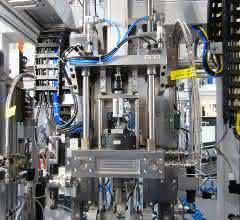
In companies of all sizes, process controlling plays a central role, especially in production. Manufacturers of high-tech components must ensure that their products meet the highest standards of certification or official acceptance and compliance with industry standards.
While specialist partner companies are increasingly being commissioned to produce test systems for reasons of time and cost, the awarding of contracts to third parties must not be accompanied by inaccurate test results for compliance with standards or norms. For this reason, manufacturers in the automotive, aviation and electrical industries place the same demands on suppliers as they do on themselves. This effect is in turn transferred to the suppliers' suppliers. These high requirements also apply to the cooperation between Sonplas and ACE shock absorbers.
Sonplas is a supplier of assembly and testing systems. The company relies on ACE products for decelerating drives. The specific task was to support the electric drive of a testing system. This brings a test head to a defined dimension.
Once the specified distance has been reached, the servomotor of the drive switches off so that the test head can no longer move. The clamping units are then actuated to ensure that it remains in this position. Next, pressure is applied to the component to be tested, creating a counterforce of around five kilonewtons. After the test, which lasts around 30 seconds, the pressure is switched off. This also removes the counterforce. The clamping units are then released and the electric drive returns to its home position.
The test head itself is guided by two guide carriages. The shafts that run through the clamping units are only used to hold the force. They are attached to the test head with a type of coupling and are therefore dependent on its tolerances.
Clamped test unit as a solution
As this test unit is used in all areas supplied by Sonplas and is designed for 120 test procedures per hour, a clamping element had to be found in ACE's portfolio that could not only apply the required forces, but also guarantee at least 1.5 million clamping procedures before replacement. In addition, a clamping weight of 40 kilograms had to be taken into account.
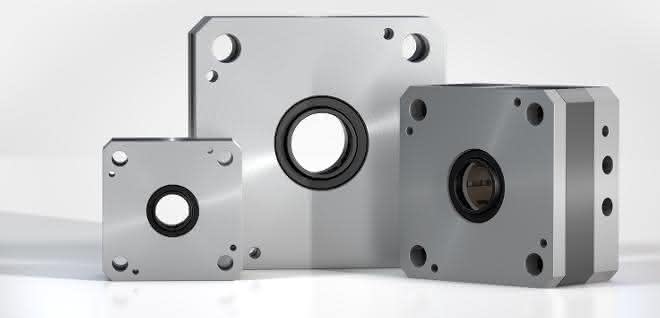
The subsequent design revealed that ACE Locked PN63-20-2-6B clamping elements are ideal for this application. With holding forces of 3,600 newtons and a holding torque of 35 newton meters, they work significantly more effectively at an operating pressure of six bar than hydraulic clamping systems, for example.
For Sonplas, this not only means the desired effective clamping, but also that the drive of the testing system could be made smaller, which saves space. In this case, only a few weeks passed between the first contact between the two companies and the successful implementation. pb


You might also be interested in
Protection against electrostatic discharge
StoFloor ESD KU 614 from StoCretec: dissipative flooring with the latest technology meets all ESD standards, is economical, extremely durable, mechanically and chemically resistant. The surface can be adjusted to be slip-resistant. The system is...
 read more...
Cables and wires from Helukabel
Food cultivation on a new level
Vertical farming - cultivation in multi-storey greenhouses - is considered one of the most exciting trends in food production. One of the pioneers in this field is the Romanian start-up Ultragreens. The company relies on solutions from Helukabel to...
read more...Further training for specialists to become security experts
With the "CESA - Certified Expert for Security in Automation" qualification, automation expert Pilz offers a two-day expert course designed to provide participants with compact security knowledge in line with the latest standards.
read more...Meaningful data on the service life of the seal
Seals prevent substances from penetrating or entering technical components. The intelligent seals from Freudenberg Sealing Technologies can significantly expand this core task in the future: the seal itself is also a sensor and becomes a "smart...
read more...Online stud configurator according to drawing
For standard bolts, with head, thread or hole
For standard bolts, with head, thread, bore or as a version with recess, mbo Osswald configurators map the standard specifications, are very easy to use, take a lot of work off the user's hands and save a lot of time.
read more...Safe palletizing with the Cobot
Verla-Pharm's medicinal products and food supplements have been available for decades. Ever-increasing throughputs result in ever-increasing logistics costs, whereby optimum utilization of the available production space is necessary.
read more...The tiger among processors
Since the move towards the Industrial Internet of Things (IIoT) and Industry 4.0 has picked up speed, processor boards and modules must be able to process exponentially growing amounts of data.
read more...VDWF publishes "Sustainability Compendium"
Nowadays, nobody can avoid "sustainability": In addition to a far-reaching presence in the media, it is also becoming increasingly important for companies in the tool and mold making industry to develop and implement appropriate concepts.
read more...More transparency and synergies with QM software
Weber, manufacturer of wood and metal sanding machines and extruders, has reorganized its quality management with ConSense IMS Professional. The software solution enables transparent documentation and more efficient processes.
read more...