

Smart sensors
Sensor systems and Industry 4.0
In the future, sensors and sensor systems will play a key role in manufacturing. Smart sensors that provide signal preparation and processing will be the focus of interest. This article explains which areas of application and core properties must be fulfilled.
In 2014, the Federal Cabinet presented Smart Factory/Industry 4.0 as a global challenge for innovation leaders in its "New High-Tech Strategy for Germany" and included it as a priority in its economic and science policy.
And indeed, the economy is on the cusp of the fourth industrial revolution. Driven by the internet, the real and virtual worlds continue to merge into the much-vaunted Internet of Things (IoT). Recent advances in the manufacturing industry have paved the way for the systematic use of cyber-physical systems (CPS), in which information from all related perspectives is closely monitored and synchronized between the physical factory floor and the computer room. The starting point for this is the use of sensors that convert the physical or electrochemical signal into an output signal. Which sensors are suitable for this purpose and which properties they must fulfill are described below.
Sensor systems in the network
More than 15 years ago, Panasonic responded to the tasks of collecting, collating and processing data for automation in production processes. Users expect a range of functions from modern sensors in terms of digital data processing: high reliability and minimal maintenance, flexible network functions and, above all, low energy consumption. These requirements can be met with intelligent sensors, so-called "smart sensors".
The potential benefits of sensor systems in production relate to the automatic identification and data acquisition of objects. The transmission and interpretation of sensor information, the derivation of production decisions and the control of production processes by tracking production orders are examples of applications.
In the future, these sensors will be an essential component of intelligent sensor systems that provide complete signal preparation and processing in addition to the actual measurement. In many cases, they communicate via high-performance industrial networks such as I/O Link, Profinet, EtherCAT, Ethernet/IP and other fieldbus technologies. This plays an important role, for example, in the distance measurement, pressure and flow measurement, fiber optic sensor technology and laser sensor technology segments. As a company, Panasonic was already focusing on smart sensors in 2006 and has played a key role in shaping them for the industrial sector. Four sensors and key application areas are presented here.
Smooth maintenance and parameterization
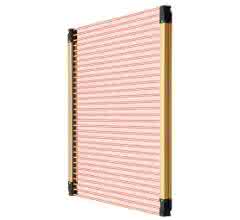
Especially with mechanical and hydraulic presses, forming presses, punching, forming, riveting, eyeletting and other automechanical assembly systems, open moving parts are a danger zone for employees and personnel. The "point of operation", i.e. the part of the system responsible for carrying out the mechanical or hydraulic process, must be safeguarded as a source of danger. Safety light curtains are an indispensable protective measure for this and their perfect functioning and regular maintenance are essential. Both are a massive cost and time factor that is addressed by the SF4D series.
The SF4D series light curtains use specially developed software to check for incorrect wiring, disconnection, short circuits and the reliability of internal circuits. The ELCA function can also be used to prevent and calibrate unwanted machine downtimes caused by extraneous light. Details of all electrical problems are shown on the digital display, making maintenance more convenient. The M12 connector guarantees quick and uncomplicated installation.
Another advantage is the seamless structure and processing of the SF4D line, which guarantees high environmental resistance. The electronics are protected by a cylindrical inner housing, and seams on the unit and lens surfaces have been reduced to such an extent that particles such as oil mist and dust cannot penetrate. The aluminum profile does the rest, guaranteeing high stability while maintaining the same product size and being resistant to mechanical stress or torsion.
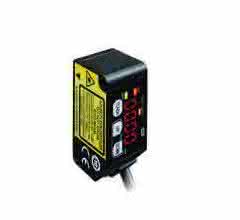
The wide range of applications for laser distance sensors is reflected in their broad use in industry and research. They are suitable for quality control and process monitoring in packaging systems, medical manufacturing and electronics production. The HG-C series opens up many new possibilities for industrial automation. These include the positioning of robot arms, thickness and position measurement of strip material, presence detection of the smallest products or the detection of overlaps of the thinnest materials. These measurements can be carried out both statically and dynamically. Dynamic measurement makes it possible to implement control loops or determine the profiles and contours of various components.
The KG-C sensor is characterized by a measurement repeatability of up to 10 μm and a response time of 1.5 ms. With a size of just 20 x 44 x 25 mm (WD), it offers high-end performance in a compact package. Three measuring ranges (100 ±35 mm, 50 ±15 mm and 30 ±5 mm) are available with a measuring resolution of 10 to 70 μm, depending on the model. The integrated display supports setup and operation, and I/O options include a 0 to 5 V analog output alongside an NPN or PNP transistor output and an external input.
Miniature pressure gauge with M8 plug-in connection
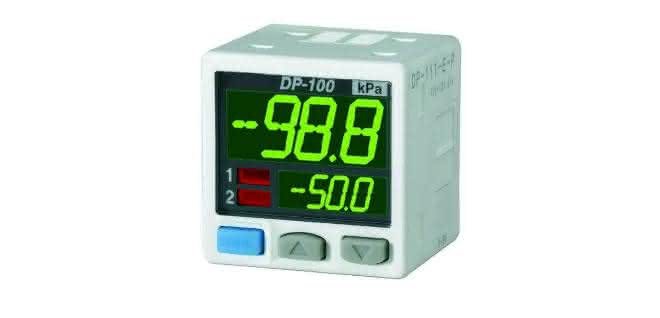
Panasonic Industry's portfolio of miniature digital pressure gauges for air pressure measurement or monitoring focuses on smart and small devices. With the DP100 series, the company is launching microprocessor-controlled miniature pressure measuring devices on the market under the brand name Sunx. They are suitable for high-precision measurement and monitoring of air pressure and non-corrosive gases in a wide range of industrial applications, particularly in mechanical and plant engineering and in air/gas pressure monitoring in manufacturing processes in the microelectronics industry.
As a special feature, the digital pressure gauge has a two-line LCD for measured values and limit or threshold values and a data copy function. With the three-color 12-segment display, the measured values or settings are clearly legible and a clear distinction can be made between the operating and setting status. The data copy function allows settings to be made on one sensor and transferred to other sensors. Thanks to the adjustable response times of 2.5 to 5,000 ms, dynamic pressure changes can be recorded, but also undesirable intermittent pressure fluctuations caused by abnormal pressure drops can be ignored. The high measuring resolution of 0.05% FS and repeat accuracy (±0.1% FS), the low hysteresis (1 digit) and temperature dependence (≤±0.5% FS) are further performance features of this new series.
Safest solution for fiber optic sensors
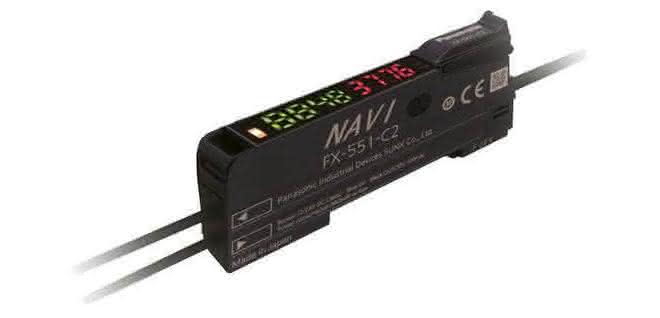
Fiber optic sensors enable measurements in environments where electrical sensors reach their limits. Unlike electrical measurement methods, the purely optical measurement method is insensitive to environmental influences, as light supplies the sensor and transmits the measurement signal. They are also small, largely corrosion-resistant and insensitive to high electrical voltages, magnetic fields and temperatures.
Preventive automatic maintenance is a significant advantage over individual evaluation, as it allows expertise and time to be used elsewhere. The FX-500 self-monitoring sensor is able to report sensor data and its own status to the host device via the I/O link master. This enables prompt analysis and maintenance of the sensor as well as problem identification. The sensor achieves a response time of 25 µs while offering high accuracy. In addition, the reliability of detection has increased by 75 percent compared to previous models.
Stefan Klose, Sales & Product Management Sensing & Measurement, Panasonic Industry Europe / am


You might also be interested in
Predictive maintenance in retrofit
Predictive maintenance pays off. This is because early detection of impending failures means that systems can be serviced in a targeted manner before production downtime occurs. But how complex is it to integrate such a maintenance concept into an...
 read more...
Maintenance instead of replacement
The circular economy starts with the machinery
Sustainability in industry starts with machines, says our guest author from Deguma: How maintenance, modernization and the 5R strategy save resources, energy and CO₂.
read more...3D printing for unplanned requirements
The material fails and the machine suddenly stops? Then you need to take the right measures to be able to resume production quickly. Material failure in the form of faulty components or material wear in the frame are a risk for any production.
read more...High demands in terms of safety, application and robustness
Demanding work in the electrical trade and energy supply as well as smooth processes in production require innovative and customized measurement technology that scores points for safety, ease of use and resilience.
read more...Car meets e-bike: riding with lubrication-free polymer bearings
Studies show that the proportion of pedestrian and bicycle traffic is increasing in urban areas. With the JetBike, JetBike GmbH from Braunschweig presents a mixture of e-bike and car and relies on lubrication-free polymer bearings from Igus.
read more...Hydraulic hub for more efficient servicing
Bosch Rexroth presents a digital toolbox for service and maintenance. With a comprehensive range of digital services, the Hydraulic Hub simplifies and accelerates the service and maintenance of hydraulic products and increases machine availability.
read more...Arnold Umformtechnik expands after-sales...
Faster help with VR glasses
Arnold Umformtechnik is expanding the after-sales service for its machines to include digital remote services. The focus is on data security, simple operation and clear processes.
read more...147,000 euros per hour: high costs for German companies due to unplanned downtime
According to the "Value of Reliability" study, 67% of industrial companies in Germany experience unplanned downtime at least once a month. This costs the German economy 147,000 euros per hour. Nevertheless, reactive maintenance concepts are not...
read more...Maintenance starts with a maintenance planner
Legal requirements stipulate that machines and systems must be serviced regularly. The maintenance work serves to ensure occupational safety and economic efficiency.
read more...