
Optical 3D scanner
You can see better with the third eye
Otto Vision has developed an optical 3D scanner for non-contact 3D measurement in quality control. With the help of two Baumer cameras, it can precisely measure the produced parts. A third camera is used for position control.
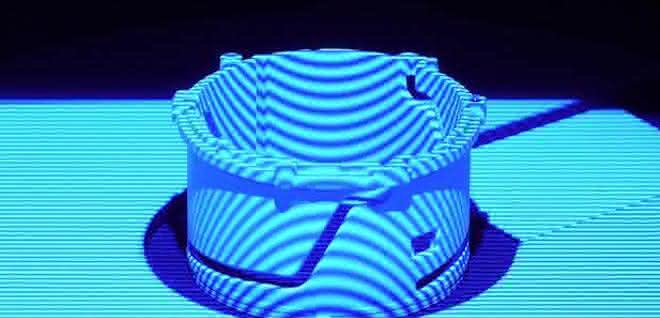
With the Flex-3A, Otto Vision Technology offers a high-end optical 3D scanner for non-contact shape and coordinate measurement in automated quality control. Thanks to the further development of the image processing system and the integration of two 12 megapixel cameras from Baumer used as stereo cameras, one device is now sufficient for capturing high-precision 3D data for checking dimensions, shape and position in measuring fields from 20 mm to 200 mm.
The non-contact 3D measurement and geometry inspection of complex objects can be carried out in all production phases - from initial commissioning through the optimization and sampling phase to series production - in order to quickly identify deviations, detect sources of error and initiate corrective measures. The Flex-3A obtains 3D surface data in high point density for a full-surface target/actual comparison. Many manufacturers use the system from Jena, particularly in the stamping industry. "Other industries are also growing. Above all, we see a wide range of new applications in the plastics industry," says Gunter Otto, Managing Director of Otto Vision.
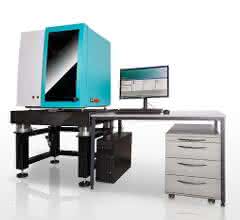
With this further development, the company has streamlined its portfolio and can now realize measuring field ranges from 20 to 200 mm with just one device. The solution for the optical system was particularly challenging. Even with fixed measuring distances, as with the previous devices, the different measuring fields could only be achieved by changing the lenses.
Goodbye passport stamps
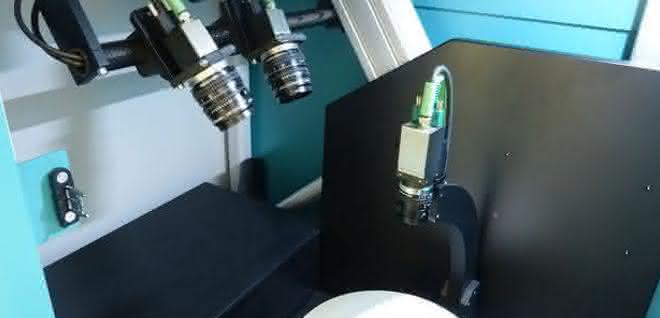
The Flex-3A works as a fully automatic multi-view system based on phase-measuring fringe projection with triangulation and phasogrammetry. The 3D measuring head is equipped with two 12 megapixel USB 3.0 cameras and an LED fringe projector with a resolution of 1440 x 1080 pixels. A third camera ensures multi-image registration. The parts to be inspected can be illuminated and recorded from several directions depending on their complexity. A complete 3D scan is achieved using an additional motorized turning fixture.
Flexible target/actual comparison
The recording method with three cameras from different angles is patented. "In addition to the two cameras on the 3D measuring head, we also use an object-fixed reference camera to determine the position of the test object. This allows the partial views to be photogrammetrically merged into a global 3D model with high precision - without having to glue registration marks, which saves additional time and costs," explains Otto. With the optional addition of a motorized turning fixture, the top and bottom sides can also be measured fully automatically. Thanks to its flexible design, the system is suitable for the initial sampling of prototypes, for spot checks during production as well as for incoming goods inspections of manufactured parts.
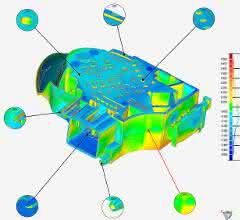
The recording of all image data and its compilation into an overall model, including calculation and evaluation, is automated and realized using powerful software. The digitized data can be aligned as point clouds or as a meshed STL surface to the coordinate system of the reference model. The graphical target/actual comparison, for example between produced parts and the corresponding CAD model, can be carried out quickly and easily in order to easily localize shape deviations such as warpage, shrinkage, offset or even tool wear.
The intuitive user interface allows any number of measurement plans to be created quickly and directly, part-specific measurement parameters to be set easily, automation sequences to be defined and the strip code to be easily adapted and optimized. Calibration after a change of measuring field is very simple.
Automated non-contact 3D inspection for dimensions, shape and position with variable measuring field sizes is quick and easy with the Flex-3A. A very high point density allows an extremely precise comparison - even for measuring tasks on small objects that would be difficult to measure tactilely. To change the measuring field, it is sufficient to replace the lenses with subsequent recalibration supported by the system using ball standards. These ball barbells included in the scope of delivery are also suitable for monitoring and subsequent documentation of the measuring accuracy.
The new 3D scanner marks the first time that Otto Vision has used USB cameras. "We have been successfully using Baumer cameras for many years. Due to the good cooperation and reliability, it was clear to us that we would also rely on these cameras for the further development of the Flex-3A," says Otto.
With the combination of a high resolution of 12 megapixels at 30 fps and a small form factor of 29 mm x 29 mm, the VCXU-124 models in the CX series were the perfect fit for the system design requirements. The Sony Pregius CMOS sensor IMX304 used also delivers excellent image quality for 3D recordings. With the USB 3.0-compatible interface, Otto also benefits from a reliable one-cable solution with plug & play functionality and saves time and costs during integration. Thanks to the all-round M3 fastening, the cameras are easy to integrate mechanically. With the optimal synchronization of the cameras and digital projector, the image processing specialists were able to utilize the full speed of the cameras.
The complete automation of 3D measurements enables fast and process-stable use under production conditions and offers a higher information density compared to tactile measurement methods. For Otto Vision, this is therefore an area with great growth potential. "In the future, we will not only focus on offline devices, but also increasingly on 3D inline inspection," says Otto.
Nicole Marofsky, Marketing Communication in the Vision Competence Center at Baumer/ am


You might also be interested in
Helu makes its first trade fair appearance under a new brand name
Helu Kabel will be presenting itself as Helu for the first time at Hannover Messe 2026, showcasing system solutions, Heluchain cables and new industrial luminaires.
 read more...
Strategic realignment with brand relaunch
In future, Helukabel will trade as Helu
The Helukabel Group is parting with part of its name: in future, the company will only operate under the Helu brand. With this step, the specialist for electrical connection technology is underlining its strategic development from a classic cable...
read more...Modular plant construction for corrugated board
Insight into the production of corrugators at BHS Corrugated: Automated, modular and equipped with Helukabel components.
read more...Best quality for the steel
Conditions in the steel industry are harsh and inhospitable. The machines used must be able to withstand the demanding environmental conditions in order to deliver the best quality at all times.
read more...If the standard cable is not sufficient
Lapp offers cables for countless applications - but not for all of them. From time to time, the developers have to modify a standard cable or develop a special cable.
read more...Slight decline in sales, strong investments
The Lapp Group has not been spared from the weakening global economy. However, the company only recorded a slight loss in the past 2024 financial year.
read more...Electrical connection technology
Cables and wires for industrial automation
Heukabel offers system solutions for cable routing from a single source. The subsidiary EKD Systems specializes in tailor-made cable drag chains made of steel, stainless steel and plastic, which are used in moving machines and systems as well as in...
read more...Lapp relies on Ultramid from BASF
Mobile charging of electric vehicles
The automotive industry is currently undergoing the biggest transformation in its history. The boom in battery electric vehicles in particular is presenting the industry with major challenges. Lapp, as a supplier of cables and connection...
read more...Cable handling application
At this year's Motek, ArtiMinds Robotics is showcasing a robot-based automation solution for the sensor-assisted assembly of flexible cables in connector housings.
read more...