
Reliable image capture
Prevent blurred images
Hexapods test image stabilization. When testing image stabilization technologies, hexapods from Physik Instrumente are used to simulate movements that cameras are exposed to during filming.
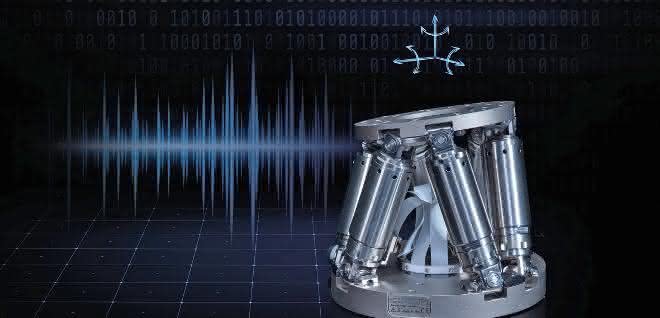
End users, manufacturers of smartphones and cameras, companies from the automotive, aerospace, security and automation technology sectors - they all place high demands on the quality of image and video recordings. Cameras are therefore evaluated in extensive tests according to certain image characteristics. These features include resolution, contrast, color, texture, zoom, autofocus, exposure and image stabilization. Thousands of images are taken and evaluated for each of these characteristics in order to obtain statistically significant results. To ensure that the image quality is comparable, cameras and camera components must always be tested under the same conditions and using the same methods.
Dxomark offers complete laboratory solutions for the analysis, comparison and optimization of image quality. The analyzer systems consist of hardware, software and test routines bundled in several modules that enable repeatable and operator-independent results. Depending on the task or the image quality characteristics to be tested, different modules can be selected and combined. One special feature of the Analyzer, for example, is the visual noise measurement. It provides an image noise metric that correlates directly with visual perception. The video analysis includes exposure, white balance, sharpness and texture with changing lighting; automated lighting scenarios can also be programmed for user-defined test requirements. The latest version of the Analyzer system is also equipped with a selfie module to enable accurate and repeatable front camera tests.
Image stabilization in the test
The image stabilization test assesses how well the optical and electronic image stabilization systems built into cameras work. This is because they are designed to compensate for movement and thus prevent blurred images. To ensure stable image capture, sensors measure the linear and angular acceleration of the movement, i.e. in cameras the shaking movements of the photographer or the vibrations of a vehicle or aircraft, so that the image stabilization system can automatically compensate for them. The effectiveness of image stabilization systems - whether optical or electronic - follows the CIPA protocol. The CIPA (Camera and Imaging Product Association) is an association of Japanese camera manufacturers that has defined standards for the test conditions for motion simulation.
Motion simulation with high repeat accuracy
The reproducibility of chamber tremors or vibrations in vehicles or aircraft is important in all test procedures relating to image stabilization. "We have to ensure that the simulated frequencies and movements around the rotation axes θX, θY, θZ (pitch, yaw, roll) are the same for every test," emphasizes Nicolas Touchard, Vice President of Marketing at Dxomark. "In the current version of the analyzer system, we are now using hexapods that enable precisely reproducible motion sequences at frequencies of up to 30 Hertz, which expands the number of potential image stabilization test scenarios."
When testing cameras and smartphones, for example, frequencies of up to twelve hertz are typical, while image stabilization in driver assistance systems often has to compensate for significantly higher frequencies. Due to their parallel kinematic design, hexapods are predestined for the precise simulation of movements or vibrations for several reasons. The main advantages over serial, i.e. stacked systems, are better path fidelity and repeatability. In addition, the moving mass is lower and therefore enables improved dynamics, which are the same for all movement axes. As no cables are moved, cable management is also unproblematic and, last but not least, the system offers a much more compact design.
The hexapods used in the new analyzer version come from the Karlsruhe-based company Physik Instrumente (PI). The Hexapod H-840, for example, is designed for testing image stabilization systems and is certified by CIPA in accordance with the DC-011-2015 standard. This standard defines rotation axes as well as the test frequencies and vibration amplitudes required for certification.
Another hexapod has been in use in the analyzer since mid-2019. The H-860 is designed for testing image stabilization systems. It offers simulation frequencies of up to 30 hertz and runs predefined trajectories, sinusoidal curves and freely definable paths with high path fidelity. Thanks to frictionless voice coil drives and the lightweight construction of highly rigid carbon milled parts with low moving masses, particularly fast and precise movements and high accelerations can be achieved.
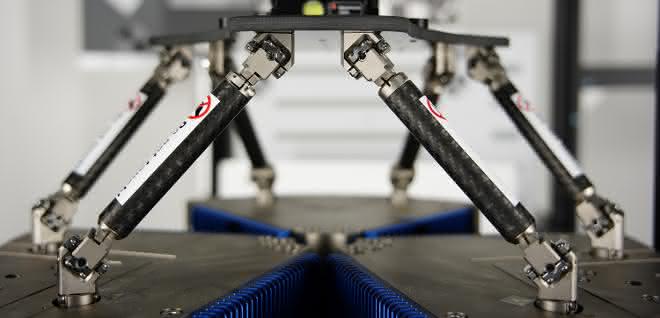
For the tests, the respective hexapod is attached to a base plate. The holders for the test specimens are mounted on the base plate. They ensure that the device to be tested is firmly attached to the hexapod during shaking. "However, we didn't just choose these hexapods because they have exactly the right specifications for simulating vibrations, but also because we receive competent support for our project from the manufacturer PI, such as when adapting the software drivers," adds Touchard.
Simple control and freely definable pivot point
The hexapods are controlled by the C-887 digital controller, which enables simple commanding. The positions are specified in Cartesian coordinates and all transformations to the six individual drives take place in the controller. A key feature of the hexapods is the freely definable rotation or pivot point. This allows the movement of the hexapod platform to be specifically adjusted to the position of the image stabilization component in the camera so that the image sensor is in the middle of all six degrees of freedom.
The hexapods have now proven themselves in the testing of image stabilization systems. However, the six-axis parallel kinematics also have advantages in other applications involving motion simulation, such as the testing of multi-dimensional position sensors and the calibration of gyro compasses in accordance with ISO 22090-1 for shipping and marine technology. as


You might also be interested in
Helu makes its first trade fair appearance under a new brand name
Helu Kabel will be presenting itself as Helu for the first time at Hannover Messe 2026, showcasing system solutions, Heluchain cables and new industrial luminaires.
 read more...
Strategic realignment with brand relaunch
In future, Helukabel will trade as Helu
The Helukabel Group is parting with part of its name: in future, the company will only operate under the Helu brand. With this step, the specialist for electrical connection technology is underlining its strategic development from a classic cable...
read more...Modular plant construction for corrugated board
Insight into the production of corrugators at BHS Corrugated: Automated, modular and equipped with Helukabel components.
read more...Best quality for the steel
Conditions in the steel industry are harsh and inhospitable. The machines used must be able to withstand the demanding environmental conditions in order to deliver the best quality at all times.
read more...If the standard cable is not sufficient
Lapp offers cables for countless applications - but not for all of them. From time to time, the developers have to modify a standard cable or develop a special cable.
read more...Slight decline in sales, strong investments
The Lapp Group has not been spared from the weakening global economy. However, the company only recorded a slight loss in the past 2024 financial year.
read more...Electrical connection technology
Cables and wires for industrial automation
Heukabel offers system solutions for cable routing from a single source. The subsidiary EKD Systems specializes in tailor-made cable drag chains made of steel, stainless steel and plastic, which are used in moving machines and systems as well as in...
read more...Lapp relies on Ultramid from BASF
Mobile charging of electric vehicles
The automotive industry is currently undergoing the biggest transformation in its history. The boom in battery electric vehicles in particular is presenting the industry with major challenges. Lapp, as a supplier of cables and connection...
read more...Cable handling application
At this year's Motek, ArtiMinds Robotics is showcasing a robot-based automation solution for the sensor-assisted assembly of flexible cables in connector housings.
read more...