

Pressure and displacement sensors
Data for human-machine-machine communication
Gefran, a provider of solutions and components for automation, drive technology and sensor technology, has launched a high-precision and robust series of magnetostrictive displacement transducers onto the market this year, including the Hyperwave product range.
Mass pressure sensors are an important instrument for controlling and safeguarding the extrusion process. They detect the pressure of the plastic melt during the process at temperatures of up to 500 °C and above. They detect excess pressure and shut down the system before employees or machines are damaged. Monitoring and controlling the melt pressure is also crucial for consistent product quality.
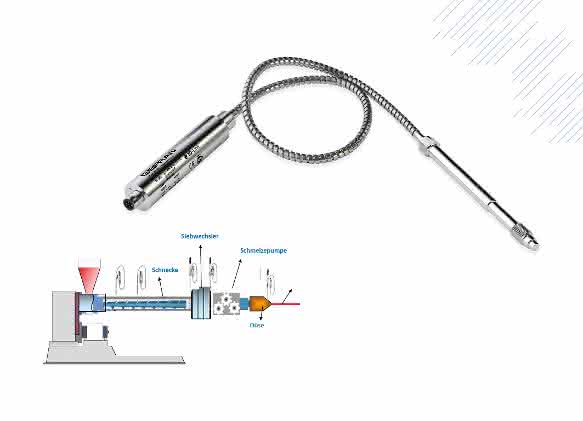
The Gefran portfolio includes sensors with and without filling media. Liquid-filled sensors use the principle of hydraulic pressure transmission. The pressure is converted into an electrical signal via a membrane with a bonded strain gauge. Typical sensor fluids are sodium-potassium, oil or mercury. However, the RoHS regulation has triggered a trend towards sensors without filling media. One example of such a sensor is the Impact. Its measuring element is a microelectromechanical system (MEMS) and works according to the piezoresistive measuring principle. A square silicon chip carries the membrane and measuring element. The measurement itself is performed by a Wheatstone measuring bridge built using SOI (Silicon on Insulator) technology. The chip has an insulating layer and is suitable for a continuous temperature of up to 350 °C.
Sensors with IO-Link
However, sensors are not only used to ensure machine safety and optimize product quality. They are also indispensable building blocks for successful machine-to-machine and human-to-machine communication. At the same time, they enable optimum data exchange between the various automation systems, machine control and synchronization as well as monitoring of the production systems.
To meet the requirements of Industry 4.0, Gefran has therefore equipped its new sensors, power controllers and regulators with the IO-Link and RTE/ProfiNET communication standard for Internet-based data exchange in real time - including the mass pressure sensors (IL series). The IO-Link protocol allows self-diagnostics of the sensors for preventive maintenance and avoidance of machine downtimes. Another advantage: in addition to the pressure signal, the IO-Link sensors also provide a temperature signal in the measuring tip, thereby increasing the number of process parameters. At the same time, the automatic testing of sensor parameters such as pressure, safety shutdown or zero point monitoring increases system reliability. In addition, all IL mass pressure sensors have PLd and SIL2 approvals. This makes them suitable for all functional safety applications. The IL sensors are available both with different filling media and, in future, as an impact version without filling media.
Potentiometric and magnetostrictive displacement transducers
Gefran has been developing and manufacturing potentiometric and magnetostrictive displacement sensors for detecting the position and displacement of moving machine parts for around 50 years. Potentiometric displacement sensors essentially consist of a wiper track and wiper. They are typically used in plastic injection molding, pneumatics and presses and are easy to install. The resolution of the output signal is practically infinite. Potentiometers work with low voltages, are available in many different designs and are comparatively inexpensive. However, they are also susceptible to wear and tear and require a lot of maintenance. They usually have to be replaced after around 100 million strokes or more and are only suitable for installation in cylinders to a limited extent. In addition, their measuring accuracy changes over their service life.
Magnetostrictive displacement transducers, on the other hand, work without contact. They are therefore wear-free and maintenance-free. Their service life is virtually unlimited - with consistently high accuracy of up to 0.01 percent. The resolution of the output signal is up to 0.5 µm. Magnetostrictive displacement transducers can be easily mounted in hydraulic cylinders. Their housing design guarantees high IP protection classes, is robust against dirt and resistant to high pressures. This makes them ideal for hydraulically moved axes. The measuring principle also allows the measurement of two or more position sensors. Incidentally, as this is an absolute displacement measurement, there is no need for a reference run when starting the system. Due to these numerous advantages, magnetostrictive sensors are gradually replacing potentiometers.
The new technology
The latest generation of magnetostrictive displacement transducers is equipped with so-called hyperwave technology. Thanks to a modified arrangement of the receiver coil, the longitudinal wave component is mechanically suppressed and only the desired torsional signal component is included in the measurement. As a result, the signal-to-noise ratio of the Hyperwave sensors is 15 times better than that of previous models. This makes the signal much more stable against vibrations and shocks and guarantees high EMC immunity of the non-contact position sensors as well as their consistently precise and continuous operation.
Hyperwave sensors also guarantee high repeat accuracy with a very low non-linearity error. They are suitable for a temperature range from -30 to 90 °C and are reliable even at extreme values.
High vibration tolerance, maintenance-free and long service life
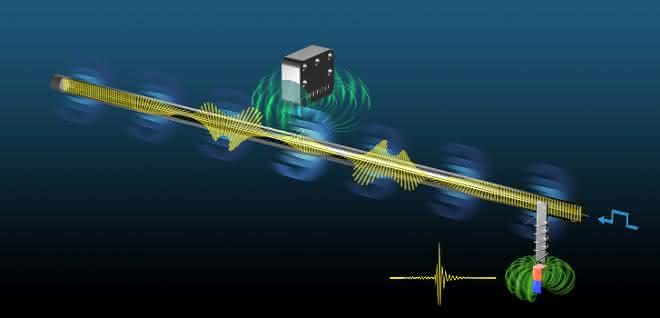
In detail, the magnetostrictive displacement transducers with hyperwave technology are characterized by a high tolerance to vibrations and shocks. The position is determined by the interaction of two magnetic fields. The first magnetic field is generated by a current pulse along the entire sensor and interacts with the second, consisting of the position magnet, which is attached to the moving axis. The magnetostrictive mode of operation without mechanical contact makes the system virtually wear-free, significantly reducing downtime and ensuring an almost unlimited service life. The devices are also equipped with a waterproof housing in accordance with protection class IP67. Thanks to these properties, the non-contact magnetostrictive displacement transducers are ideally suited for use in demanding industrial environments.
Gefran offers non-contact displacement transducers in profile and rod design. The profile type can be used universally and can be easily mounted directly on the structure to be measured using brackets. The position sensor is either free or guided.
In the stainless steel rod design, Hyperwave displacement transducers are primarily used in hydraulic cylinders with operating pressures of up to 350 bar to detect the position of the piston in real time. Thanks to a magnetic float design, they can also be used as a level sensor. Both designs are available with analog signal or digital interfaces (SSI, fieldbuses such as CANopen, Profibus, ProfiNET). The large selection of analog outputs enables direct measurement of displacement and speed as well as inverse measurement with high precision and repeat accuracy.
Both Hyperwave models are available in three different versions: General with a measuring range of up to 1,500 mm, Plus up to 2,500 mm and Advanced up to 4,000 mm. Typical applications include dancer control (basic version), presses (Plus versions) and injection molding machines, wind turbines or dam gates (Advanced version). From the first quarter of 2020, the Advancedversion will be expanded to include a ProfiNET interface, which is specially designed to meet the needs of the metal industry.
To meet the requirements of Industry 4.0, Gefran equips its products with IO-Link - including the displacement transducers in the Hyperwave series.
Fabian Ehing, Sensor Sales Specialist, Gefran Germany


You might also be interested in
Hebotec at the Hannover Messe 2025
Connecting consumers without tools
Additional robots, control cabinets, control panels or other consumers can be easily integrated into the EMC concept of an existing production line using the PAK 25 equipotential bonding terminal from Hebotec.
 read more...
Motion controller for small drives
Medium power range covered
Faulhaber has another housing-less and compact motion controller in its range, which is particularly suitable for integration in device construction and medical technology applications.
read more...Safe solutions for cable installations
From thick power cables to thin sensor lines, cables and lines must be routed safely through systems and machines. A challenge that should not be underestimated, explains Jörg Sokat, Head of Product Management at Pflitsch.
read more...Displacement measuring systems
Economic positioning
The integrated position measuring system IMS from Bosch Rexroth is now also available as IMS-compact for absolute measurement. The non-contact solution with magnetic measuring principle enables robust and economical position detection for linear...
read more...Economic positioning
The integrated position measuring system IMS from Bosch Rexroth is now also available as IMS-compact for absolute measurement. The non-contact solution with magnetic measuring principle enables robust and economical position detection for linear...
read more...Sensors with IO-Link for extruders
The melting pressure always in view
Macchi, a manufacturer of blown film extrusion lines, optimized its extruders for Industry 4.0 by integrating melt pressure transmitters with digital IO-Link output for precise recording of the melt pressure and magnetostrictive displacement...
read more...Vision with good visitor response
6505 visitors and 378 exhibitors attended the machine vision trade fair in Stuttgart.
read more...Würth Elektronik at the embedded world
Würth Elektronik, manufacturer of electronic and electromechanical components, is presenting itself as a partner to developers at embedded world. At stand 110 in hall 2, the company will be presenting its portfolio and the associated services.
read more...Die-cast electronics housing
CTX Thermal Solutions manufactures cost-effective die-cast housings in application-specific geometries.
read more...