
Predictive maintenance
Retrofitting for the cloud connection
Technical equipment breakdowns are a nuisance for everyone. If tools break, we repair or replace them. Large systems and machines, on the other hand, are not so easy to replace or maintain. Repairs also often pose a problem for operators of such systems, as there is a risk of long downtimes. The Industrial Internet of Things could solve these problems.
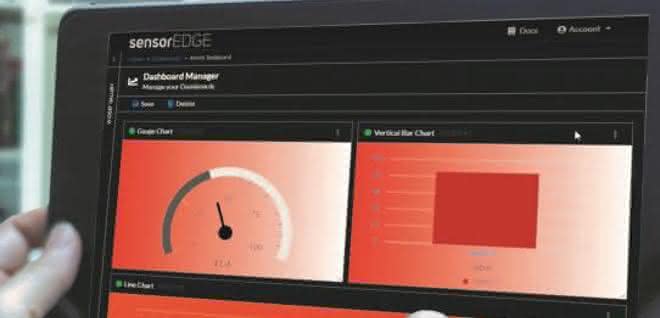
The most important concept for avoiding machine and system downtimes is called predictive maintenance and is not new - DCS, PLC and SCADA providers have been working on it for decades. However, internet and cloud technologies have opened up completely new markets in this area. With SensorEdge, Hilscher offers a ready-to-use solution for continuous monitoring of critical machine parameters and direct cloud connection for data analysis. Within minutes, users can go online with SensorEdge, equip machines with IO-Link-capable sensors and react to wear and malfunctions at an early stage.
Why wait with foresight?
Predictive maintenance is status-based maintenance in which systems and machines are monitored using sensors. These sensors provide real-time data that can be used to predict when maintenance will be required. Monitoring machinery as part of a predictive maintenance concept offers enormous savings potential for OEMs and end users:
25 to 30 percent lower maintenance costs,
70 to 75 percent fewer faults,
35 to 45 percent less downtime and
20 to 25 percent increase in production.
There is a huge stock of installed machines worldwide that are usually referred to as "brownfield". A predictive maintenance solution that can be retrofitted to existing systems to enable status-based monitoring therefore has enormous potential. Systems and processes that have been in operation for many years are often difficult or impossible to monitor. Failures can be frequent and costly.
Market for predictive maintenance is growing strongly
For providers with a broad installed base, maintenance can become a problem. As a result, experts estimate that the global market for predictive maintenance will grow from 3.8 billion US dollars in 2020 to 13.9 billion US dollars in 2026 - an indication of the high demand for effective solutions. The consequences of the coronavirus pandemic are likely to increase this pressure even further.
Retrofitting existing systems with sensors and a so-called sensor edge device is the key to setting up a safe, cost-effective and simple predictive maintenance system. The sensor edge device collects data from a large number of sensors, handles local communication processing and provides an internet uplink to the cloud. Once in the cloud, the data can be retrieved by customer applications for further analysis and processing.
Hilscher has developed such a sensor edge device called SensorEdge, which enables the sensor-to-cloud connection required for retrofit scenarios. Each SensorEdge processes the data from up to eight IO-Link sensors. If required, several SensorEdge devices can also be linked in one installation. The IO-Link sensors are integrated into the system to monitor wear, such as vibration changes in a motor or temperature changes on a coil.
IO-Link standard for manufacturer-independent sensor selection
IO-Link is an international standard for point-to-point networking for intelligent digital sensors. It enables both remote configuration and the continuous transmission of measurement data. All major sensor manufacturers support this technology - there are currently around 10,000 corresponding sensor types available on the market. With IO-Link, practically any monitoring requirement can be implemented easily and economically. For mobile or space-critical applications, Hilscher also offers the NetField Device IO-Link Wireless Master for wireless and IO-Link-compliant transmission of sensor data.
The sensors are connected to an IP67-compliant sensor edge "block". The decisive factor here is that this connection is made without interfering with another part of the system or control system. SensorEdge is therefore a genuine stand-alone solution. It is also cost-effective and easy to implement in order to transfer data from a system retrofitted with sensors to the cloud and monitor it centrally. Plant manufacturers can use it to develop their own retrofit kits containing the SensorEdge device and suitable sensors for the respective application.


You might also be interested in
ebm-papst is growing again thanks to AI and data centers
ebm-papst returned to a growth trajectory in fiscal year 2025/26. Air Technology, data center applications, and artificial intelligence are driving revenue and investment.
 read more...
SPE on the Verge of a Market Breakthrough
Single Pair Ethernet (SPE) has moved beyond the conceptual phase and is increasingly being implemented in industrial settings. The focus here is not only on higher data rates and simplified cabling, but above all on the issue of system integration...
read more...More than 900 exhibitors already registered
Around six months before the start of the trade fair, more than 900 companies have registered for SPS 2026 in Nuremberg. The trade fair focuses on industrial AI, cyber security and digital transformation.
read more...Virtual PLCs in practice: How vPLCs make production systems more flexible and scalable
The increasing networking of IT and OT is fundamentally changing industrial automation. The IT/OT Integration Summit shows how modern technologies can make production environments more efficient, flexible and future-proof. The event will focus on...
read more...Sales growth in a turbulent market environment
Thanks to innovations and a focus on strategic industrial markets, Sick was able to moderately increase its sales in the 2025 financial year. In a turbulent market environment, the company was able to maintain its position and gain market share with...
read more...Siemens presents new AI agent
Siemens is launching 'Eigen Engineering Agent', an AI for automation technology. The solution is integrated into the TIA Portal, has been tested with over 100 companies and is designed to significantly accelerate engineering processes.
read more...Schaeffler keeps sales almost stable
Schaeffler generated revenue of EUR 23.5 billion in 2025 and increased EBIT before special items to EUR 936 million. At 266 million euros, free cash flow was significantly above the prior year and forecast. Net income remained negative due to high...
read more...Advancing artificial intelligence together
Helukabel is stepping up its activities in the field of artificial intelligence and is now a member of the IPAI. The innovation and collaboration platform for companies, research facilities, institutions and administration has set itself the goal of...
read more...New impetus for ifm sales
Two new positions were filled at ifm at the start of 2026: Markus Wolf becomes Managing Director Sales Germany, Sven Quant takes over the position of Central Managing Director in the Process Sensors division within the ifm Group.
read more...