
CERN
Material testing of particle accelerator components
The European Organization for Nuclear Research CERN (Conseil Européen pour la Recherche Nucléaire) is one of the largest and most renowned centers for basic research in physics. All components that work in the harsh environment of particle acceleration must undergo thorough mechanical testing. These tests in the CERN testing laboratory are carried out using testing machines from ZwickRoell, among others.
The acceleration of high-energy particle beams to almost the speed of light and their collision are accompanied by technical challenges resulting from the harsh conditions inside the particle accelerator. The components used in the Large Hadron Collider (LHC) are exposed to cryogenic temperatures as well as high ionizing radiation, strong magnetic fields and ultra-high vacuum.
As the LHC is currently being upgraded for even higher beam energies, precise investigations are required, for example, on collimators made of new materials such as molybdenum graphite and copper diamond composites.
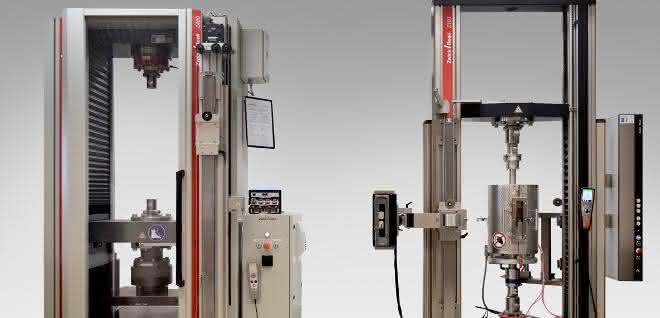
CERN has a mechanical testing laboratory in which ZwickRoell testing machines are used. The aim is to use mechanical measurements to validate finite element analyses (FEA) and carry out safety inspections. The ZwickRoell universal testing machine AllroundLine Z100 TEW is used to perform mechanical tests on materials under quasi-static conditions.
These include tensile, compression and flexure tests at room and high temperatures of up to 1,200 °C on ceramics, composite materials, polymers and metal alloys. The laserXtens 2-120 HP/TZ high-temperature extensometer, which is designed for non-contact measurement of deformations at temperatures of up to 2,000 °C, is used for strain, compression and flexure measurements.


You might also be interested in
RS expands partnership with Phoenix Contact
RS Components has significantly expanded its range of products from Phoenix Contact. The distributor now supplies more than 45,000 products from the manufacturer of products, solutions and digitalization expertise for the electrification, networking...
 read more...
Component design via online tool
mbo Osswald aims to set new standards in the world of fastening technology with its new sleeve configurator. This tool was developed to design individual components for different industries precisely and in line with requirements.
read more...Competitive advantages with large machines
Whether 3D-printed components for machines and systems, prototypes or aids for design: additive manufacturing is almost indispensable for modern companies in mechanical and plant engineering and automation if they want to play in the premier league.
read more...Networking event at Schunk: Expert Days on...
Expert exchange at the highest level
On October 25 and 26, 2023, SCHUNK is once again organizing the Expert Days: an annual international and cross-industry event on the topic of "Robotic Material Removal". 70 specialists from Europe and North America will meet in Brackenheim-Hausen to...
read more...Transport technology from the modular system
Many transport tasks can be realized with the help of linear technology. Pre-configured solutions are available to simplify the interaction between the linear unit, motor, gearbox and controller. This minimizes the effort required for research and...
read more...Purchasing optimization for rolling bearing...
Best choice thanks to pre-classification
With the ABEG method, Findling Wälzlager has created a transparent and calculable decision-making basis for avoiding oversizing and undersizing of rolling bearings. This purchasing optimization helps customers to always select the technically and...
read more...Predictive maintenance on the smart drive
Baumüller offers a drive-based software solution to diagnose the machine status. The Smart Condition Monitoring tool runs on the PLC integrated in the drive controllers and uses the drive to record signals. Sebastian Maul, application engineer at...
read more...Siemens: continued profitable growth and...
Result April to June 2023: strong momentum
Siemens continued its profitable growth trajectory in the third quarter of fiscal year 2023 (ending June 30, 2023). All industrial businesses achieved strong revenue growth. The company also recorded strong order momentum for major projects and in...
read more...How production can benefit from AI
Together with AI technology, IIoT networking makes it possible to better control machine parameters and optimize quality with predictive quality. Downtimes and set-up times can also be further minimized. Cloud platforms also make these technologies...
read more...