

Energy management software
Save energy and optimize processes
Hundreds or even thousands of sensors integrated into a long-range network - these are the most important advantages of LoRaWAN.
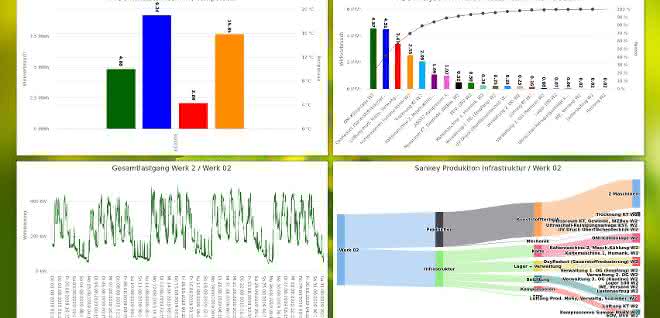
A Long Range Wide Area Network, LoRaWAN for short, is based on the open and bidirectional radio technology LoRa, which makes it possible to send small amounts of data over long distances while saving energy. It is therefore ideal for optimizing energy use, quality assurance and processes in large-scale industrial plants, infrastructure operators and municipal utilities.
In combination with an energy management solution such as that from Econ Solutions, LoRaWAN offers a cost-effective way of automatically recording and evaluating sensor data, especially when it comes to larger areas, areas with insufficient internet coverage or remote locations. In contrast to the 50 to 100 m range of conventional WLAN, LoRa signals can - depending on topography, building density, bandwidth, data throughput and antenna power - cover up to 15 km and, in exceptional cases, even up to 50 km. The signals are also suitable for so-called deep indoor locations, such as basements.
As an open standard developed specifically for the collection and exchange of status information, LoRa can be used by any company for an IoT or M2M network. The end devices used with LoRa do not require a separate power supply, and the energy-saving nature of the wireless technology means that batteries have a service life of ten years, and in some cases even up to 15 years. Due to the low costs, a large number of sensors can also be used. In addition, LoRa does not require any license fees for frequencies.
Automated data acquisition
A classic use case is, for example, a widely branched industrial plant in which several sensors automatically record various measured values such as electricity, gas, oil and water consumption of the most important machines. The measurement data is sent to a LoRa gateway, which collects the data and forwards it to the network and application server. The econ4 energy management software can be connected here, which evaluates the data and displays it clearly in graphs. The software uses data from various sensors, meters and probes as well as manually entered consumption values. From this, it generates analyses and reports that show at a glance where and when how much energy was consumed.
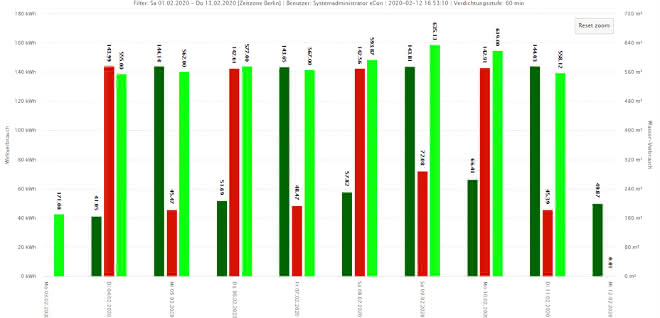
In addition to all media (electricity, gas, water, oil, etc.), econ4 can also evaluate status data such as temperature, humidity, pressure or flow rate. Users can call up these data and evaluations at any time on any end device. The solution from Econ Solutions also enables the combination of different interfaces and standards such as Modbus TCP, Modbus RTU, S0 pulse, OPC, BacNET, data loggers from different manufacturers or different file formats.
The energy management software provides all standard reports, such as progress analyses with time comparisons, reports on threshold value violations and cost reports as well as numerous management and special reports - from ABC analyses to the analysis of operating states, correlation analyses and weekly profiles to energy flow diagrams (Sankey) and spectral analyses (heat maps).
Energy and performance data combined
The energy requirements of systems, machines or appliances not only provide useful information on energy efficiency and energy costs, but also on production states, active power, downtimes, maintenance or repairs. How high is energy consumption actually during different production states? How high is it in stand-by mode? When are there peak loads? How long are the set-up or downtimes for specific orders? Is there an increased energy requirement with constant output? Are threshold values exceeded or undercut? This can indicate higher friction losses or defective parts, for example. In such cases, preventive maintenance can prevent damage to the machine or quality problems.
However, not only energy data can be recorded, but also quantities, throughput times or speeds - i.e. classic key performance indicators from production. The energy data collected can be combined and evaluated with data from existing process and building management systems as well as machine and production data acquisition systems (MDA or PDA) or ERP with econ4. This gives companies an overview of energy and process costs per unit, per machine or per production batch at the click of a mouse. They can provide their customers with information onCO2 emissions per component produced or compare machines in terms of energy and performance indicators. This provides companies with a powerful control tool for energy management, sustainability, quality assurance, process optimization, business controlling and investment decisions.
LoRaWAN in practice
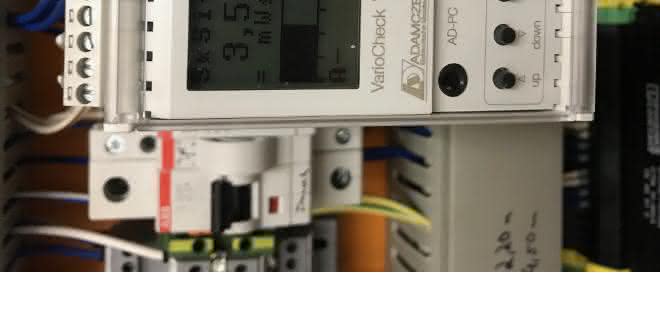
The municipality of Riegel am Kaiserstuhl, for example, shows how municipalities use a LoRaWAN with the solution from Econ Solutions. It uses it to regularly and automatically record various measured values at the pumping station, at the elevated tank for the drinking water supply and at the elementary school.
As in many municipalities, most of this data was recorded manually in Riegel. This is time-consuming and error-prone, for example due to transposed figures when transferring the values to the software. The same applies to the water level of the elevated drinking water tank located outside. In the past, the municipality's water master had to drive to the elevated drinking water tank two to three times a day to read the level. Now, thanks to LoRaWAN and the econ4 energy management software, he has this information on his smartphone at all times. The software is offered to cities and municipalities as a cloud solution by Energieagentur Regio Freiburg.
The LoRa gateway used in Riegel covers a radius of around two kilometers and is installed at the highest point in the municipality for ideal reception of the sensor data. The LoRaWAN network currently comprises two measuring devices at the pumping station and one at the elevated tank for the drinking water supply, as well as four sensors at the elementary school. The groundwater pumps at the pumping station were selected for automated data collection as they are located outside the municipality and manual readings have therefore taken a lot of time so far. With a daily running time of around ten to twelve hours, they also make a significant contribution to the municipality's energy costs.
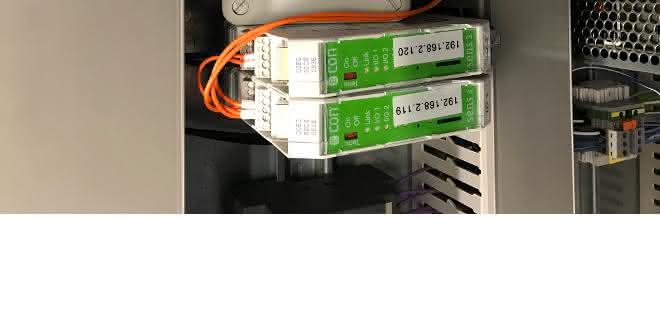
In order to quantify this proportion, they were equipped with two econ sens3 energy and power meters as part of the LoRaWAN project. They measure the power consumption and active consumption of the pumps. One of the measuring devices is equipped with a data logger that records four additional analog or digital signals - in this case the amount of groundwater pumped. As the measured values from the econ sens3 are read out via Modbus RTU, a LoRaWAN Modbus converter converts them into a format that can be processed by LoRa. The energy officer receives the current energy consumption of the pumps and their consumption over time on his PC and smartphone.
Riegel already had a corresponding measuring device in use for measuring the fill level of the elevated drinking water tanks. Here too, a converter converts the analog signals for LoRaWAN. The water manager can now easily call up the fill level of the elevated tanks and the amount of drinking water pumped per pumping process on his smartphone. He can also set threshold values so that he receives an alarm message if the fill level exceeds or falls below a critical value.
Better climate
LoRa sensors for temperature and humidity are also used in the local elementary school to analyze the heating and cooling behavior of the buildings during the recent very hot summers and then derive suitable measures. Sensors are now so inexpensive and easy to install that such measurements are also to be carried out in the municipality's multi-purpose hall. This is no problem for the LoRa gateway: the cost-effective model is designed for up to 500 sensors.
In Riegel's new depot, a flat screen will also alternately display the energy consumption of the groundwater pumps and the fill level of the elevated tank. The municipality is also planning to simplify flood protection with the help of LoRaWAN: The water levels of the Elz, Dreisam and Glotter rivers, which flow into the Leopold Canal at Riegel, are to be measured automatically for this purpose and the evaluations also displayed on the screen.
Daniel Wiedmann, System Integration / Automation at Econ Solutions


You might also be interested in
ESTIA aims to strengthen Europe's cloud
New tech alliance for EU sovereignty
Twelve companies, including Dassault Systèmes, are founding the European Sovereign Tech Industry Alliance (ESTIA). The initiative aims to strengthen Europe's technological independence and define requirements for sovereign cloud services. The start...
 read more...
Deutsche Telekom and Nvidia launch one of Europe's largest AI factories
With the Industrial AI Cloud in Munich, Deutsche Telekom and NVIDIA are creating one of the largest AI factories in Europe. Companies can train AI models, carry out simulations and access 10,000 GPUs.
read more...Leveraging data potential with AI and streaming
Huge data treasures are still lying dormant in many manufacturing companies. And yet it is high time that these treasures were unlocked. There is often a lack of resources and capacity to make data usable in real time. Streaming production data can...
read more...More awareness of noise
Dematic offers solutions that are tailored to different cloud environments and reduce environmental impact through reduced material consumption and improved energy efficiency.
read more...Generative AI in the automation environment
The mechanical engineering and automation industry is undergoing profound change. This transformation is being driven by more volatile global trade, geopolitical crises and increasing market pressure, which demands greater agility, technological...
read more...Rigid data structures have had their day
The traditional data center is no longer the center of data. A hybrid cloud storage approach enables manufacturing companies to both meet the current requirements of data-intensive processes and future-proof their infrastructure.
read more...Software as a service in three stages
CIM Database Cloud is a new out-of-the-box solution from Contact for end-to-end digital product development.
read more...How production can benefit from AI
Together with AI technology, IIoT networking makes it possible to better control machine parameters and optimize quality with predictive quality. Downtimes and set-up times can also be further minimized. Cloud platforms also make these technologies...
read more...More expertise for digital engineering
Altair, a computational science and artificial intelligence (AI) company, has acquired OmniV, a technology from Michigan, USA-based software company XLDyn.
read more...