
ESR strain gauges
Digitized monitoring of large systems
Large structures such as bridges, wind turbines and cranes are exposed to high loads. Their safe operation requires comprehensive monitoring. Heidenhain and Leine & Linde are presenting a new series of measuring devices for this purpose.
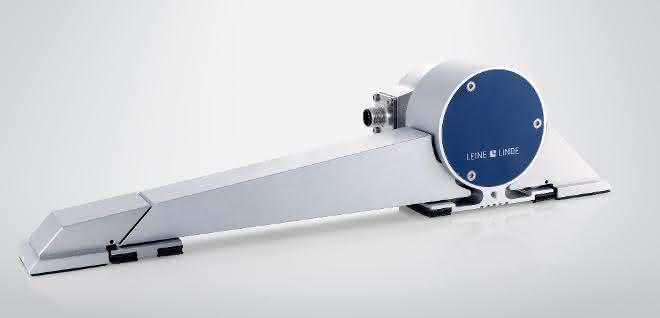
The ESR strain gauges from Heidenhain and Leine & Linde open up new possibilities for short-term, recurring or permanent strain and load measurements. They are a highly accurate, robust and reusable alternative to conventional systems for monitoring large structures. The use of an electro-optical encoder for measuring strain and outputting digital measurement signals is completely new.
Proven technology in a new application
Rotary encoders are the industrial standard for determining the position and speed of motors. They have been used in this function for decades in production and automation systems as well as in wind turbines and elevators. The ESR strain gauges now use the robust and proven rotary encoder technology to measure the change in length between two points. These two points are attached to the object to be measured 200 millimeters apart. One measuring point is located in line with the axis of the rotary encoder shaft, the other at the end of a connecting rod. Every relative change in length of the loaded object to be measured compared to the parallel, unloaded connecting rod leads to a change in angle at the rotary encoder, which is used to detect expansion or compression movements.
Based on the selected geometries, one increment of the encoder corresponds to a change in length of five namometers or an elongation of 0.025 µε. According to the measuring range of plus/minus 5000 µε, this results in an available resolution of plus/minus 200,000 values or over 18 bits. This is around five times more measurement information than in conventional installations with foil-based strain sensors.
The ESR strain gauges also work fatigue-free and, thanks to their high scanning frequency, they are also suitable for measuring in dynamic applications. With protection class IP66 and an operating temperature of minus 40 to plus 100 degrees Celsius, the rotary encoder is well protected against environmental influences and optimally designed for outdoor applications.
Because the material of the connecting rod can be selected according to the material of the measurement object, the ESR strain gauges offer constructive, passive temperature compensation. This is because temperature-related strains are not measured due to the identical coefficients of thermal expansion of the connecting rod and the measurement object.
Digital data with lots of added value
Thanks to the highly integrated optical scanning in the encoder, the ESR strain gauges deliver a highly accurate digital measurement signal with extremely low noise. The digital EnDat 2.2 interface transmits the measurement signal to the subsequent electronics without interference or loss, even over long cable lengths. It can also provide additional information such as the ambient temperature on site at the strain gauge and data for diagnostics and condition monitoring of the gauge itself. as
Hall 1, Stand 1-122


You might also be interested in
Helu makes its first trade fair appearance under a new brand name
Helu Kabel will be presenting itself as Helu for the first time at Hannover Messe 2026, showcasing system solutions, Heluchain cables and new industrial luminaires.
 read more...
Strategic realignment with brand relaunch
In future, Helukabel will trade as Helu
The Helukabel Group is parting with part of its name: in future, the company will only operate under the Helu brand. With this step, the specialist for electrical connection technology is underlining its strategic development from a classic cable...
read more...Modular plant construction for corrugated board
Insight into the production of corrugators at BHS Corrugated: Automated, modular and equipped with Helukabel components.
read more...Best quality for the steel
Conditions in the steel industry are harsh and inhospitable. The machines used must be able to withstand the demanding environmental conditions in order to deliver the best quality at all times.
read more...If the standard cable is not sufficient
Lapp offers cables for countless applications - but not for all of them. From time to time, the developers have to modify a standard cable or develop a special cable.
read more...Slight decline in sales, strong investments
The Lapp Group has not been spared from the weakening global economy. However, the company only recorded a slight loss in the past 2024 financial year.
read more...Electrical connection technology
Cables and wires for industrial automation
Heukabel offers system solutions for cable routing from a single source. The subsidiary EKD Systems specializes in tailor-made cable drag chains made of steel, stainless steel and plastic, which are used in moving machines and systems as well as in...
read more...Lapp relies on Ultramid from BASF
Mobile charging of electric vehicles
The automotive industry is currently undergoing the biggest transformation in its history. The boom in battery electric vehicles in particular is presenting the industry with major challenges. Lapp, as a supplier of cables and connection...
read more...Cable handling application
At this year's Motek, ArtiMinds Robotics is showcasing a robot-based automation solution for the sensor-assisted assembly of flexible cables in connector housings.
read more...