

Functionalities for sensors
Deep learning: training for the sensor
Sick offers software applications based on deep learning algorithms. Users of system solutions in logistics automation can benefit from this.
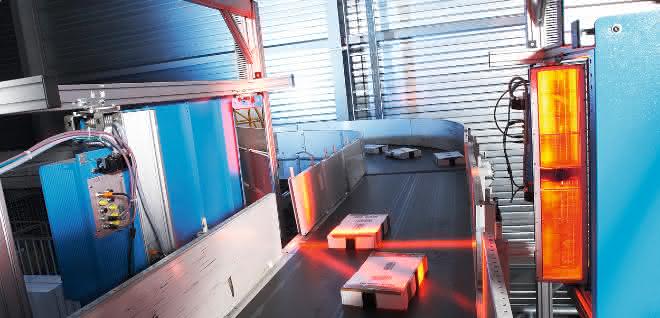
Sensors use deep learning to automatically recognize, inspect and classify objects or features, providing intelligence that was previously reserved for humans. As a sub-area of machine learning, deep learning is therefore probably the most important future technology within the field of artificial intelligence and is also a long-term driver of Industry 4.0.
After reporting on the successful use of deep learning algorithms in initial pilot projects, Sick has developed software applications based on deep learning for the logistics automation system business. In this application, the deep learning system recognizes whether a sorting tray in a logistics hub is actually only loaded with one object. This leads to more efficient flows of goods.
Training for the sensor
Neural networks are used to implement deep learning. In contrast to the process of classic algorithm development, which is mainly characterized by the manual development of a suitable feature representation, a neural network is trained to find the optimal features for its task and can be retrained again and again with suitable data in order to adapt to new conditions.
Sick uses an independent in-house computer and IT base both for building the training data set by capturing and evaluating thousands of images and examples and for training the neural networks. The extensive calculation of the complex operations of the deep learning solution for training is carried out on specially equipped computers with high GPU performance. The new deep learning algorithms generated from this are provided locally on the sensor and are therefore available immediately and fail-safe, for example on an intelligent camera.
In principle, the concept of sensors specialized by artificial intelligence can also be applied to simple sensors such as inductive proximity switches, retro-reflective photoelectric sensors, ultrasonic sensors and others. In addition, system solutions such as the increasingly demanding vehicle classification at toll stations offer potential for a deep learning-based classification of vehicles into toll classes. as


You might also be interested in
Modular storage concept
Gebhardt will be presenting the new Gebhardt Upstream at its LogiMat trade fair stand. The proven software solutions, warehouse technology solutions and conveyor technologies such as Galileo IoT, StoreWare and SpeedSorter can also be seen there.
 read more...
Flexible I/O and safety modules
To speed up commissioning and increase throughput in intralogistics systems, a system solution provider also uses decentralized I/O and safety modules.
read more...Fast shipping from the toy manufacturer
Dematic has automated the returns and shipping logistics at toy manufacturer Haba. The intralogistics specialist has installed a space-saving Dematic pocket sorting system at the distribution center in Bad Rodach, where it supports the efficient...
read more...Data analytics for sorting technology
Collect, analyze and optimize data
System provider Beumer is presenting an intelligent data analytics solution that can be used to examine large volumes of data that are generated during sorter operation, for example, and visualize the results.
read more...Digitalization in the material flow
Gebhardt: Smart sorter for logistics 4.0
Gebhardt is launching a fully automated, horizontal and smart sorting system onto the market. The SpeedSorter has a modular design with digital components and is suitable for various conveyed goods.
read more...Sorters take over order-related picking
Sorters play a crucial role in controlling and diverting the flow of goods. With the Omni Sorter and the Sphere Sorter, Trapo offers two solutions that help to keep supply chains running smoothly.
read more...Dispatch center in South Korea
Avancon installs sorter for Samsung smartphones
Together with the South Korean system integrator Asetec, a specialist in electronic control systems, pick-to-light systems and communication with higher-level BUS/IT systems, Avancon has installed a distribution and sorting system for the Samsung...
read more...High-performance sorter from Interroll
Crossbelt sorter processes 20,000 pieces per hour
With the Crossbelt Sorter MX 025H, Interroll is expanding its portfolio of automatic sorting solutions with a new high-performance system that can process up to 20,000 conveyed goods per hour.
read more...E-commerce: sorting system gets shoes on their way
Ferag is equipping the MyBox Logistics distribution center in Kielce, Poland, with a Denisort sorting line. It will sort 8,600 units - mainly shoes and fashion items - per hour.
read more...