
Camera-supported alignment and measuring system
Adjusted with light
Electronic autocollimators use the absolute straightness of light for non-contact, high-precision measurements. The optical alignment and measurement system from Hofbauer Optik works with the help of uEye industrial cameras from IDS.
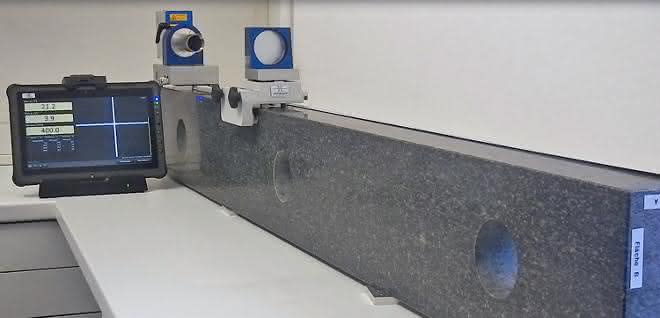
Straightness and alignment are essential for trouble-free system operation, especially with large machine components and rail constructions. Even small deviations can lead to increased wear and bring an entire system to a standstill. Precise alignment or measurement of linear guides in advance is therefore crucial for the quality and service life of a system.
Electronic autocollimators use the absolute straightness of light for non-contact, high-precision measurements. The smallest deviations in the straightness of a surface or a guide can be detected via changes in angle. For this purpose, a collimated light beam, i.e. a light packet with individual parallel beams, leaves an optical system and is reflected back into it by a plane mirror. In this way, the Elwi-Ger 3000 electronic autocollimator from Hofbauer Optik enables two-dimensional, precise and fast measurement of straightness and flatness.
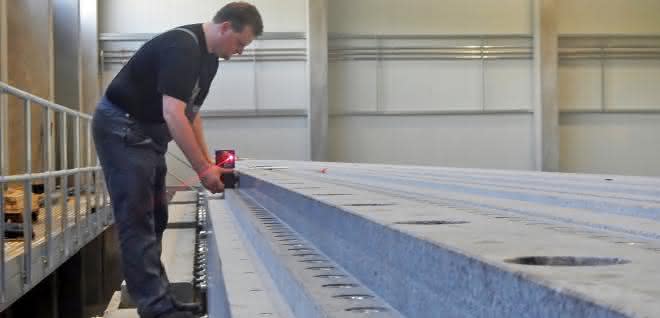
The flexible system can be used on technical surfaces for aligning and checking linear guides as well as for measuring the curvature of large components and rail systems. This makes it just as suitable for plant construction as it is for track and tunnel construction. However, it can also be used as a straightness standard for tasks such as testing stone rulers. For example, a granite straight edge with a length of 160 centimetres can be measured in less than five minutes with an accuracy of less than 0.5 micrometres per meter.
The optical test device measures straightness in the X and Y directions simultaneously and can be used in any position (spatial axis). The system includes the measuring head and extensive accessories, such as an adjustable holder, a measuring mirror, an attachment laser and the associated USB connection to the display unit. Nevertheless, it is small and compact and works on battery power for up to eight hours.
The system is operated directly on the IP65-compatible tablet. Data transfer and remote control of the measuring system can also be carried out via smartphone. Straightness evaluation is possible directly without an additional PC. An automatic protocol with document tracking is available as a report in PDF format after each measurement.
Fast and precise thanks to camera technology
"With the Elwi-Ger 3000, we are continuing our consistent development of precision measurement technology in mechanical engineering. The integrated uEye industrial camera from IDS Imaging Development Systems makes a major contribution to this," explains Dr. Engelbert Hofbauer, owner and Head of Development at Hofbauer Optik.
It sees a crosshair or a vignetted illuminated area, i.e. with shading towards the edge of the image, in monochrome LED light. These result mathematically from the correlation function of two circular areas of the same diameter. The latter, in turn, are created during autocollimation, as mentioned above, by reflection of the emitted light cone on a distant mirror.
The intensity distribution in the image or on the camera results in a regular circular cone, whereby several so-called V-SPOTs can also be visible in various applications. The precise position of the V-SPOTs is calculated with sub-pixel accuracy (< 1/50 pixel peak-to-valley and 1/100 deviation from the root mean square). Based on this, corresponding angles are determined in up to three dimensions (degrees of freedom) and simultaneously up to three degrees of positional freedom.
Thanks to the patented vignetting method, Hofbauer is the only company in the world capable of overcoming the problems of the classic autocollimation method and measuring lengths of over 100 meters even at extremely large angles (1,000 seconds = 17 millimeters per meter) with angular second accuracy and evaluating them using the tilt method.
Two possible measuring methods
Two possible measuring methods are available to the user: With the inclination method, a measuring mirror on a mirror base or on the guide carriage of a linear guide is moved over the test specimen in equal steps and the change in inclination is measured. The straightness is determined and displayed by summing (integrating) the height differences determined from the partial sections. This method achieves the highest accuracy with the lowest measurement uncertainty.
Alternatively, depending on the application, the height method can also be used for measurement. In this case, the reflector is also attached to a suitable base or to the linear slide or the moving axis (machine table, traverse) and can be positioned anywhere on the path. The deviation from the ideal straight line (optical axis) is measured and displayed immediately and directly. The advantage here is that adjustment processes can be carried out directly.
Camera models
The Elwimat-Ger 3000 contains one industrial camera from the uEye camera family, depending on the customer application. There is a choice of different models with GigE or USB 3.1 Gen 1 interface, as a board level version or with housing. Whether a cost-effective project camera or a compact powerhouse, all models are quality-tested and pre-calibrated. With the IDS software and Plug & Play, they can be integrated quickly and are therefore particularly economical.
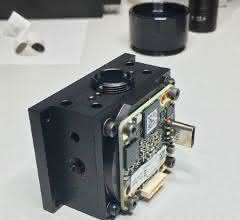
Specifically, the UI-3272LE-M-VU, a cost-effective and versatile project camera from the uEye LE USB 3.1 Gen 1 series with a torsion-proof USB Type-C connection, is used. USB Power Delivery makes it possible to offer a variable peripheral power supply at the I/O port. It is equipped with the Sony IMX265 area sensor - one of the best image sensors in the 3 MP pixel class. The 1/1.8" size of the global shutter CMOS sensor provides a choice of suitable lenses. The industrial camera delivers frame rates of up to 57 fps at full resolution (3.2 MP: 2056 x 1542 px) and 80 fps at Full HD resolution. The USB 3.1 Gen 1 camera is therefore suitable for visualization tasks in machine vision applications. The board level variants are available with upright (-VU) - as in the Elwimat - or horizontal USB Type-C orientation and also have a ten-pin I/O SMD connector for GPIO, trigger and flash.
With the fast USB 3.1 Gen 1 technology, the data transfer rate could be increased from 480 MBit/s to five GBit/s, with the same or longer cable length. The measurement frequency in full screen mode increased by a factor of five from just under twelve frames per second to 57 fps. For special applications in vibration and frequency analysis, the clock rates can be extended into the KHz range using AOI technology as well as subsampling and binning methods.
Software
Hofbauer uses the IDS Software Development Kit to integrate the industrial camera into its system. "With the IDS SDK, we have the advantage of a standardized programming interface for all IDS cameras. Programming is therefore independent of the model connection, regardless of whether it is USB 2, USB 3.1 Gen 1 or GigE," explains Dr. Hofbauer, adding: "New camera models are also supported without any software changes. This fits in with our goal of reconciling the highest demands on measurement technology with user-friendly operability." Another reason for using the IDS software was the simple use of additional functions such as EEPROM and GPIOs. The SDK is compatible with Windows and Linux.
Outlook
Straightness and alignment are essential in mechanical and plant engineering. The Elwi-Ger 3000 makes it easy to measure, adjust and record the results for different applications. It does not miss even the smallest changes in angle. In contrast to the competition, it achieves measuring lengths of over 100 meters with an accuracy in straightness measurement of 0.5 micrometers per meter, i.e. 0.05 millimeters at 100 meters measuring distance. The flexible and mobile usability as well as the extensive range of accessories provide additional customer benefits. as


You might also be interested in
Helu makes its first trade fair appearance under a new brand name
Helu Kabel will be presenting itself as Helu for the first time at Hannover Messe 2026, showcasing system solutions, Heluchain cables and new industrial luminaires.
 read more...
Strategic realignment with brand relaunch
In future, Helukabel will trade as Helu
The Helukabel Group is parting with part of its name: in future, the company will only operate under the Helu brand. With this step, the specialist for electrical connection technology is underlining its strategic development from a classic cable...
read more...Modular plant construction for corrugated board
Insight into the production of corrugators at BHS Corrugated: Automated, modular and equipped with Helukabel components.
read more...Best quality for the steel
Conditions in the steel industry are harsh and inhospitable. The machines used must be able to withstand the demanding environmental conditions in order to deliver the best quality at all times.
read more...If the standard cable is not sufficient
Lapp offers cables for countless applications - but not for all of them. From time to time, the developers have to modify a standard cable or develop a special cable.
read more...Slight decline in sales, strong investments
The Lapp Group has not been spared from the weakening global economy. However, the company only recorded a slight loss in the past 2024 financial year.
read more...Electrical connection technology
Cables and wires for industrial automation
Heukabel offers system solutions for cable routing from a single source. The subsidiary EKD Systems specializes in tailor-made cable drag chains made of steel, stainless steel and plastic, which are used in moving machines and systems as well as in...
read more...Lapp relies on Ultramid from BASF
Mobile charging of electric vehicles
The automotive industry is currently undergoing the biggest transformation in its history. The boom in battery electric vehicles in particular is presenting the industry with major challenges. Lapp, as a supplier of cables and connection...
read more...Cable handling application
At this year's Motek, ArtiMinds Robotics is showcasing a robot-based automation solution for the sensor-assisted assembly of flexible cables in connector housings.
read more...