
3D cameras
3D data directly from the camera
When 3D image processing is used in computationally intensive applications, interfaces and CPU performance quickly become a bottleneck. It is then practical if the 3D camera already takes over some of the computing work - such as Ensenso XR.
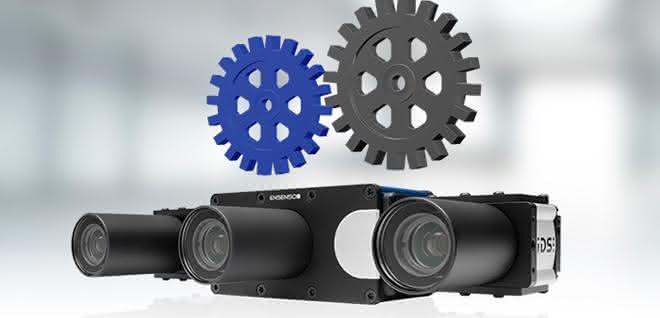
If large volumes or multiple object views are to be inspected automatically using 3D cameras, such as on continuously running production lines in the automotive industry, high-resolution 3D result data must be generated and processed quickly due to the specified cycle times. Stereo camera systems with large 5 MP sensors and variable baselines provide the ideal output data, but also produce enormous amounts of data. As a result, interfaces and CPU performance can quickly become the limiting bottleneck in such high-performance 3D applications.
The challenge: to reduce data rates and performance requirements for system components without compromising data quality. At the same time, the systems need to be space-saving and efficient. IDS has therefore developed the Ensenso-XR series of embedded 3D cameras with integrated data processing.
In machine vision applications with 3D cameras that work according to the principle of spatial vision (stereo vision), camera images are processed at a high resolution and frame rate in order to make the resulting data available to downstream processes as quickly as possible. The calculation of the three-dimensional data, so-called "point clouds", from the image material of the stereo cameras requires several complex process steps, which were previously performed by powerful industrial PCs (IPCs).
With increasing demands on the quality and speed of this result data, modern 3D stereo cameras, such as the Ensenso X series, use high-resolution 2D cameras with a Gigabit Ethernet interface. However, the transmission of the 2D output data to the processing IPC requires optimal utilization of the network bandwidth in order to avoid time delays or data loss. Apart from this, the processing performance of the IPC hardware must constantly grow in order not to restrict the overall system.
The performance of such 3D camera systems can be further increased by using high-quality components. Thanks to interchangeable 2D cameras, the flexible design of the Ensenso X series is not tied to specific data interfaces and sensor resolutions and can continue to grow in line with the requirements for speed, object sizes and quality. However, high-resolution, fast GigE cameras, specially shielded cables, high-performance network technology and powerful PC hardware are simply too expensive for some applications. Sufficient space must also be available for these peripherals.
Ensenso is taking a different approach with the XR camera series. According to the principle of the Internet of Things (IoT), each individual component in a "distributed system" has a specific task and generates results that are directly reused by other systems. In the case of a 3D camera, these are three-dimensional coordinates of pixels of a real object.
Onboard 3D processing
Thanks to an SoC (System-on-Chip) integrated in the Ensenso XR projector unit, the camera carries out the 3D processes itself, including stereo analysis. After correction of the lens distortion, the 2D output images are converted into an axis-parallel stereo system by a virtual rotation of the cameras (rectification), which greatly facilitates all subsequent analyses. The matching algorithms for still or moving scenes then search the recorded image pairs for corresponding pixels.
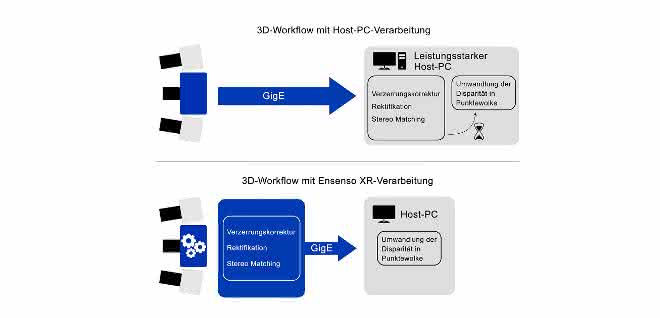
For these pixels, the different perspectives of the cameras also result in different horizontal shifts in the image plane, which is referred to as "disparity". Due to the geometric relationships in the parallel stereo system, this disparity represents a measure of the spatial depth of a 3D point in millimetres after applying ray theorems and knowing the known system parameters, such as focal lengths, pixel sizes and the base length of the stereo system.
These time-consuming and computationally intensive pixel operations are executed in a highly parallelized manner by a supporting FPGA in the camera. This enables a 3D data rate to be realized that is comparable to that of an Ensenso X system that performs stereo analysis on a desktop PC with an Intel Core i7 Quad CPU.
Advantage Embedded
In conjunction with FlexView2 technology, models in the XR36 series are able to process up to 16 images in rapid succession for the 3D data set of a still scene without any additional time delay caused by the transfer of raw data to the host PC. The shifting of the projector pattern by FlexView2 results in different 3D points with each image pair, which contributes to a very high-resolution 3D display.
By shifting the computationally intensive processes to the camera, they no longer need to be carried out by powerful industrial PCs. In addition, the transfer of 3D result data instead of the high-resolution 2D raw data reduces the network load. With fast, direct memory access between image acquisition and processing, there are enormous advantages in terms of result rate and bandwidth reduction for high-resolution 3D data in this application compared to external processing on an industrial PC.
According to IDS, multi-camera systems in particular benefit from the resource-saving properties of the XR series. If raw data from several high-resolution 2D cameras has to be transported over the network, bandwidth bottlenecks quickly occur, resulting in frame rate drops that have a negative impact on overall performance. This is where the early evaluation and simultaneous data reduction of the XR series scores with stable result rates, less computing power of the peripheral components and therefore a smaller footprint. A 3D application with Ensenso XR cameras can be scaled more easily to the required demands.
To further reduce the data rate, the camera only transmits the "disparity map". The 16-bit 1-channel image is considerably smaller than a complete point cloud, which is a 32-bit RDB image with a color overlay. The simple conversion can be carried out by the Ensenso SDK on the industrial PC without much computing load.
In addition to the wired Gigabit Ethernet connection, an additional WLAN interface allows temporary access to data and parameters during setup and maintenance, which is very useful when cabling is difficult or cost-intensive. Furthermore, the new Ensenso XR projector unit has an integrated front light. In use, it supports the calibration of the working environment or improves the image quality of the 2D camera images if the ambient light is insufficient or no external lighting is available. as


You might also be interested in
Helu makes its first trade fair appearance under a new brand name
Helu Kabel will be presenting itself as Helu for the first time at Hannover Messe 2026, showcasing system solutions, Heluchain cables and new industrial luminaires.
 read more...
Strategic realignment with brand relaunch
In future, Helukabel will trade as Helu
The Helukabel Group is parting with part of its name: in future, the company will only operate under the Helu brand. With this step, the specialist for electrical connection technology is underlining its strategic development from a classic cable...
read more...Modular plant construction for corrugated board
Insight into the production of corrugators at BHS Corrugated: Automated, modular and equipped with Helukabel components.
read more...Best quality for the steel
Conditions in the steel industry are harsh and inhospitable. The machines used must be able to withstand the demanding environmental conditions in order to deliver the best quality at all times.
read more...If the standard cable is not sufficient
Lapp offers cables for countless applications - but not for all of them. From time to time, the developers have to modify a standard cable or develop a special cable.
read more...Slight decline in sales, strong investments
The Lapp Group has not been spared from the weakening global economy. However, the company only recorded a slight loss in the past 2024 financial year.
read more...Electrical connection technology
Cables and wires for industrial automation
Heukabel offers system solutions for cable routing from a single source. The subsidiary EKD Systems specializes in tailor-made cable drag chains made of steel, stainless steel and plastic, which are used in moving machines and systems as well as in...
read more...Lapp relies on Ultramid from BASF
Mobile charging of electric vehicles
The automotive industry is currently undergoing the biggest transformation in its history. The boom in battery electric vehicles in particular is presenting the industry with major challenges. Lapp, as a supplier of cables and connection...
read more...Cable handling application
At this year's Motek, ArtiMinds Robotics is showcasing a robot-based automation solution for the sensor-assisted assembly of flexible cables in connector housings.
read more...