

Modernization of signal systems
Weidmüller protects London Underground signaling systems
The technology in the tunnels of the London Underground is exposed to difficult conditions. Enclosures from Weidmüller protect the sensitive technology required for new signaling systems in the harsh environment.
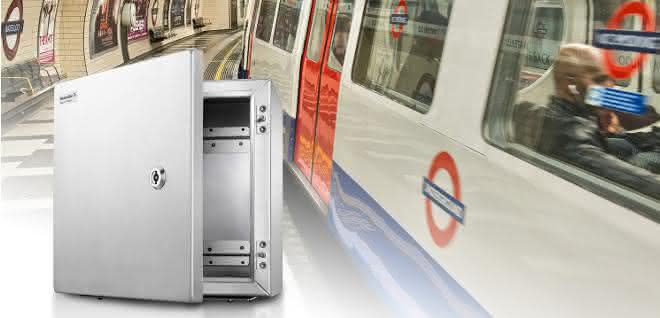
The world's first subway network was built in London more than 150 years ago, and today the London Underground has the longest line in Europe at 402 kilometers. Every day, around 4.8 million people travel on the Tube on the extensive routes in the tunnels beneath London's busy streets. The trend in passenger numbers is rising.
To ensure that passengers can continue to travel faster and more smoothly on the subway in the future, new train control technology is to be implemented across the entire route network to enable shorter train sequences. The Four Lines Modernization Project (4LM), currently the largest rail infrastructure project for the modernization of signalling systems worldwide, is the first step in this direction. It includes the installation of new train control technology on the Circle, District, Hammersmith & City and Metropolitan subway lines. Together they account for 40 percent of London Underground's traffic.
Four subway lines, 3,500 Weidmüller enclosures
Whether dust, vibrations or high temperatures - the technology in the tunnels of the London Underground is exposed to difficult conditions, of which the passengers are often unaware. To ensure that everything runs smoothly, know-how from Detmold is being used: 3,500 enclosures from Weidmüller are helping to protect the sensitive technology required for the new signaling systems in the harsh environment. The demands on the technology are high, as Detmar Saalmann, Global Segment Manager Transportation at Weidmüller, knows: "The humid environment in the underground tunnels as well as strong temperature fluctuations require special enclosures with specially manufactured ventilation drains and seals."
In addition, when installed above ground, it must be ensured that the train drivers are not dazzled by sunlight reflecting off the housing surfaces. "These challenges were taken into account when manufacturing the special housings and a low-reflection stained surface was developed," continues Saalmann.
The working conditions in London Underground make the project partners' job more difficult, as the modernization work has to be carried out during ongoing operations. "In addition, the new equipment must be compatible with the existing infrastructure, some of which is over 150 years old, and have a minimum service life of 40 years," explains Saalmann.
At the end of 2019, London Underground passengers will be able to experience the first results of the modernization work when the new train control technology goes into operation on the Circle line. But the 4LM project is just the beginning of a series of modernization projects for London Underground: all other lines of the transport system will follow by 2024. When all the work is finally completed, London Underground passengers will be able to enjoy the benefits of the modernizations for many decades to come and travel quickly from one place to another in London. This is also thanks to the protection of the new signaling systems by technology from Detmold. as


You might also be interested in
Housing and inserts for plenty of power
Lapp presented the expansion of its Epic Power series at SPS 2023: four new M23 circular connector inserts and three new M23 housings. The special feature: all housings can be combined with any of the four inserts.
 read more...
News and product updates from Smartgas
Portable gas analyzers for outdoor use
Smartgas is starting the second half of the year with a series of updates to existing products and a number of new products. Portable analyzers expand the range of applications, while new accessories such as protective housings and heating modules...
read more...Everything accurate in switch cabinet construction
To ensure smooth work processes, tools for processing enclosures and housings must function flawlessly and reliably. Häwa rounds off its punching range with the Multi-Press 500.
read more...Shafts and conversion parts
The Rodriguez range includes ball bushings including matching housings, shaft brackets, crossbars and supports.
read more...Cooling and temperature control units
Hygienic packaging sells safely
In few industries are the requirements for hygiene in the production process as strict as in the food sector - the health of consumers has top priority. This results in enormous challenges for all machines and components involved, especially in...
read more...Simple tool change in seconds
With the CMS, Schunk is launching a user-friendly, manual change system for quick component replacement. In addition to its simple and convenient operation, the CMS also stands out with its extensive range of optional modules and complementary end...
read more...Motion controller for small drives
Medium power range covered
Faulhaber has another housing-less and compact motion controller in its range, which is particularly suitable for integration in device construction and medical technology applications.
read more...Welding solutions in the name of resource efficiency
At the Welding & Cutting trade fair in Essen (September 11-15), Fronius will be focusing on the major drivers in welding technology. Quality requirements are increasing in all industries, but the required welding specialists are scarce. In...
read more...Safe solutions for cable installations
From thick power cables to thin sensor lines, cables and lines must be routed safely through systems and machines. A challenge that should not be underestimated, explains Jörg Sokat, Head of Product Management at Pflitsch.
read more...