
IT security
Structured processes are the be-all and end-all
Cyber risks continue to increase and companies are forced to increase their IT security. Elementary measures include the establishment of structured security processes and the introduction of an information security management system (ISMS).

Many companies, especially in the SME sector, invest insufficiently in IT security, usually for cost reasons. This approach can work for a long time, but it doesn't have to. It harbors a high risk potential and can result in considerable damage. In particular, the legal requirements (including the IT Security Act 2.0 or GDPR) are putting SMEs and operators of critical infrastructures under considerable pressure. The possible consequences of negligent handling of information security range from simple data theft, industrial espionage and denial of services to blackmail - keyword ransomware. Companies should also not ignore the ever-increasing fines imposed in the wake of GDPR violations: Fines in connection with the IT Security Act 2.0 are set to be significantly adjusted this year.
In view of the high cyber risks and the threat of sanctions, hardly any company, let alone any government agency, can do without a comprehensive IT security strategy. Fortunately, this realization is becoming increasingly widespread, meaning that more is being invested in IT and information security than in the past in order to avoid jeopardizing one's own business and company values.
The task is clear: if companies want to remain successful in the digital world in the future, they must pursue an efficient, end-to-end information security strategy and permanently establish an information security management system (ISMS). The aim of such a strategy must be to take appropriate security measures, taking into account the respective risk, and to continuously evaluate the company's own procedures and techniques. Sensibly applied cyber security requires an overall organizational and structured approach that can also take into account changes in the business structure. And conversely, changes in the business structure must also include or entail an overall organizational and structured approach to IT security.
Experience shows that the introduction of an ISMS is only successful if the management level of a company is effectively committed to it from the outset: without sustained management buy-in, there will be no sustainable information security. The involvement of the board or management level is important simply because investments have to be made in order to implement information security. In addition, management must of course support any changes and convince employees of their necessity. After all, the implementation of security measures can also be laborious, make work processes more difficult or even have a demotivating effect. In practice, a basic safety check (quick check) has proven to be extremely helpful. This can be used by any company in any industry to quickly gain a good and practical overview of its own information security status.
Norms and standards lead the way
The positive thing about information security is that no company has to start from scratch. Established standards are available and should be used. ISO27001 and the BSI IT baseline protection in its modernized form, for example, are sufficiently flexible to cover the requirements of a wide range of companies, for example with regard to company size, the complexity of the infrastructure or the need for protection. The BSI's "Guide to basic protection in accordance with IT-Grundschutz: 3 steps to information security" is particularly suitable for small and medium-sized companies. It contains reduced requirements and supports the rapid introduction of an ISMS. In addition to such standards, internal compliance requirements must of course also be observed.
Risk assessment is the starting point
A comprehensive risk assessment - according to the BSI, a structure and protection requirements analysis or, as part of business continuity management, a business impact analysis - is always the first step in defining a security strategy and implementing an ISMS. It makes no sense to take security measures if the risks have not been analyzed and assessed. The result of a risk analysis can also be, for example, that certain security measures are not taken because the effort involved is disproportionate to the potential damage - the saying "don't shoot sparrows with cannons" also applies here. On the other hand, IT systems that are crucial to the company's value creation must be protected to the maximum.
A holistic risk assessment is therefore an indispensable basis for an efficient security strategy. The minimum requirements include clarifying the following questions:
- What does my information network look like? Which IT systems are available? Which business units use which systems?
- How vulnerable are the systems really? Are the IT systems only targets of script kiddies or also of criminals or even external services?
- Where does data leave the company? What do the interfaces look like?
- What happens to the business if certain IT systems fail?
- How likely is a failure - whether due to an attack or a technical defect?
- How much will it cost to fully or partially restore operations after a failure?
- What other costs does a failure entail, for example with regard to fines due?
- How much does a comprehensive backup of all relevant systems cost?
Solution selection and employee qualification
Based on the specified strategy, the necessary security solutions and tools must be introduced. It is necessary to evaluate the solutions in question, carry out cost-benefit analyses and clarify installation, operation and maintenance issues. Under certain circumstances, the use of consulting services from external service providers can be useful in this process. Complete outsourcing of IT security can also be a recommended approach for many companies due to resource bottlenecks.
It is of fundamental importance that the existing workforce can implement the security strategy, i.e. the necessary qualifications must be available in the company. In addition, a company must define responsibilities for the implementation and control of organizational measures and undertake activities to motivate and raise awareness among employees. As part of an ISMS, it is an absolute must to create and demonstrate a training and awareness concept. The question of outsourcing also arises with regard to the security expertise available within the company. A company should consider whether it is more cost-effective to train its own staff or involve external experts.
Overall, a structured approach is required when establishing security processes, whereas selective activities are unlikely to lead to success and a consistently higher level of security. It is also important that the security culture is lived within the company; although management is the starting point, the subsequent awareness of employees is essential.
Despite all reservations about the costs associated with security measures, one aspect should not be neglected. Security is always an opportunity to assert oneself in the market. Medium-sized companies in particular, which act as suppliers to organizations or institutions of high governmental importance - keyword critical infrastructures - must increasingly provide evidence of information security. Security is therefore increasingly becoming a competitive factor.
CGI's recommendation for action
According to CGI's best-practice experience, the following approach to establishing an information security management system has proven successful:
- Basic security check (ISMS quick check)
- Carrying out a structure and protection requirements analysis
- Preparation of a comprehensive and detailed risk assessment
- Definition of a catalog of measures
- Securing critical assets through suitable measures
- Taking low-hanging fruit measures to achieve quick success with little effort
- Securing non-critical assets in a further step
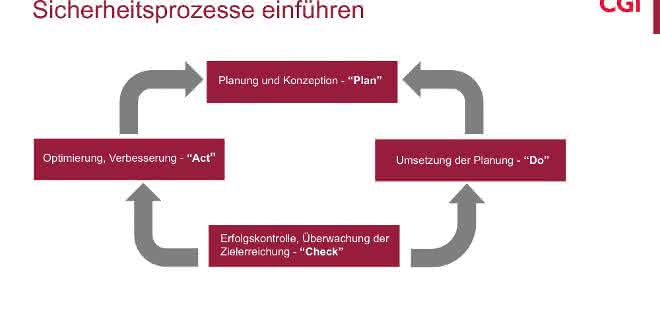
One point must not be ignored: Security is a process, which means that a continuous review of the measures taken in accordance with the PDCA cycle is also essential. This should take place at least once a year.
Andreas Kirsch, Director Consulting Services and Teamlead for IT Governance, Risk and Compliance at CGI in Cologne.


You might also be interested in
Protection against electrostatic discharge
StoFloor ESD KU 614 from StoCretec: dissipative flooring with the latest technology meets all ESD standards, is economical, extremely durable, mechanically and chemically resistant. The surface can be adjusted to be slip-resistant. The system is...
 read more...
Cables and wires from Helukabel
Food cultivation on a new level
Vertical farming - cultivation in multi-storey greenhouses - is considered one of the most exciting trends in food production. One of the pioneers in this field is the Romanian start-up Ultragreens. The company relies on solutions from Helukabel to...
read more...Further training for specialists to become security experts
With the "CESA - Certified Expert for Security in Automation" qualification, automation expert Pilz offers a two-day expert course designed to provide participants with compact security knowledge in line with the latest standards.
read more...Meaningful data on the service life of the seal
Seals prevent substances from penetrating or entering technical components. The intelligent seals from Freudenberg Sealing Technologies can significantly expand this core task in the future: the seal itself is also a sensor and becomes a "smart...
read more...Online stud configurator according to drawing
For standard bolts, with head, thread or hole
For standard bolts, with head, thread, bore or as a version with recess, mbo Osswald configurators map the standard specifications, are very easy to use, take a lot of work off the user's hands and save a lot of time.
read more...Safe palletizing with the Cobot
Verla-Pharm's medicinal products and food supplements have been available for decades. Ever-increasing throughputs result in ever-increasing logistics costs, whereby optimum utilization of the available production space is necessary.
read more...The tiger among processors
Since the move towards the Industrial Internet of Things (IIoT) and Industry 4.0 has picked up speed, processor boards and modules must be able to process exponentially growing amounts of data.
read more...VDWF publishes "Sustainability Compendium"
Nowadays, nobody can avoid "sustainability": In addition to a far-reaching presence in the media, it is also becoming increasingly important for companies in the tool and mold making industry to develop and implement appropriate concepts.
read more...More transparency and synergies with QM software
Weber, manufacturer of wood and metal sanding machines and extruders, has reorganized its quality management with ConSense IMS Professional. The software solution enables transparent documentation and more efficient processes.
read more...