
Cyberattacks
Significant rise in IT crime in 2021
The number of cyberattacks has risen rapidly in 2021. With the growing networking and integration of software, operational technology (OT) is also increasingly becoming the focus of attackers.
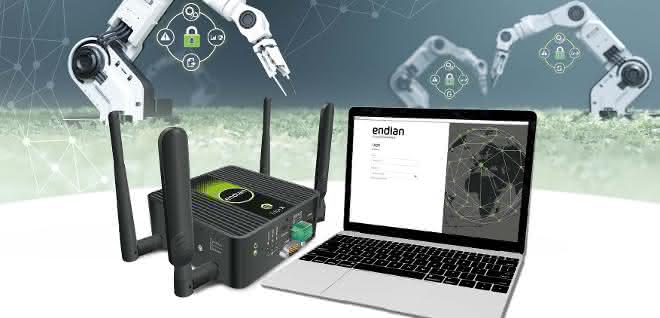
Endian, a leading security manufacturer in the field of Industry 4.0, recommends ten protective measures for OT in 2022.
"Security in OT presents completely different challenges to those in a classic IT environment," says Endian CEO Raphael Vallazza. "The service life of industrial systems in particular is very different from that of IT equipment. In IT, every system is considered obsolete after a maximum of five years and is replaced. In industry, machines and systems are in operation for much longer, which leads to very heterogeneous environments. This makes uniform updates for the operating system, firmware and anti-virus software, which is so heavily dependent on being up-to-date, much more difficult."
Networks in industrial companies that have grown over the years also pose a security risk: Malware can quickly spread across entire production facilities via the numerous networking points. The coronavirus pandemic has further exacerbated the situation. "The pandemic has further blurred the clear distinction between internal and external access," explains Vallazza. "External maintenance personnel needed stable remote access, as did employees who had to do their work from home."
Endian recommends that companies implement the following measures to ensure the security of their OT environments:
Visualize networks
The graphical representation of networks helps to make their increasing complexity manageable. Seeing the various components, sensors and connections in front of you makes it easier to understand communication within the company and beyond its boundaries. Irregularities in the processes can thus be identified more quickly. At the same time, visualization forms the basis for network segmentation.
Segment networks
Ransomware is still the biggest threat to companies in Germany. Attackers encrypt company data using malicious code in order to then extort a ransom. The malicious code often aims to spread as inconspicuously as possible in the networks in order to achieve maximum effect. Dividing the operating network into individual, separate segments is therefore a fundamental step in ensuring security in the OT area. IoT security gateways, which are connected in front of the individual segments, can be used to subdivide networks without requiring changes to the network structure.
Introducing the zero trust concept
The more digitalization progresses, the fewer clear boundaries corporate networks have: Suppliers and business partners need access to certain company resources for optimal planning and the pandemic has brought many employees into the home office. The zero trust concept is based on the assumption that no access - whether internal or external - is trustworthy. It no longer relies on locations, but on identities, authorization and secure authentication of users and machines for every access.
Manage authorization and authentication centrally
By setting up user accounts and credentials, it is possible to ensure that only authorized employees have access to machines and systems. To manage this, administrators need a central tool that allows them to set up, change or delete roles and authorizations in real time. The introduction of access rules can further increase security. For example, it is possible to specify that employees only have access to the networks from certain countries. Regions in which the company has neither branches nor customers can be excluded.
Two-factor authentication
Insecure passwords are also a high security risk in the OT environment. Companies should rely on two-factor authentication, especially in light of the continuing trend towards working from home. In addition to a password, users need another factor to log in to a machine or network. The so-called "possession factor" is often used, for example, where users are sent a unique password to their smartphone.
M2M communication with certificates
Machines are also increasingly communicating with each other. The same principle applies here as for human-machine communication: Appropriate authorization is required for access. Certificates give each device a unique identity so that it can identify itself to machines, systems and people.
Focus on edge computing
Before data is sent to a central cloud, it must undergo a preliminary evaluation where it is collected, i.e. in the respective machine or system. This procedure saves bandwidth and ensures that less data is exposed to the risk of theft or manipulation during transmission.
Encrypt communication
As soon as data is exchanged between the edge and the cloud, it is exposed to particular risks. A VPN establishes an encryption tunnel for each transmission and thus ensures that the data is unusable for anyone attempting to intercept or record the communication.
On Premises solution
Companies should retain their independence at all times and be able to decide for themselves where their sensitive data is managed. On-premises solutions offer maximum flexibility, as they can be used in the cloud, in your own data center or at your system house partner.
Sensitization of employees
Most malicious code enters the company via phishing emails. By feigning false facts or a false identity, the attackers try to persuade an employee to open an infected attachment or link. Regular training and testing can help to actively involve employees in cyber defense.


You might also be interested in
ESTIA aims to strengthen Europe's cloud
New tech alliance for EU sovereignty
Twelve companies, including Dassault Systèmes, are founding the European Sovereign Tech Industry Alliance (ESTIA). The initiative aims to strengthen Europe's technological independence and define requirements for sovereign cloud services. The start...
 read more...
Deutsche Telekom and Nvidia launch one of Europe's largest AI factories
With the Industrial AI Cloud in Munich, Deutsche Telekom and NVIDIA are creating one of the largest AI factories in Europe. Companies can train AI models, carry out simulations and access 10,000 GPUs.
read more...Leveraging data potential with AI and streaming
Huge data treasures are still lying dormant in many manufacturing companies. And yet it is high time that these treasures were unlocked. There is often a lack of resources and capacity to make data usable in real time. Streaming production data can...
read more...More awareness of noise
Dematic offers solutions that are tailored to different cloud environments and reduce environmental impact through reduced material consumption and improved energy efficiency.
read more...Generative AI in the automation environment
The mechanical engineering and automation industry is undergoing profound change. This transformation is being driven by more volatile global trade, geopolitical crises and increasing market pressure, which demands greater agility, technological...
read more...Rigid data structures have had their day
The traditional data center is no longer the center of data. A hybrid cloud storage approach enables manufacturing companies to both meet the current requirements of data-intensive processes and future-proof their infrastructure.
read more...Software as a service in three stages
CIM Database Cloud is a new out-of-the-box solution from Contact for end-to-end digital product development.
read more...How production can benefit from AI
Together with AI technology, IIoT networking makes it possible to better control machine parameters and optimize quality with predictive quality. Downtimes and set-up times can also be further minimized. Cloud platforms also make these technologies...
read more...More expertise for digital engineering
Altair, a computational science and artificial intelligence (AI) company, has acquired OmniV, a technology from Michigan, USA-based software company XLDyn.
read more...