

IT security
Security architecture from a single source
Companies and authorities are confronted with increasing security requirements. The market for security solutions and products is becoming increasingly confusing and users are spoiled for choice.

There is therefore much to be said for the use of vendor-neutral services from a single source, which organizations can use to overcome the complex challenges specific to their requirements.
The security of information technology systems in public authorities and companies involves a high degree of complexity. The threat level is not decreasing, but is actually increasing continuously. The German Federal Office for Information Security (BSI) recently emphasized that "the coronavirus-induced surge in digitalization has increased the potential attack surface and thus the risk of successful cyber attacks".
Increasing security requirements ideally demand centralized management of clients, email transport services, mobile devices and data management based on uniform standards, especially in view of the stricter requirements in the areas of regulation and compliance. All organizations are faced with the same questions: How do you comply with the multitude of regulations and how do you manage the high technical effort involved in operating IT systems? Almost all IT managers, from IT department heads and administrators to CIOs and CISOs, face a similar challenge.
Isolated solutions or integrated security architecture
Although there are a number of solutions on the market that cover individual security areas, there are hardly any services that offer the necessary expertise and solution portfolio from a single source. Before an organization implements several individual solutions, it should consider using an end-to-end, holistic offering that covers the entire spectrum of IT security requirements. This avoids the introduction of isolated solutions, which increase administration costs and may also be problematic from a security and performance perspective.
The services offered by an external service provider in the field of IT security should range from consulting to solution selection and implementation through to operation. It is essential for the client that the service provider and its employees have the appropriate qualifications, certifications and references.
According to the IT baseline protection principle, every ISMS first requires the definition of protection objectives. At this stage, it makes sense to work with an external service provider who has a stable ISMS in place at the company for many years. This allows the user to be supported in the initial steps of definition.
Based on the protection goals, the service provider can make recommendations on architecture and tools and design a concrete implementation scenario with the selection of products and solutions. Ideally, the service provider pursues a vendor-independent best-of-breed approach using the perfect and technologically leading solutions for the respective application.
Cornerstone of a comprehensive service offering
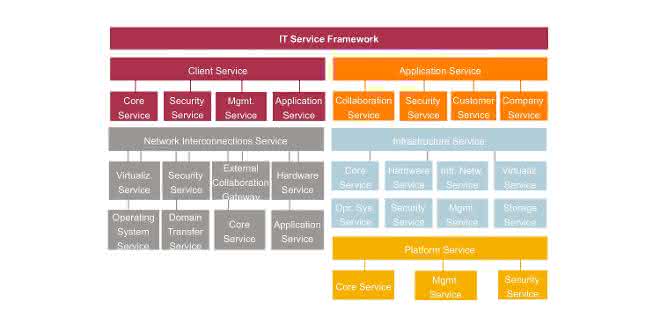
Service offerings have proven themselves in practice. This also applies to IT security. A service offering should have a high degree of flexibility, modularity and scalability and thus cover the different and increasing requirements of authorities and companies of all sizes. Flexibility and modularity mean that the provider is only used by the client, for example, for consulting services, for the creation of documentation or for the provision of individual service applications such as software packaging, backup or SharePoint. A common scenario for many companies is that the end devices meet the security requirements, but not the backend. The provider must be able to react flexibly to this initial situation with an integrated security concept. The same applies if a company does not want to use a solution designed for maximum security for all employees, but only for a dedicated group of people.
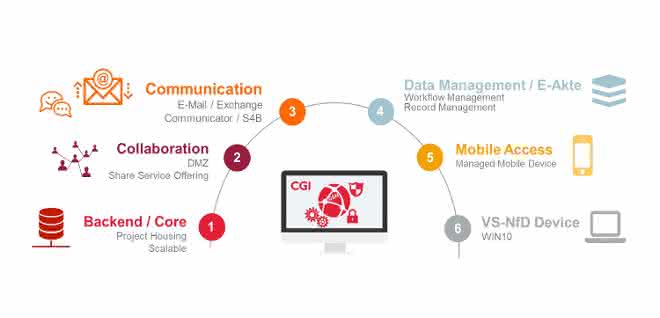
Practical experience shows that important cornerstones of the service offering are the areas of backend, collaboration, communication, data management, mobile access and end devices. Specifically, the IT solutions must include managed network services such as DMZ network management, core services such as system management and directory services, application services such as Windows application management, anti-virus and collaboration as well as end-user services such as client patch management and client software packaging. In terms of security services, SIEM, SOC and CERT services in particular should be part of the service provider's offering.
When deciding on a service provider, authorities or companies are faced with the challenge that the use of state-of-the-art technologies alone cannot guarantee IT security. It is equally important that the service offering provides a high level of security that is proven by compliance with strict regulations. These include the BSI standards 200-1, 200-2 and 200-3 as well as 100-4 and the BSI-Isi series. The provider must also be able to use products and solutions for authorities, public bodies and non-public bodies such as the classified industry that are certified by the BSI and explicitly approved for use up to the classification level VS-NfD (classified information - for official use only). ITIL-compliant documentation of the services ensures that methodical and substantive good practices are reused. This forms the basis for the sustainability of the solutions created.
An essential criterion for a comprehensive range of IT security services is the requirement-specific support of different operating models, from on-premises use with self-service management to managed services and full outsourcing including field service. In view of the basic requirements of public authorities and many companies, it is important that the provider of managed services or full outsourcing models guarantees that data storage and administration take place exclusively in Germany and that the service provider demonstrably has no access to the public authorities' or companies' IT security data at any time.
There is no doubt that the challenges in terms of IT security will continue to increase. Instead of using silo solutions to patch up existing potential threats and replace them with foreseeable new vulnerabilities, public authorities and companies should examine whether the use of an integrated service offering that covers customer-specific requirements in all security areas in a modular and scalable manner is not the better approach. Experience shows that this approach reduces costs while guaranteeing the required level of IT security, increases future-proofing and thus protects existing investments and maximizes the cost-effectiveness of new procurements.
Jürgen Nolte, Director Consulting Services at CGI Germany


You might also be interested in
"We are clearly different from the competition"
The IT company 21unity offers a range of hardware and software services, as well as traditional services. Andreas Mühlbauer spoke to Managing Director Anja I. Gondolf about the company's appearance at the Hannover Messe, its services and future...
 read more...
Think digital, act local
When it comes to industrial damping technology, on-site advice is often very valuable for engineers and designers.
read more...Plagiarius 2024 negative prize
On January 26, 2024, the Plagiarius campaign awarded its dreaded "Plagiarius" negative prize for the 48th time to manufacturers and retailers of particularly brazen counterfeits and fakes.
read more...Spindel Full Service records second-best...
Maintenance as an economic success factor
Spindel Full Service, the spindle repair specialist from Baden-Württemberg, can look back on its second-best financial year in its history - with 15% growth compared to the previous year. And the further forecast also looks good.
read more...Thyssenkrupp and Novelis cooperate
Platform for the circular economy
With a platform for the circular economy in the automotive industry, the two companies Thyssenkrupp Materials Services and Novelis want to set new standards for the recycling of used materials. The open platform will enable access to larger...
read more...How production can benefit from AI
Together with AI technology, IIoT networking makes it possible to better control machine parameters and optimize quality with predictive quality. Downtimes and set-up times can also be further minimized. Cloud platforms also make these technologies...
read more...Marco Ghirardello takes the lead
Fanuc has appointed Marco Ghirardello (48) as the new President and CEO of Fanuc Europe. Ghirardello succeeds Shinichi Tanzawa, who has led the company since 2016 and will take on a new role at Fanuc's headquarters in Japan.
read more...Efficient robot monitoring
Microchips are installed almost everywhere - whether in smartphones, washing machines or cars. With increasing digitalization, the demand for semiconductors has been growing rapidly in all areas of the economy for years.
read more...Everything on one platform
Functional and powerful tools are essential for professional work on the construction site, in the workshop or when carrying out repairs.
read more...