
Protection through zero-trust segmentation
Strengthening cyber resilience in Industry 4.0 environments
The development of Industry 4.0 has led to increased automation and networking of manufacturing systems, which brings significant benefits for the efficiency and flexibility of production processes. However, this increasing connectivity also increases the risks in the area of cyber security.

For security experts, the focus should therefore no longer be on preventing attacks altogether, but rather on ensuring that production operations can continue uninterrupted even in the event of an attack. Zero Trust Segmentation (ZTS), a fundamental part of any Zero Trust security strategy, provides robust protection against cyberattacks, enabling companies to quickly contain security incidents and significantly increase their cyber resilience.
Industry 4.0 as a challenge for cyber security
While the linking of IT and OT (Operational Technology) in Industry 4.0 environments opens up new opportunities to increase efficiency in production, it also creates additional vulnerabilities. These are increasingly being exploited by cyber criminals to carry out ransomware attacks, data theft and supply chain compromises, all of which can have a devastating impact on the production and supply capacities of affected companies. According to the VDMA study "Industrial Security and Product Piracy 2024", around a quarter of the member companies surveyed have been affected by a serious cyber security incident in the last two years.
Cyberattacks such as ransomware can paralyze manufacturing systems, disrupt production lines, disrupt supply chains and cause significant operational downtime. These disruptions can lead to delayed order fulfillment, lost production and significant financial losses, including the cost of repairing and restoring systems. There is also a risk of confidential information, such as intellectual property or customer data, being stolen, which can lead to legal consequences and significant reputational damage. Attackers are also increasingly using manufacturers as access points to wider supply chains to access supplier, partner and customer systems. This can put a strain on business relationships and result in the loss of partnerships and collaborations.
In February 2024, for example, there was a serious cyber attack on battery manufacturer Varta. The incident forced the company to shut down production at its main sites in Germany, Romania and Indonesia - affecting around 4,200 employees. Even more than ten days after the incident, operations were only possible in limited areas where systems could function without network access. The full impact of the attack remained unclear for a long time, but the disruption resulted in significant production downtime, delivery delays and very likely significant financial losses, both from the halt in production and the expense of system repairs and IT security restoration. This incident illustrates the far-reaching consequences of cyberattacks - not only in terms of immediate production losses, but also in terms of a company's long-term stability and reputation.
In the face of these increasingly professional and frequent cyber attacks, manufacturing companies are under ever more acute pressure to improve their cyber security strategies and effectively protect critical systems and sensitive data. The increasing convergence of IT and OT systems and the transition to the Industrial Internet of Things (IIoT) are particularly problematic. In these highly networked environments, conventional security solutions such as firewalls and traditional network-centric approaches such as the Purdue model are reaching their limits. As devices become more intelligent and functions merge onto individual hardware platforms, the potential attack vectors also multiply significantly. Lateral movements in the network are becoming easier, which massively increases the risk for manufacturers. To successfully withstand modern, complex attacks, companies urgently need to rethink their security approaches. Attacks are now unavoidable, so the focus must be on minimizing the impact. In particular, this requires effective incident containment measures to minimize the impact of cyberattacks and protect business operations.
Strengthening cyber resilience with Zero Trust
A proven and effective strategy for strengthening cyber resilience and mitigating security incidents is Zero Trust. Based on the principle of "trust no one, verify everything", Zero Trust assumes that no user or system is inherently trustworthy, even within the corporate network. Every access must be verified and authenticated, regardless of the location or identity of the user.
In correctly designed zero-trust environments, virtually no successful cyberattacks can take place. This is achieved through a combination of zero trust segmentation, continuous monitoring and the "least privilege" principle.
A zero-trust architecture significantly increases cyber resilience, but requires a systematic approach. Manufacturers should consider the following steps to ensure a successful implementation:
- Identification of critical systems: The first step is to identify all IT and OT systems in the network that are essential for maintaining production, i.e. minimum operations, and map out their interdependencies.
- Creation of security policies: Once the critical systems and their communication paths have been identified, granular policies based on the "least privilege" principle must be created that limit access to critical resources to the minimum required.
- Segmentation of the network: The network should be divided into smaller segments to limit the attackers' freedom of movement and to ensure that an attack on one segment does not jeopardize the entire network.
- Continuous monitoring: Monitoring network traffic is critical for early detection of potential threats. Manufacturers should ensure that they have the necessary tools to detect anomalies in network traffic and respond quickly.
- Automated response to attacks: In the event of an attack, companies should be able to take immediate action to minimize the damage. Automated security solutions can help to quickly contain attacks and restore systems.
The cornerstone of Zero Trust
At the heart of Zero Trust is Zero Trust Segmentation, a technology that is critical to security incident containment. With ZTS, manufacturers can divide their network into highly granular, controlled segments between which data flow is strictly monitored and access is limited to what is absolutely necessary. This offers manufacturers numerous benefits, including
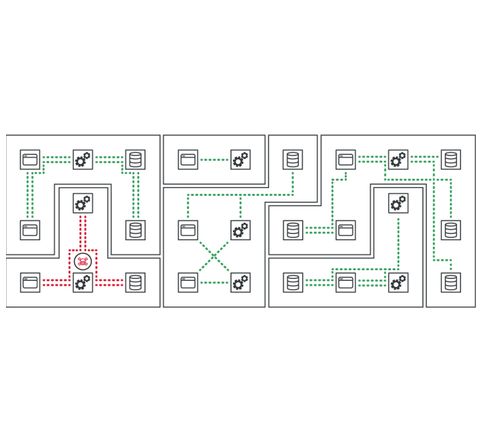
- Increased operational resilience: By segmenting networks into smaller, manageable areas and implementing strict access controls, it is more difficult for attackers to move laterally within the network. This considerably restricts the damage radius in the event of an attack and significantly reduces the impact of attacks. Even if attackers compromise part of the network, they cannot access the rest of the network, ensuring business continuity.
- Protection of industrial control systems (ICS) and operational technology (OT): Industrial control systems and OT are particularly vulnerable to attack as they often do not meet the same security standards as IT systems. ZTS makes it possible to effectively protect these systems by controlling the data traffic between them and only allowing authorized connections. This allows potential threats to be isolated before they can affect production.
- Visibility and control: A key benefit of ZTS is the real-time visualization of network traffic. Visibility makes it possible to quickly identify suspicious activity and respond immediately. Security policies can be dynamically adjusted based on these findings, minimizing response time to threats.
- Compliance with legal requirements: Manufacturers operating in highly regulated industries such as automotive or pharmaceuticals must adhere to strict security requirements. Zero Trust segmentation can help companies ensure compliance with these regulations and safeguard the integrity of their data and systems.
- Scalability and flexibility: As production processes and technologies are constantly evolving, zero trust segmentation offers a flexible and scalable solution that can be adapted to changing security requirements.
Cyber resilience as a competitive advantage
As the manufacturing industry continues to adopt automation, networking and intelligent systems as part of Industry 4.0, it remains a prime target for cyberattacks. Traditional, network-based security approaches are no longer sufficient to prevent the spread of an attack. Instead, manufacturers must adopt a zero-trust approach that focuses on protecting critical systems and containing breaches when they occur.
By using technologies such as zero-trust segmentation, manufacturers can better protect their critical systems and data, meet regulatory requirements and strengthen their operational resilience against sophisticated cyberattacks.
At a time when cyberattacks are becoming more professional and more frequent, switching to a zero-trust architecture is no longer an option, but a necessity for manufacturers who want to future-proof their Industry 4.0 environments and prepare for the coming technological change.
Alex Goller, Cloud Solutions Architect EMEA at Illumio


You might also be interested in
European companies prioritize security over growth
With the integration of artificial intelligence (AI) into business-critical processes, European companies are shifting their priorities. Instead of pure innovation projects, the focus is increasingly on security, governance and scalability.
 read more...
NIS2 meets store floor
The NIS2 directive significantly increases the requirements for OT security. This article shows how companies can combine structure, verifiability and practical relevance with IEC 62443-2-1 - from governance to auditability on the store floor.
read more...From risk to resilience
NIS2 significantly increases the requirements for industrial security concepts. In addition to cyber resilience, physical access protection is becoming increasingly important.
read more...Security Operations Center module
When cyber attacks reach production
Adlon is further developing its Security Operations Center and adding another module to the existing Managed SOC for Microsoft 365 environments (based on Managed XDR): Managed SOC Advanced.
read more...Kisters at the Hannover Messe 2026
Protection of 3D CAD data in product development
The protection of design data is becoming increasingly important in cross-company exchange. Today, modern software solutions offer a wide range of technologies to effectively protect 3D CAD data from unauthorized access and reverse engineering.
read more...Cyber threats: Four key trends 2026
Autonomous AI agents, industrialized cybercrime and attacks on critical infrastructures are rapidly changing the threat situation. Why cybersecurity will only work at machine speed in 2026.
read more...Demir Imeroski takes over management of the Hamburg branch
With effect from September 1, 2026, Demir Imeroski will take over the management of the Hamburg branch of Assa Abloy Sicherheitstechnik in addition to his role as Head of Client Operations. He succeeds Klaus Germer, who is taking his well-deserved...
read more...Criminals use AI systematically
Trend Micro warns in a new study of the increasing professionalization of AI-supported cybercrime. Deepfakes, fraud and malware are gaining in importance.
read more...Lifecycle management and safe IO-Link communication
At SPS, Pilz will be presenting solutions that combine safety and security in production. The focus is on the digital Myzel Lifecycle Platform, a SaaS offering for the management of machinery and personnel over the entire lifecycle.
read more...