
Correct implementation of the Ordinance on Industrial Safety and Health
Protection goal safe workplace
Modern occupational health and safety is not just about accident prevention, but also about avoiding health hazards and ensuring well-being in the workplace. The obligations for operators of machines and systems with regard to machine safety are regulated in the Ordinance on Industrial Safety and Health.
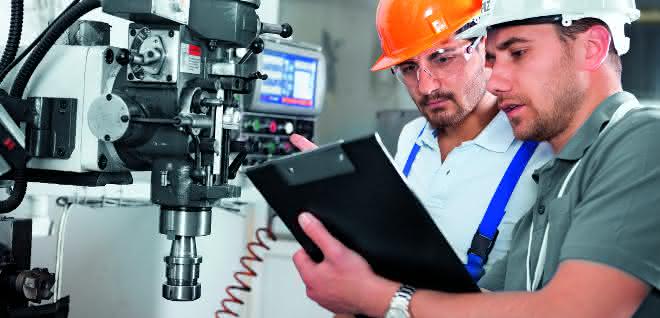
Employers in all EU countries are obliged to only provide employees with safe work equipment. To this end, hazards must be assessed, equipment inspected, inspection intervals determined, inspection results documented and employees trained. As a corresponding regulation, the Use of Work Equipment Directive 2009/104/EC is aimed at users of machinery and equipment. In short, it deals with (machine) safety in the workplace. The Use of Work Equipment Directive makes employers responsible for the safety of their business. This increases entrepreneurial freedom, but also obliges them to implement the legislation in practice.
In Germany, the Work Equipment Directive is implemented by the Ordinance on Industrial Safety and Health (BetrSichV). It regulates the provision of work equipment by the employer, the use of work equipment by employees during their work and the operation of systems requiring monitoring in terms of occupational health and safety. It concerns both equipment safety and ergonomics as well as hygiene in the workplace. The references contained therein to the technical rules for operational safety are applicable to all hazards that may arise when using work equipment. Hazards that may arise from the work equipment itself, the working environment or the work objects on which activities are carried out with work equipment must be taken into account.
Risk assessment as a central tool
Occupational health and safety requirements are formulated as protection goals and apply to all work equipment. The risk assessment plays a central role in this. It requires the employer to "determine the necessary measures for the safe provision and use of work equipment". The risk assessment should be started as early as the procurement of work equipment and is mandatory before the start of any maintenance work as well as for modifications and conversions. The employer is obliged to ensure that this requirement is met both when the respective work equipment is used for the first time and subsequently on a regular basis through inspections. Necessary protective measures must be evaluated in the risk assessment in accordance with the "state of the art" of the machines in the field. Based on the risk assessment, the employer determines the type, scope and inspection intervals of the required work equipment inspections, taking into account the legal requirements. The entire risk assessment must be documented in writing and kept up to date.
In addition, the employer must specify the type and scope of the required tests of the protective equipment for their work equipment. Employers can find assistance in the Technical Rule for Operational Safety (TRBS) 1201, which lists proven inspection intervals for recurring inspections.
Through the process of risk assessment and documentation, accidents can be prevented, work-related illnesses avoided and costs saved. In many cases, insurance premiums can also be reduced.
Companies must use so-called competent persons to prepare the necessary technical documentation and carry out safety inspections in accordance with BetrSichV. The requirements that a "qualified person" must meet are specified in the Technical Rules for Industrial Safety (TRBS) 1203. In principle, they must have vocational training, a certain amount of professional experience, recent professional activity and regular further training in the area to be tested. An employer is free to decide which employee to appoint as a "qualified person". They must satisfy themselves of the employee's competence and be able to prove this in the event of a legal dispute. The written appointment of a qualified person is mandatory.
Alternatively, a company can also outsource this obligation to an external body. In this case, the client is obliged to check the competence of the company carrying out the work. Accredited bodies prove to be particularly helpful here, as accreditation provides a legally binding statement of competence from such bodies. This satisfies the obligation to provide evidence.
Making common cause with the service provider
Pilz in Ostfildern, for example, maintains an independent inspection body, accredited by the German Accreditation Body (DAkkS), which carries out the inspection of protective equipment on behalf of companies as a "competent person", as required by the BetrSichV. Pilz's services range from the safety assessment of work equipment, i.e. plant and machinery, as part of the risk assessment in accordance with BetrSichV, and the determination of the scope and deadlines for testing work equipment, to the development of specific solutions for risk minimization and the legally compliant preparation of technical documentation for authorities.
Together with the companies, the Pilz experts develop proposed solutions for the implementation of specific protective measures identified in the risk assessment. The Pilz experts show how hazards can be reduced, thus lowering the operator's liability and operating costs. Pilz prepares the risk assessment for machinery or plant, which is of considerable importance in the event of an accident at work and can serve as proof to the authorities. Pilz can also offer testing of protective equipment within the EU and worldwide. C. Bittner/as


You might also be interested in
Conrad continues to grow
Conrad Electronic now generates 80% of its sales with business customers and has successfully developed from a traditional technology retailer into a B2B procurement platform. The company aims to become Europe's leading procurement platform for...
 read more...
AI finds its way into automotive customer service
In addition to computer solutions for vehicle diagnostics, Getac now also offers AI-based digital tools that support customer contact in service operations.
read more...SMC: "Preferred Supplier" from Bosch
The technology and service company Bosch has recognized SMC for the performance of its automation technology in factory and process automation and awarded it the status of "Preferred Supplier" in the material group "Standardized Pneumatic Devices".
read more...Combined ERP forces
The medium-sized ERP providers Step Ahead Software, Godesys and Informing merge to form the Step Ahead Group.
read more...Cybersecurity for asset-intensive companies
Forge Cybersecurity Platform, the new software platform from Honeywell, has been developed for the cybersecurity of asset-intensive companies and critical infrastructures. The platform is available in three versions.
read more...Automated machine tool as a success factor
Industry 4.0 is the hot topic of the moment. For small and medium-sized companies and contract manufacturers, it holds great potential for increasing production efficiency step by step. The focus here is on efficient and user-specific automation...
read more...Nemo hand vacuum lifts all materials
A new addition to the Eurotech portfolio is the battery-operated Nemo vacuum cleaner, which is suitable for handling almost all surfaces.
read more...Future-oriented cobot projects
Three pillars of successful cobot initiatives
What is important if cobot projects are to be future-oriented? Automation and robotics expert Omron has identified three aspects for human-machine collaboration.
read more...Short-stroke linear actuator instead of pneumatic cylinders
The new short-stroke linear actuator from Ketterer Antriebe and halstrup-walcher is characterized by high dynamics and a large stroke in a compact size. Thanks to the integrated electronics, the drive is easy to control compared to pneumatic...
read more...