
Safety modules
Minimal downtimes in the event of a fault
Baumüller has integrated an individually and safely parameterizable delay time into its new safety modules - for increased machine availability.
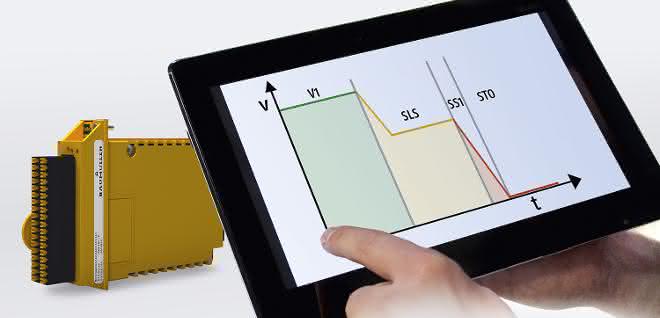
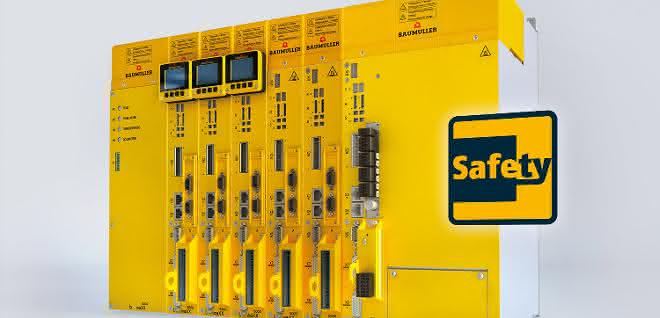
Baumüller has added a freely parameterizable delay time to its new SAF 002/003 safety modules in the b maXX 5000 inverter series. The delay time is switched between a safety function and the associated Safe-Torque-Off (STO) error response. In this way, the machine mechanics are optimally protected against damage in the event of a fault and downtimes are minimized.
Typically, the safety modules are equipped with various safety functions that are used for safe monitoring when required. If, for example, a limit value violation is detected during the safe monitoring of a speed, the system reacts by triggering the STO function, which switches the drive torque-free. However, in this case, the motor may not come to a controlled standstill, i.e. it may coast to a halt.
Avoiding danger and increasing productivity
Baumüller has now developed an innovation for the SAF 002/003 safety modules: The parameterizable delay time is an individually programmable time window, depending on the safety function, which is switched between the safety functions and the STO function.
If, for example, the pre-parameterized speed is exceeded during active Safe Limited Speed (SLS) monitoring, the delay time is started. At the same time, the safety module sends a signal to the inverter so that it performs a specific action. This action can be parameterized in advance; for example, the inverter brakes the drive in a controlled manner within the set time. Only when the machine has come to a standstill is the drive safely switched to torque-free.
Embroidery machine use case
A typical area of application for this function is the textile industry, for example. If a machine operator moves within the danger zone of a machine, the machine can automatically start safe monitoring and reduce the speed (SLS). If the active SLS speed monitoring detects that the set speed limit has been exceeded, the safety module automatically switches on the previously parameterized delay time before triggering the STO function. The controller receives the signal to remove the needle from the fabric within this time before STO is executed and the drive is switched torque-free. This functionality can prevent needle breakage or an error in the embroidery pattern, for example, and production can be resumed quickly. as


You might also be interested in
From risk to resilience
NIS2 significantly increases the requirements for industrial security concepts. In addition to cyber resilience, physical access protection is becoming increasingly important.
 read more...
Security Operations Center module
When cyber attacks reach production
Adlon is further developing its Security Operations Center and adding another module to the existing Managed SOC for Microsoft 365 environments (based on Managed XDR): Managed SOC Advanced.
read more...Lifecycle management and safe IO-Link communication
At SPS, Pilz will be presenting solutions that combine safety and security in production. The focus is on the digital Myzel Lifecycle Platform, a SaaS offering for the management of machinery and personnel over the entire lifecycle.
read more...The basics of warehouse safety
Safety in the warehouse primarily relates to the employees. However, goods must also be transported safely and transport equipment must not be damaged.
read more...Environmental containers and fire protection
Companies can choose from a wide range of environmental containers for storing chemicals and other hazardous substances.
read more...Secure focus on access
To ensure comprehensive safety, holistic safety concepts for safety and industrial security on machines are required. Authorizations and access must be clearly regulated.
read more...Added value through safety and productivity
Machine malfunctions can have serious consequences and put people's health at risk. Functional safety therefore plays a central role in industry. With control and inverter technology including integrated safety functions from ABB, plant operators...
read more...Protect Ethernet interfaces
Pilz is expanding its portfolio of operating and signaling devices with the control element PIT oe ETH. It is equipped with an Ethernet port that can be activated and protects freely accessible Ethernet interfaces in industry against unauthorized...
read more...Protective tool in everyday life
Cybershield is a company founded in 2021 with a focus on operational technologies and has set itself the goal of significantly advancing IT security in the OT sector and supporting customers.
read more...