
Cybersecurity
VDE: Industry must better protect networked production
In Industry 4.0, networked sensors, actuators, machines and systems create new targets for cyber criminals.
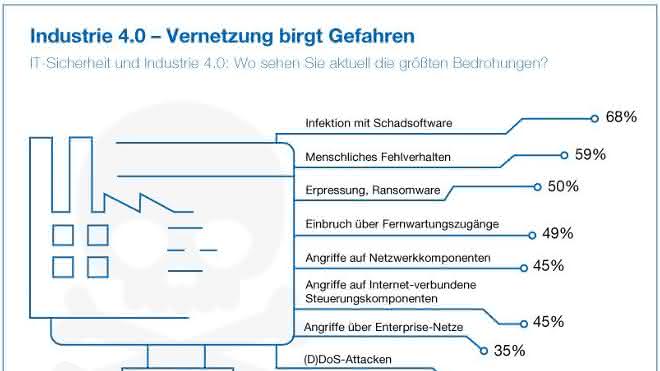
The greatest dangers are infections with malware, blackmail using Trojans or ransomware, intrusions via remote maintenance access and, last but not least, human error.
This is one of the findings of the VDE Tec Report 2018, a survey conducted by the technology association VDE among its 1,350 member companies and universities in the electrical engineering and information technology sector. "Production companies need state-of-the-art, highly flexible IT security measures in order to fully exploit the benefits of Industry 4.0, such as efficiency gains, more flexible production or localized production on demand," said VDE CEO Ansgar Hinz at the Hannover Messe. In the survey, 68 percent of respondents stated that infection with malware is the greatest threat to Industry 4.0. Malware gives criminal hackers the opportunity to steal individual IP, i.e. sensitive product and production data, undetected, sabotage production or blackmail the company. Every second company says that blackmail using Trojans or ransomware in particular is a threat.
Remote maintenance and network components harbor dangers
Almost half of companies and universities (49%) consider "intrusions" via remote maintenance access to be a serious threat. Remote maintenance (remote monitoring & predictive maintenance) is one of the most important service offerings based on globally networked equipment and systems. However, other interfaces to the internet also pose a threat to industry. 45% of respondents see attacks on inadequately protected network components as a threat and 45% also fear attacks on control components that are connected to the internet. "Networked production facilities must be secured with technical, organizational and personnel protection measures, i.e. systemic IT security," emphasized Hinz. Around one in three companies fear attacks via the company network and one in four fear unauthorized access to IT resources, DDoS attacks or targeted sabotage. Last but not least, people in the system are a significant risk factor: 59% consider human error to be a threat to IT security.
Security deficits open the door to criminal hackers
According to the results of the survey, four out of ten companies and universities have already been affected by cyber attacks. Another four out of ten respondents do not know whether they have been attacked. "The VDE assumes that the number of companies and universities affected is very high," said Hinz. The companies and universities surveyed cited security deficits in their own organization as the reason for successful cyber attacks. 75 percent say that employees lack awareness of the risk of cyber attacks. This is also due to a lack of education on the part of employers: 30 percent state that employees do not receive sufficient and systematic training on IT security issues. However, technical and organizational reasons also play a role. A good one in two people criticize the fact that IT attacks are noticed too late or not at all. And 45 percent say that IT systems are not adequately protected and cannot withstand attacks. "If cyber attacks are not detected quickly, cyber criminals have an easy time gaining a foothold in companies' IT systems, siphoning off data or manipulating it," explained Hinz. According to the survey, one fundamental problem is that organizations still see cyber security as a cost driver rather than a necessity. Almost one in three respondents agreed with this statement. "Systemic cyber security must be an integral part of every company's management task," added Hinz.
Clear majority want to increase investment in cyber security
In the survey, 61% of companies and universities stated that they want to increase their investment in defending against cyber attacks. However, many organizations are apparently reaching their limits in view of the increasing complexity of the issue: 79% of respondents are convinced that many companies are overstretched financially and in terms of personnel due to the growing demands on IT security.


You might also be interested in
Plagiarius 2024 negative prize
On January 26, 2024, the Plagiarius campaign awarded its dreaded "Plagiarius" negative prize for the 48th time to manufacturers and retailers of particularly brazen counterfeits and fakes.
 read more...
Ivalua honors winners of the Generative AI...
AI-supported "add-ons" for buyers within 48 hours
Ivalua, provider of cloud-based spend management solutions, announced the winners and innovations of the first Generative AI Innovation Cup. The competition took place in December 2023. It was open to all Ivalua partners and employees - more than...
read more...Efaflex celebrates 50 years of high-speed...
The emphasis is on "fast"
Since day one, Efaflex has wanted to use new technologies as early as possible and drive progress in the industry. This year, the family business is celebrating its 50th anniversary under the motto "Fast Forward".
read more...Security of supply even during power outages
In the winter of 2022, Germany was worried about energy shortages. The drugstore retailer dm did not paint any horror scenarios, but nevertheless saw the possibility of controlled, temporary, regional power cuts (brownouts).
read more...Safety technology in mechanical engineering
Modules with new functions
Euchner's product highlights at EMO 2023 include the communication-capable solenoid interlocks.
read more...Transforming the paper industry towards climate neutrality
Together with partners from industry and research, Voith is developing a project for the optimization of energy and material flows in paper production. The aim of the research project is to develop a digital framework that enables effective process...
read more...Up to 95 percent less flue gas thanks to direct extraction
The requirements for occupational safety measures and safety technology are also constantly increasing in welding technology. The Technical Rules for Hazardous Substances (TRGS) stipulate that welding fumes and harmful substances must be extracted...
read more...Competitive advantages with large machines
Whether 3D-printed components for machines and systems, prototypes or aids for design: additive manufacturing is almost indispensable for modern companies in mechanical and plant engineering and automation if they want to play in the premier league.
read more...Transport technology from the modular system
Many transport tasks can be realized with the help of linear technology. Pre-configured solutions are available to simplify the interaction between the linear unit, motor, gearbox and controller. This minimizes the effort required for research and...
read more...