

System development and commissioning
Virtual commissioning with the DT
A structural model of the digital twin and end-to-end data management enable faster and more efficient system development and commissioning.
The discussion about the term "digital twin" (DT) and the associated concepts has expanded. In relation to industrial production, the DT refers to a holistic, networked virtual representation of a physical entity. The spectrum of these entities ranges from individual products and specific manufacturing processes to complex automated production systems. A common metamodel, the Digital Twin Structure Model (DTSM), which integrates and classifies the various aspects, was developed at the FAPS chair. This structural model of DT in the context of manufacturing provides an overview and explanation of the dimensions, functionality and coupling of DT in relation to its environment. The DTSM is visualized by a three-dimensional solution space (Figure 2).
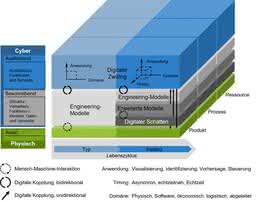
The descriptive submodels of the DTSM include engineering models, extended models (data-driven black box models) and the digital shadow (real data of the physical asset). Within the DTSM, the DT manifests itself as a set of executable digital applications and functions that use engineering and extended models together with the digital shadow to visualize, identify, predict or control states of a physical asset to generate additional value. It resides in the executive execution layer and spans the entire lifecycle, products, processes and resources.
An important aspect for the successful use of DT is continuous data management to ensure that the most up-to-date data is always available. This challenge can only be met by using product data management (PDM) and product lifecycle management (PLM) software. The need for these software solutions arose due to the increasing use of computer-aided product development and the growing complexity of the process. Companies were faced with the challenge of managing digital data and analog documents in parallel. In addition, products became more complex, so that documents from other disciplines were added and the heterogeneity of the data increased.
Many of the possibilities that serve to increase efficiency within the product creation process are implemented in the digital factory (DF). VDI guideline 4499 provides a definition of DF: "The digital factory is the generic term for a comprehensive network of digital models, methods and tools [...] that are integrated through end-to-end data management." The aim is the holistic planning, evaluation and continuous improvement of all essential structures, processes and resources of the real factory in connection with the product. The spectrum ranges from a pure data model and planning tools to a simulation model and virtual commissioning.
Simulation models are already used in the planning phase to optimize systems. Many different models are often created to check and optimize individual aspects of the system. For example, individual components are evaluated in the FEM analysis, checked for durability and optimized if necessary. Other functionalities are checked at module level or in the overall model. One example of this is the material flow simulation, which can focus either on individual modules or on their interaction in the system. When combining different simulations, a distributed simulation environment is required as a basis.
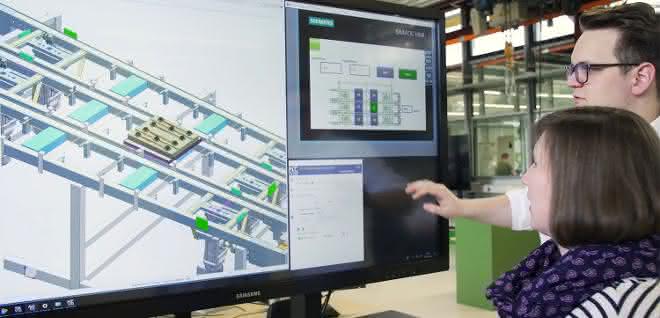
If the software to be used is also to be checked and, if necessary, adapted and optimized within the simulations, this is referred to as virtual commissioning. Based on the simulation models, it is possible to test the software - within the simulation models, with a simulated control system (Fig. 1) or with the hardware that is also to be used on the system during operation. By linking software, mechanics and electrics at an early stage, the commissioning of the system is shortened and carried out more cost-effectively and with better quality. According to the definition described above, the DT of production plants can therefore be used up to the commissioning of the plant and beyond. The standard digitalization tools play an important role in this. If these are used in a holistic approach, plant development will be better, faster and more efficient in the future.
Florian Faltus, Eva Russwurm, Matthias Brossog, FAPS


You might also be interested in
Plagiarius 2024 negative prize
On January 26, 2024, the Plagiarius campaign awarded its dreaded "Plagiarius" negative prize for the 48th time to manufacturers and retailers of particularly brazen counterfeits and fakes.
 read more...
Ivalua honors winners of the Generative AI...
AI-supported "add-ons" for buyers within 48 hours
Ivalua, provider of cloud-based spend management solutions, announced the winners and innovations of the first Generative AI Innovation Cup. The competition took place in December 2023. It was open to all Ivalua partners and employees - more than...
read more...Efaflex celebrates 50 years of high-speed...
The emphasis is on "fast"
Since day one, Efaflex has wanted to use new technologies as early as possible and drive progress in the industry. This year, the family business is celebrating its 50th anniversary under the motto "Fast Forward".
read more...Security of supply even during power outages
In the winter of 2022, Germany was worried about energy shortages. The drugstore retailer dm did not paint any horror scenarios, but nevertheless saw the possibility of controlled, temporary, regional power cuts (brownouts).
read more...Safety technology in mechanical engineering
Modules with new functions
Euchner's product highlights at EMO 2023 include the communication-capable solenoid interlocks.
read more...Transforming the paper industry towards climate neutrality
Together with partners from industry and research, Voith is developing a project for the optimization of energy and material flows in paper production. The aim of the research project is to develop a digital framework that enables effective process...
read more...Up to 95 percent less flue gas thanks to direct extraction
The requirements for occupational safety measures and safety technology are also constantly increasing in welding technology. The Technical Rules for Hazardous Substances (TRGS) stipulate that welding fumes and harmful substances must be extracted...
read more...Competitive advantages with large machines
Whether 3D-printed components for machines and systems, prototypes or aids for design: additive manufacturing is almost indispensable for modern companies in mechanical and plant engineering and automation if they want to play in the premier league.
read more...Transport technology from the modular system
Many transport tasks can be realized with the help of linear technology. Pre-configured solutions are available to simplify the interaction between the linear unit, motor, gearbox and controller. This minimizes the effort required for research and...
read more...