
Machine learning
Research project for AI-based robot calibration
The aim of the Kirk research project is to use machine learning to develop new software-driven calibration methods for industrial robots. The initiators of the joint project are the University of Stuttgart, DHBW Karlsruhe and ArtiMinds Robotics.
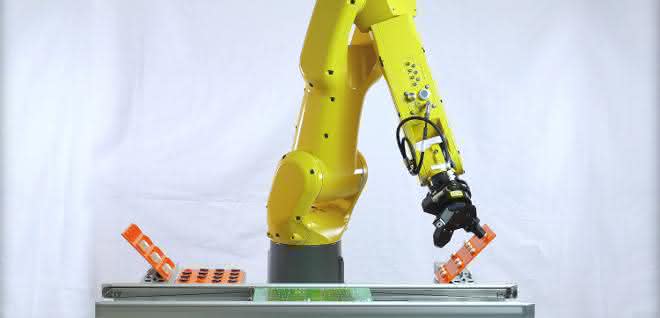
Industrial robots are characterized by reliable and precise process execution. To ensure the high level of accuracy required for this, the systems must be individually recalibrated at regular intervals. This is costly and time-consuming and means a considerable amount of extra work, especially for SMEs. In addition, more and more inexpensive robot arms are coming onto the market, which potentially have even greater positioning inaccuracies for mechanical reasons.
Only geometric errors can be corrected with currently available calibration methods. However, temperature or load-dependent inaccuracies, for example, can only be compensated for inadequately. Recalibration during operation, which would be important for a sustainable optimization process, is also not feasible.
To close these gaps and use machine learning to develop new software-driven calibration methods for practical use, robotics expert ArtiMinds Robotics, the University of Stuttgart and DHBW Karlsruhe launched the AI project Kirk in April 2020.
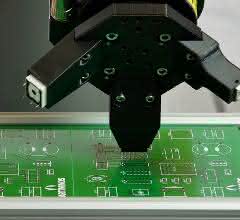
Darko Katic, technical contact for the project and Artificial Intelligence team leader at ArtiMinds, explains: "The ability to capture and analyze data automatically reduces the effort for the user and makes it easier for SMEs in particular to build up the necessary expertise to make optimal use of a robot system." The aim is to increase accuracy with software support in order to be able to use robots flexibly for a wide range of applications, to simplify work processes with a solution that is independent of the robot type and manufacturer and to reduce the workload on specialist personnel.
"Deep neural networks (deep learning) form the basis for making the complex relationships between external factors and the time-varying properties of the individual robot controllable and thus increasing positioning accuracy," says AI researcher Prof. Marco Huber from the IFF at the University of Stuttgart.
The Institute for Industrial Manufacturing and Factory Operation (IFF) at the University of Stuttgart and the Robot and Human Motion Lab (RaHM Lab) at the Baden-Württemberg Cooperative State University Karlsruhe are responsible for the basic research in the project. Together with ArtiMinds Robotics as an industrial partner, the results will be transferred to real industrial applications. Finally, the newly developed methods will also be integrated into the Robot Programming Suite (RPS) programming software. The project is scheduled to end in spring 2022. as


You might also be interested in
Plagiarius 2024 negative prize
On January 26, 2024, the Plagiarius campaign awarded its dreaded "Plagiarius" negative prize for the 48th time to manufacturers and retailers of particularly brazen counterfeits and fakes.
 read more...
Ivalua honors winners of the Generative AI...
AI-supported "add-ons" for buyers within 48 hours
Ivalua, provider of cloud-based spend management solutions, announced the winners and innovations of the first Generative AI Innovation Cup. The competition took place in December 2023. It was open to all Ivalua partners and employees - more than...
read more...Efaflex celebrates 50 years of high-speed...
The emphasis is on "fast"
Since day one, Efaflex has wanted to use new technologies as early as possible and drive progress in the industry. This year, the family business is celebrating its 50th anniversary under the motto "Fast Forward".
read more...Security of supply even during power outages
In the winter of 2022, Germany was worried about energy shortages. The drugstore retailer dm did not paint any horror scenarios, but nevertheless saw the possibility of controlled, temporary, regional power cuts (brownouts).
read more...Safety technology in mechanical engineering
Modules with new functions
Euchner's product highlights at EMO 2023 include the communication-capable solenoid interlocks.
read more...Transforming the paper industry towards climate neutrality
Together with partners from industry and research, Voith is developing a project for the optimization of energy and material flows in paper production. The aim of the research project is to develop a digital framework that enables effective process...
read more...Up to 95 percent less flue gas thanks to direct extraction
The requirements for occupational safety measures and safety technology are also constantly increasing in welding technology. The Technical Rules for Hazardous Substances (TRGS) stipulate that welding fumes and harmful substances must be extracted...
read more...Competitive advantages with large machines
Whether 3D-printed components for machines and systems, prototypes or aids for design: additive manufacturing is almost indispensable for modern companies in mechanical and plant engineering and automation if they want to play in the premier league.
read more...Transport technology from the modular system
Many transport tasks can be realized with the help of linear technology. Pre-configured solutions are available to simplify the interaction between the linear unit, motor, gearbox and controller. This minimizes the effort required for research and...
read more...