
Significantly increased efficiency and durability
Major progress in printed solar cells
Researchers at Chemnitz University of Technology print solar cells with nine percent efficiency and high durability. The DFG research group Popular is now investigating the ageing of the cells across universities.

In 2011, the working group led by Prof. Dr. Arved Hübler from the Institute of Print and Media Technology at Chemnitz University of Technology published the first solar cell printed on paper - already a great success at the time. "The feasibility was demonstrated, but with a power efficiency of only 1.7 percent and a very reduced durability, the values were not yet convincing," says Hübler.
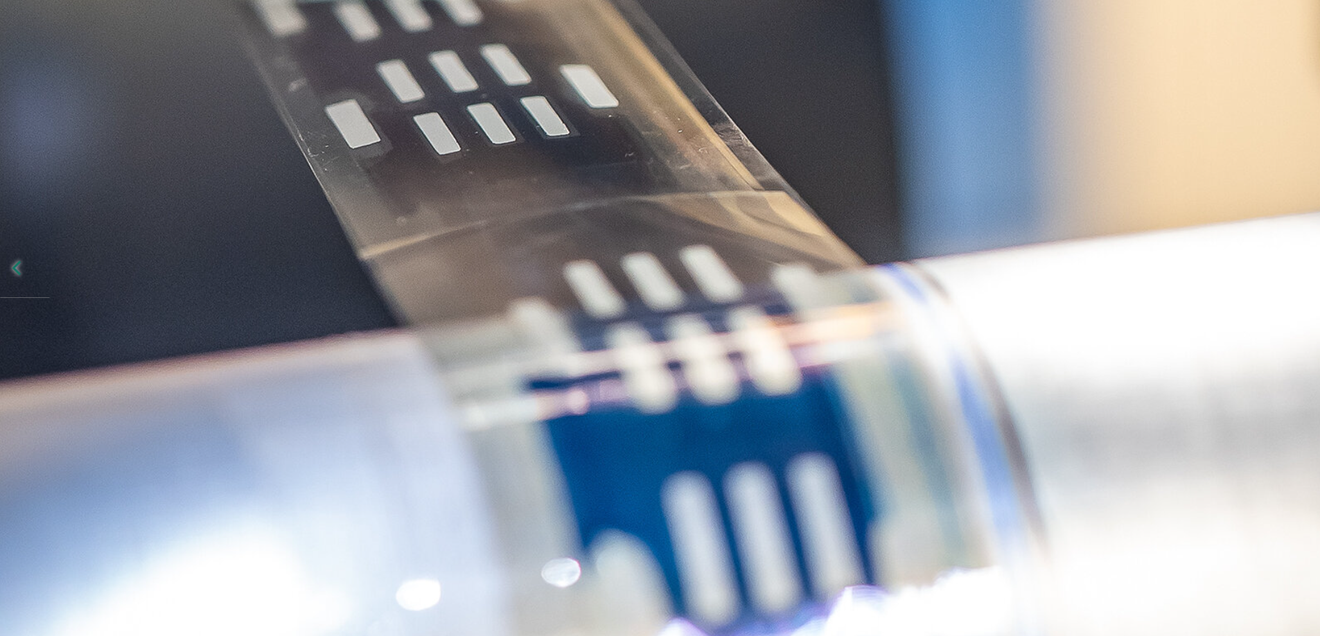
His working group has now succeeded in printing solar cells with an efficiency of nine percent and significantly improved durability. The yield in the production of the well-functioning cells is already over 88%, which is already very high.
Printed solar cells with organic semiconductors
"Organic semiconductors are located in the central, photoactive layer of the solar cell and convert incident light into a stream of electrons," says Hübler. "The cells printed at Chemnitz University of Technology use the polymer mixture PM6:Y12, which is embedded in five other layers. With the help of these layers, the electrical power generated can be harnessed. The layers are printed like a magazine page on a web press. Liquid printing inks are placed on top of each other and dried. However, these layers are not used for their color, but for their electrical functions."
Inter-university ageing studies
The progress was achieved as part of the research group "Popular - Printed & Stable Organic Photovoltaics with Non-Fullerene Acceptors" funded by the German Research Foundation (DFG).
Prof. Dr. Carsten Deibel, Chair of Optics and Photonics of Condensed Matter at Chemnitz University of Technology and spokesperson for the DFG research group, reports: "The solar cells printed in Chemnitz were taken directly to the project partners in Prof. Dr. Christoph Brabec's group at the University of Erlangen-Nuremberg to investigate their durability. There they are currently undergoing accelerated ageing. After six weeks, these aged solar cells can be compared with fresh solar cells printed at Chemnitz University of Technology in order to determine the causes of ageing."
The investigations are being carried out in the working group of Prof. Deibel and Prof. Dr. Dietrich Zahn at the Institute of Physics at Chemnitz University of Technology and by the members of the POPULAR team Prof. Dr. Yana Vainzof (TU Dresden), Prof. Dr. Eva Herzig (University of Bayreuth) and Prof. Dr. Safa Shoaee (University of Potsdam).

The results are incorporated into evaluations by simulation programs of the printed solar cells, which are carried out by the team led by Prof. Dr. Martin Stoll from the Faculty of Mathematics at Chemnitz University of Technology in collaboration with Prof. Dr. Jan-Frederik Pietschmann (University of Augsburg) and Prof. Dr. Roderick MacKenzie (University of Durham). The knowledge gained will help in the development of new organic semiconductors, which is the responsibility of Prof. Dr. Michael Sommer from the Institute of Chemistry at Chemnitz University of Technology.
"Printed solar cells have great market potential"
According to Hübler, printed solar cells are a promising candidate for the next generation of solar cells:
"Despite their very energy-intensive production, today's solar cells are relatively inexpensive because they are produced in China using extremely cheap coal-fired electricity. However, the next generation of technology will have to produce much more efficiently, which is where printing comes in."
In his opinion, square kilometers of solar cells can be printed on paper or film and brought to market in a short space of time with little energy input. "Potential markets are already known. Climate change requires more and more shading, for example in agriculture. Kilometers of solar panels can simply be pulled across the fields and cleared away later. However, the service life of the printed solar cells must be right for a successful application," says Hübler.
With the work of the Popular research group, fundamental questions can now be clarified in order to lay the foundations for a next-generation solar cell industry - hopefully in Germany again.
DFG Research Group "Popular
The research group "Printed & Stable Organic Photovoltaics with Non-Fullerene Acceptors - Popular" (FOR 5387), which is funded by the German Research Foundation with around five million euros, is a leader in the field of optoelectronic characterization of organic solar cells.
Prof. Dr. Carsten Deibel, Chair of Optics and Photonics of Condensed Matter at Chemnitz University of Technology, is the spokesperson for the DFG research group. Fourteen scientists from several universities in Germany and the UK are involved in the group.
The common goal is to produce organic solar cells using printing processes suitable for mass production and to understand and improve them with complementary experiments and simulations.
Source: Chemnitz University, Mario Steinebach


You might also be interested in
Bosch, Toyota, BMW, and Repsol Are Testing Renewable Gasoline in Real-World Conditions
Does the mobility transition have to wait for new cars? Bosch, Toyota, BMW, and Repsol are testing renewable gasoline in real-world conditions in Spain. The pilot project aims to demonstrate that more climate-friendly fuels also work with existing...
 read more...
A quantum computer that performs calculations using oscillations
When it comes to storing information, quantum computers have so far run up against technical limitations. Instead of electromagnetic storage, researchers are now using mechanical vibrations. Their vibrating memory can store significantly more...
read more...Digital twin in battery production
Faster to more powerful batteries
The battery factory of the future is increasingly working digitally: simulations accompany the development of new cells, and intelligent sensors monitor production in real time. Researchers at the Fraunhofer Institute for Industrial Mathematics ITWM...
read more...6 Criteria for the objective comparison of humanoid robots in industry
A new benchmark from Fraunhofer IPA is intended to enable the first standardized and neutral analysis of humanoid robots for industrial use based on six key criteria.
read more...Giving lightweight construction a profile
Pultrusion: A process that forms fibers under tension
Pultrusion is developing from a niche process into a key process for lightweight construction and sustainable fiber composite structures. The Fraunhofer IWU shows applications from energy to mobility.
read more...Automated restoration of windows from old buildings
The Chair of Production Systems at Ruhr University Bochum is working with the company Kilivations to develop a robot-based process for the restoration of windows potentially contaminated with asbestos in old and listed buildings. The aim is to make...
read more...New location in Leipzig for defense and security research
The Fraunhofer FKIE is opening a new site for defense and security research in Leipzig. The focus is on cyber security, resilience and industrial innovation.
read more...Development of self-adaptive industrial robots
Intelligent robotics on the way to industrial applications
The EU-funded "RoboSAPIENS" project aims to develop self-adaptive industrial robots for safe human-robot collaboration. Initial results from the Fraunhofer IFF show successful tests with digital twins in real production environments.
read more...Europe is increasingly losing touch in chip research
The research and development of semiconductor technologies is increasingly taking place outside Europe, particularly in Asia. This is shown by evaluations of semiconductor patents by EconPol Europe.
read more...