
Simulation tools
Model-based development of gripping processes
The modeling of compliant and fluidic effects in automated gripping increases development efficiency, freedom from damage, process productivity and reliability in the industrial handling of delicate objects.
At first glance, using simulation tools for handling and assembly processes seems excessive and costly for conventional rigid equipment and handling objects. However, the trend in recent years has been towards flexible and compliant gripping systems (soft grippers), whereby the adaptive properties are specifically used for product variants in production.
The necessary flexibilization in production is due to constantly increasing product customization and, as a result, ever smaller batch sizes. Smaller batch sizes require correspondingly greater set-up effort, which is reflected in the additional work involved in commissioning and parameterizing the processes.
Particularly in the case of compliant soft grippers or flexible handling objects, a specific stiffness characteristic must be taken into account, which varies depending on the application and must be identified experimentally and with great effort in order to implement the process robustly.
To minimize commissioning and parameterization effort, models and procedures were determined that specifically model the compliant effects of soft grippers and handling objects and determine the physical limits of the process simulatively and predictively. A flexible handling object is presented in the first example and a compliant soft gripper in the second example.
As an example of an elastic and flexible handling object, an application from battery production is presented in which foil-like electrode sheets are separated from a magazine and transferred to a downstream process. The challenge of this separation task is to minimize the cycle time, maximize the throughput and yet prevent any damage to the electrode. Due to the surface-sensitive electrode material, every contact must be analyzed and adjusted during the separation process. However, the dynamic effects that occur during the separation process are non-linear and multidimensional in nature and can only be evaluated specifically and with great effort using purely experimentally driven investigations, which is why a simulation-driven approach was chosen.
With the help of a coupled CFD-FEM simulation, a separation process simulation was generated that, among other things, is able to show stresses that could not be measured in-situ using direct conventional measurement methods. The process simulation then makes it possible to validate various cell formats and materials for the next generation of electrodes in advance and to reduce the necessary adjustments to the system to a minimum.
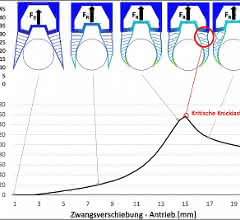
The second example is a flexible and compliant soft gripper. Soft grippers are primarily used in the food industry, where soft and compliant end effectors are used to handle surface-sensitive food of all kinds without leaving pressure marks. However, when it comes to the industrial sector, soft grippers are rarely used. The reason is simple. A very high level of reliability and accuracy is required from the gripping technology, and this can only be determined and specifically guaranteed conventionally, with flexible gripping systems, with a great deal of experimental effort. As soon as there is a product variance (contour, shape, weight or center of gravity), new empirical studies are required to identify the optimum configuration.
Research is being carried out to close this knowledge gap and to validate handling and assembly processes in advance using simulations with compliant soft grippers. To this end, material models have been created that can accurately depict the compliant material behavior under load. Furthermore, generic gripping scenarios were simulated and experimentally examined in order to ensure the feasibility of processes with regard to object loads in the industrial sector.
At the Institute for Machine Tools and Factory Operation at the TU Berlin, Department of Handling and Assembly Technology, the aim is to invalidate the strained impressions in the industrial sector towards soft grippers and flexible handling objects by means of simulation-based and experimentally validated applications. Potential users should be encouraged to take the step towards compliant gripping systems in the industrial segment, and Prof. Franz Dietrich and his team are happy to provide support. Simulation-driven functional and process validation enables the user to validate and configure processes automatically in advance. This means that all relevant parameters are determined by simulation before the process is actually put into operation and cost-efficient parameterization is then carried out without major rejects and adjustments.
Alexander Müller, Research Engineer, IWF of the TU Berlin


You might also be interested in
Plagiarius 2024 negative prize
On January 26, 2024, the Plagiarius campaign awarded its dreaded "Plagiarius" negative prize for the 48th time to manufacturers and retailers of particularly brazen counterfeits and fakes.
 read more...
Ivalua honors winners of the Generative AI...
AI-supported "add-ons" for buyers within 48 hours
Ivalua, provider of cloud-based spend management solutions, announced the winners and innovations of the first Generative AI Innovation Cup. The competition took place in December 2023. It was open to all Ivalua partners and employees - more than...
read more...Efaflex celebrates 50 years of high-speed...
The emphasis is on "fast"
Since day one, Efaflex has wanted to use new technologies as early as possible and drive progress in the industry. This year, the family business is celebrating its 50th anniversary under the motto "Fast Forward".
read more...Security of supply even during power outages
In the winter of 2022, Germany was worried about energy shortages. The drugstore retailer dm did not paint any horror scenarios, but nevertheless saw the possibility of controlled, temporary, regional power cuts (brownouts).
read more...Safety technology in mechanical engineering
Modules with new functions
Euchner's product highlights at EMO 2023 include the communication-capable solenoid interlocks.
read more...Transforming the paper industry towards climate neutrality
Together with partners from industry and research, Voith is developing a project for the optimization of energy and material flows in paper production. The aim of the research project is to develop a digital framework that enables effective process...
read more...Up to 95 percent less flue gas thanks to direct extraction
The requirements for occupational safety measures and safety technology are also constantly increasing in welding technology. The Technical Rules for Hazardous Substances (TRGS) stipulate that welding fumes and harmful substances must be extracted...
read more...Competitive advantages with large machines
Whether 3D-printed components for machines and systems, prototypes or aids for design: additive manufacturing is almost indispensable for modern companies in mechanical and plant engineering and automation if they want to play in the premier league.
read more...Transport technology from the modular system
Many transport tasks can be realized with the help of linear technology. Pre-configured solutions are available to simplify the interaction between the linear unit, motor, gearbox and controller. This minimizes the effort required for research and...
read more...