

Artificial intelligence
Dynamic HRC in production
Modern cobots can coordinate with humans with the help of AI. This flexibility of robots offers new opportunities in the manufacturing industry. But how do humans influence this dynamic?
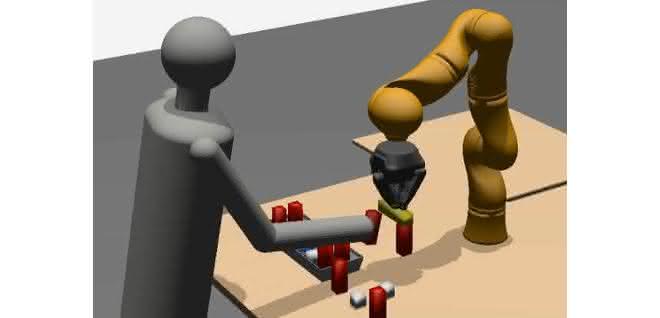
The wide availability of collaborative lightweight robots promises a new type of flexible robot colleague. A distribution of tasks that utilizes the strengths of humans, such as dexterity and adaptability, and of robots - power and precision - is particularly suitable for the small series production of products with many variants. Simulation systems can be used as part of the digital factory to plan suitable processes.
Virtual partial process automation
Corresponding approaches to virtual partial process automation through human-robot collaboration (HRC) incorporate digital human models that enable automated evaluation with tools such as MTM-UAS or EAWS. Together with the physical simulation of robot behavior, the optimal process can be determined and its benefits quantified, for example in the form of a reduction in cycle time or improvements in ergonomic parameters. Decisions on the introduction of HRC can therefore be made by comparing the predicted benefits with the costs of the system.
In contrast to this static form of virtual HRC planning, in which humans and robots follow a predetermined optimal division of tasks, dynamic systems are increasingly gaining ground in HRC research. Thanks to artificial intelligence, dynamic cobots are able to continuously coordinate with team members. They perceive their environment with sensors, can reschedule and communicate with their partners. The workflow is therefore not fully known in advance, but adapts dynamically to human preferences, individual decisions or unforeseen events.
Cost-benefit ratio
This makes it more difficult to predict the cost-benefit ratio for dynamic HRC. With the goal of "maximum flexibility", the consideration of a single, optimal HRC solution is pushed into the background. Instead, the average team performance across different work processes that can occur during the manufacture of a product is of interest for evaluation. For this purpose, several collaborative processes must be evaluated with the simulation system, which differ in terms of dynamic human actions and the resulting robot reactions.
This raises the question of how humans can be taken into account as the cause of process variance in production simulation. The Chair of Applied Computer Science III at the University of Bayreuth is investigating cognitive digital human models that aim to simulate situation-related human decisions in handling processes as an extension of modeling for physical ergonomics and workflow time analysis.
Approach to cognitive processes
Markov decision processes are used to approximate the cognitive processes. This stochastic mathematical model enables the mapping of decisions that are random on the one hand, but on the other hand are oriented with a high probability towards the goal of successfully completing the task together with the robot. This ensures that the simulated behavior in several runs of a process in the simulation is different in each case, but that plausible sequences nevertheless result. Each decision triggers an action in the simulation system, for example processing a process step or changing the location in the workspace.
The actions can be weighted differently by selecting a reward function that encodes different boundary conditions. By changing this function, different scenarios can be considered, for example, HRC with a foreman who leaves the workplace more frequently, with a well-trained team member who likes to interact with the robot or with a person with low technology acceptance who tends to refuse interaction. As the simulation progresses, a growing degree of fatigue is also calculated, which manifests itself in an increasing probability of errors and in transitions to a break phase.
Overall, extensive data sets with different plausible HRC processes can be generated automatically, covering many relevant aspects of dynamics in hybrid teams. However, the area of application is not limited to cost-benefit analysis. In the future, it could also be used for safety analysis as the next step towards the certification of dynamic cobots.
Dr. Dominik Riedelbauch, Prof. Dr. Dominik Henrich, Chair of Applied Computer Science III, University of Bayreuth


You might also be interested in
Intelligent sensor technology for the packaging industry
At Interpack 2026, Sick will be showcasing its portfolio of sensor, automation and AI-supported solutions for secure and digitally networked packaging processes in the consumer goods, healthcare and pharmaceutical industries.
 read more...
Sales growth in a turbulent market environment
Thanks to innovations and a focus on strategic industrial markets, Sick was able to moderately increase its sales in the 2025 financial year. In a turbulent market environment, the company was able to maintain its position and gain market share with...
read more...Photonic microchips with 3D connector
How a 3D system makes photonic chips industrially viable
A research team from Heidelberg is developing a 3D-printed "connector" for photonic microchips. The solution promises a low-loss, standardized coupling of glass fibre and chip - and could fundamentally simplify the production of photonic integrated...
read more...Advanced material retrieval system
Steute shows nexy wireless network with extended connectivity
Steute's Leantec division is presenting an enhanced version of the nexy wireless network with improved connectivity and additional cybersecurity functions. The background to the further development is the increasing use of automated guided vehicles...
read more...Detecting air bubbles in liquids
EBE is launching a capacitive bubble sensor on the market that reliably detects air bubbles and liquid breakages, regardless of the liquid and the condition of the hose.
read more...Miniature acceleration sensors
Structural tests on printed circuit boards
The Z22198 family consists of very small triaxial accelerometers from Kistler that measure vibrations in three orthogonal axes.
read more...Positive development in sensor and measurement technology
In the first quarter of 2025, the sensor and measurement technology industry recorded sales growth of three percent compared to the previous quarter - according to the results of the quarterly member survey conducted by the AMA Association for...
read more...Sick extends contract with CEO
The Supervisory Board of Sick has extended the contract of CEO Dr. Mats Gökstorp by 5 years. The company also announced that Feng Jiao has resigned from his position as Chief Sales Officer at his own request. Markus Scaglioso has been appointed to...
read more...Kistler and Keller Pressure deepen partnership in China
The Kistler Group is intensifying its cooperation with Keller Pressure. By signing the agreement, the two companies are reaffirming their commitment to strengthening synergies and developing the Chinese market in a targeted manner.
read more...