
Display
Efficient palletizing and packaging with collaborative robots
Collaborative robots are increasingly coming into focus in the packaging sector. Used intelligently, they optimize processes, increase efficiency and significantly reduce costs. Global market leader Universal Robots shows how this technology can be used to easily build individual solutions for packaging and palletizing.
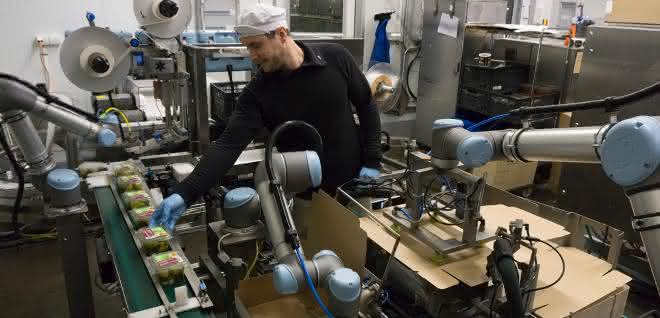
Every manufacturing company knows that the value creation process does not end with final assembly. To ensure that products can be delivered on time and in the desired quality, the last step on the production line must also be well thought out - packaging and palletizing. Robots are a popular tool for automating these processes. This is also confirmed by the International Federation of Robotics (IFR). The number of packaging robots installed worldwide each year increased fifteen-fold from 2007 to 2017 to around 32,600 units. In the same period, the number of palletizing and order picking applications tripled to just under 10,000 units in 2017.
One of the drivers of this development is the generation of collaborative lightweight robots (cobots). Companies often integrate robotic arms into existing systems to which employees must have direct access. The fundamental criterion when purchasing a new robot is its ability to collaborate - i.e. to be used directly alongside humans without a protective housing. In addition, user-friendliness and ease of set-up are the overriding principles of collaborative robotics. The implementation of the cobots and their changeover from one task to another is therefore efficient and resource-saving.
Wide range of robot applications
Universal Robots (UR) is a pioneer in this field of automation. The world market leader's cobots are designed to work directly with the user - light, flexible and intuitive to operate. This makes them an uncomplicated and cost-effective alternative to conventional industrial robots, such as Cartesian machines, whose share in the packaging sector is declining - from 71% in 2015 to 51% in just two years, according to IFR.
Given the broad range of applications for the technology, this is hardly surprising:
- The UR robots can automate almost any conceivable task.
- Typical applications in the packaging sector are Labeling and packaging of products or stacking on pallets.
- The UR models are named after their load capacity in kilograms: UR3, UR5 and UR10.
Robots in a practical test
When it comes to palletizing, larger and stronger robots are a particularly suitable choice, such as the UR10. With a working radius of up to 1.3 meters and a load capacity of 10 kilograms, it can stack goods extremely efficiently - for example at Gustav Hensel GmbH und Co KG. As the final component of a fully automated system of assembly and packaging machines for the production of cable junction boxes, a UR10 moves around 2.5 tons of packaged goods per shift.
For smaller tasks such as labeling or packaging, companies like to choose the more compact UR5 and UR3 models. Atria Scandinavia, the largest manufacturer of vegetarian gourmet products in Northern Europe, for example, uses three UR robot arms in its packaging line. They label the food, pack it in cartons and finally stack it on pallets. In this way, they prepare almost 230 items per hour for delivery.
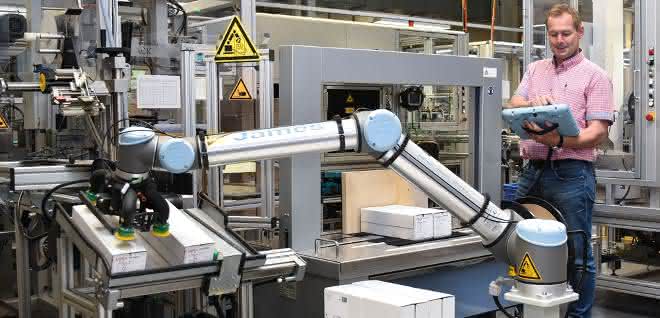
Gripping tool for different packaging materials
On its own, a robot arm is just a "naked" tool. Before it can be integrated, it is therefore essential to select suitable peripheral products, i.e. grippers and the like. As a rule, there is a solution for every packaging unit and every material - whether delicate paper, sensitive glass or heavy cardboard.
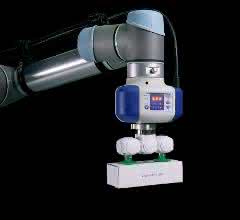
UR has established the Universal Robots+ showroom to provide companies not only with the right robot colleague, but also with the complete package they need. This online platform offers a collection of grippers, software and other accessories that are guaranteed to be compatible with the robots.
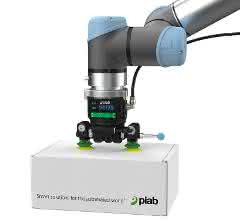
Suction grippers often prove their worth in palletizing applications. After all, no interfering contours should be generated during stacking. When used with parallel grippers, the gripper's own fingers would always get in the way when placing boxes. The UR10 is also equipped with a suction gripper at medium-sized company Hensel. This was designed so that it can flexibly handle four different carton sizes.
Palletizing assistant: catalyst in the integration process
Universal Robots' vision is to make its robot technology accessible to companies of every industry and size - and this is also reflected in the ease with which tasks can be programmed.
For palletizing, for example, UR robots have an integrated palletizing assistant. This enables operators to create a palletization on one or more levels in just a few steps and in a very short time:
- To do this, they first select a predefined pattern in which the robot is to stack the goods.
- They then teach it the dimensions of the pallet simply by moving to its four corner points.
- The next step is to enter the number of positions on the pallet and show the robot a pattern movement for approaching these points.
- The assistant does the rest by itself.
The advantage is obvious: the low costs for programming and integration. The payback period for collaborative robots is usually less than 12 months, making them the fastest in the industry - a real competitive advantage for the destacking sector.
Do you want to pack and palletize efficiently with cobots? You can find more tips and tricks in this white paper!


You might also be interested in
Helu makes its first trade fair appearance under a new brand name
Helu Kabel will be presenting itself as Helu for the first time at Hannover Messe 2026, showcasing system solutions, Heluchain cables and new industrial luminaires.
 read more...
Strategic realignment with brand relaunch
In future, Helukabel will trade as Helu
The Helukabel Group is parting with part of its name: in future, the company will only operate under the Helu brand. With this step, the specialist for electrical connection technology is underlining its strategic development from a classic cable...
read more...Modular plant construction for corrugated board
Insight into the production of corrugators at BHS Corrugated: Automated, modular and equipped with Helukabel components.
read more...Best quality for the steel
Conditions in the steel industry are harsh and inhospitable. The machines used must be able to withstand the demanding environmental conditions in order to deliver the best quality at all times.
read more...If the standard cable is not sufficient
Lapp offers cables for countless applications - but not for all of them. From time to time, the developers have to modify a standard cable or develop a special cable.
read more...Slight decline in sales, strong investments
The Lapp Group has not been spared from the weakening global economy. However, the company only recorded a slight loss in the past 2024 financial year.
read more...Electrical connection technology
Cables and wires for industrial automation
Heukabel offers system solutions for cable routing from a single source. The subsidiary EKD Systems specializes in tailor-made cable drag chains made of steel, stainless steel and plastic, which are used in moving machines and systems as well as in...
read more...Lapp relies on Ultramid from BASF
Mobile charging of electric vehicles
The automotive industry is currently undergoing the biggest transformation in its history. The boom in battery electric vehicles in particular is presenting the industry with major challenges. Lapp, as a supplier of cables and connection...
read more...Cable handling application
At this year's Motek, ArtiMinds Robotics is showcasing a robot-based automation solution for the sensor-assisted assembly of flexible cables in connector housings.
read more...