
Display
Automation boost for the ERP world
The global economy is shaky, the workforce is at its limit: if you want to be successful today, you need massive leaps in productivity. Asseco brings the ERP world together with the process level - as the basis for efficient automation and Agentic AI that actually does what it is supposed to do.
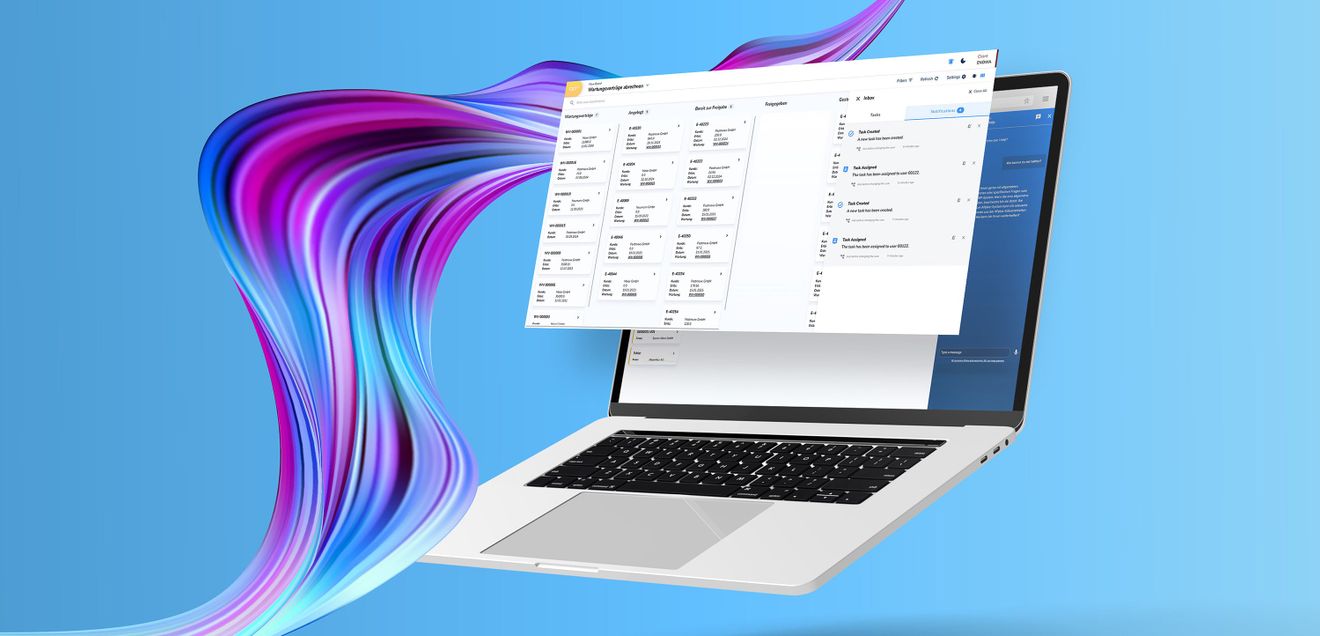
From creating an order to checking material availability and determining delivery dates: Even in the digital age, many work steps are still characterized by a high level of manual effort. Can Agentic AI bring the long-awaited turnaround? After all, AI agents are also able to carry out specific actions based on their analyses, thus relieving employees of time-consuming routines.
In order for the use of agentic AI to actually be successful, the right preparatory work is required. After all, the agents will only work smoothly if they actually know which sub-steps are required to complete the task in question, in which order they need to be processed and which data needs to be available at which stage. What they need is a digital process map from which they cannot deviate uncontrollably.
ERP specialist Asseco Solutions supports the creation of this map by integrating processes into the ERP world.
Process-oriented working method in the ERP system
Since 2023, APplus has been offering users an innovative usage mode that allows them to edit central core processes in a process-oriented manner. Users no longer have to make their own way through data-heavy views. Instead, the "Flow Mode" guides them step by step through the editing of the required process flows.
A system that benefits users in two ways: On the one hand, the lean, process-focused way of working enables a comprehensive speed boost for daily tasks. Practical customer experience has shown that central core processes can often be completed at double to triple the speed in flow mode. At the same time, digital process mapping creates valuable groundwork for the use of Agentic AI: the so-called "process flows" are stored in the machine-readable language "Business Process Model and Notation" (BPMN) and are therefore directly understandable for artificial intelligence.
A good 60 central company processes are already predefined as part of the latest APplus 9 product generation. The spectrum of possible processes ranges from master data maintenance such as article creation, purchasing processes or scheduling to specific processes such as outsourcing, which extend from production to purchasing and logistics.
The ERP takes the initiative
Even without the use of AI, process sequences defined in APplus 9 can already be run through in a rule-based manner if desired, in order to relieve employees of time-consuming routine processes. For example, an incoming email with a service request acts as a trigger. The ERP system then runs through the corresponding flow process automatically, creates a service ticket, checks the availability of the required spare parts, identifies suitable technicians for a maintenance call and schedules the corresponding appointment.
Decision nodes enable rule-based control of the process. For example, it is possible to define which process steps require the approval of a responsible specialist and which the ERP can implement independently. The rules, as well as individual adjustments to the process flow, can be made purely on a configuration basis, meaning that no extensive programming knowledge is required.
Basis for the production of the future
Speed and efficiency have become key success factors in the manufacturing industry. A status quo in which the digital mapping of company processes is becoming increasingly important in several respects: Not only does it open up ways for a new, significantly streamlined way of working in the ERP system. It also creates the basis for comprehensive rule-based automation in order to reduce the workload of employees. And finally, it paves the way for a technological future in which AI agents interact with company processes in a controlled manner and within clear guidelines - making the highly automated production processes of the future a reality.


You might also be interested in
Automated incoming orders for plastics manufacturer
Following the successful pilot project at the German site in Frickenhausen, Greiner Bio-One International GmbH is introducing a new AI-based application with the help of digital engineering provider Tietoevry Create (formerly Infopulse).
 read more...
How production can benefit from AI
Together with AI technology, IIoT networking makes it possible to better control machine parameters and optimize quality with predictive quality. Downtimes and set-up times can also be further minimized. Cloud platforms also make these technologies...
read more...Continuously developing innovations
In the run-up to the Hannover Messe, Andreas Mühlbauer spoke to Oliver Winzenried, CEO of Wibu-Systems, about the innovations the company is presenting in Hannover and the technological trends at the trade fair.
read more...Machine and equipment construction
Order around the clock
Item has opened its new international online store, which offers over 4,000 components for machine and equipment construction. Whether individual aluminum profiles, custom designs or complete equipment for ergonomic workstations: the extended search...
read more...Unlocking hidden CAD data potential
With the new version of the Classmate software suite, Simus has increased the user-friendliness and effectiveness of the modules. From structuring and cleansing databases to synchronization with SAP, the tools provide sustainable benefits in design,...
read more...Manage tools digitally
Based on the current requirements in modern production companies, lean production is today's standard. In order to generate real competitiveness even in small and medium-sized companies, in addition to resource planning combined with deadline...
read more...Process control with traceability through soldering tips with microchips
RS has added a new 300 W manual soldering platform to its range with the WXsmart from Weller. The station combines all soldering applications in a single device and comes with a new range of intelligent soldering tips. In this way, the WXsmart...
read more...ams.Solution makes new internal appointments to the Management Board
After more than 30 years at the helm of ams.Solution, Manfred Deues stepped down as CEO on September 30, 2022 and will move to the Supervisory Board. At the same time, Eckhard Ulmer, another member of the Management Board and one of the company's...
read more...Increasing productivity in industrial manufacturing
Transparent production planning and control for the digital factory - 5thIndustry presents the real-time app 5i.Progress. The latest development from the software experts enables intuitive order management for employees in production.
read more...