

Wheels and castors increase work safety
Getting security rolling
If designed correctly, wheels and castors can make a significant contribution to increased work safety. The main causes of accidents at work can be mitigated by moving and braking loads safely and keeping them stable.
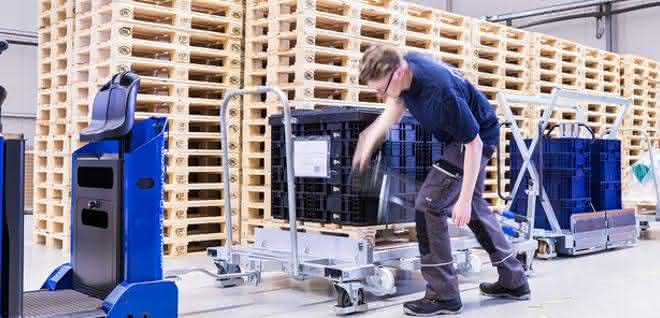
According to the German Social Accident Insurance (DGUV), 30% of the 781,050 reportable workplace accidents in 2016 were caused by movement. The fourth most common cause of accidents, at around ten percent, is manual transportation. In addition to a person carrying a load, this also includes transporting an object vertically and horizontally.
When a trolley is in motion, it can quickly become a dangerous projectile depending on its speed. Blickle divides the potential hazards in intralogistics into three areas according to the movement status of the transport device: Moving, braking and stationary. In these situations, the wheel and castor specialist helps to increase occupational safety.
There are numerous sources of danger when operating a vehicle while driving. A castor equipped with foot protection offers protection from injuries caused by vehicle wheels or objects being thrown upwards. Customers can choose this accessory for many castor and fixed castor series. "Our transport systems are equipped with foot protection on all castors as standard," says Peter Beele, Product Manager at Blickle's long-standing customer LKE from Marl, one of the leading manufacturers of transport equipment and systems. "The topic of occupational safety is very important in intralogistics. Our customers therefore expect us to pay particular attention to the protection of their employees."
Dead man's brake protects people
To prevent accidents at work, it is also important that the operator of a trolley retains control at all times while driving. Unlike conventional locking systems, drum-braked castors allow the speed of the trolley to be reduced even while it is in motion. Blickle also offers a wide range of swivel and fixed castors with dead man's function to further increase personal safety. The dead man's brake has a braking force of over 600 N. In the initial position, the brakes are closed and only release when actively applied.
Electromechanical dead man's brakes are used in the ErgoMove range of electric drive systems. Thanks to automatic brake release by means of sensor hand detection on the operating handles, the transport trolley can only be moved if the operator has both hands actively on the trolley. The trolley brakes immediately when a handle is released. The emergency stop and pinch protection function also prevents pressure and crushing injuries.
The focus is not only on occupational safety when moving and braking loads, but also during the resting phase. This is where the Blickle locking systems come into play. These are either integrated directly into the castors as wheel and slewing ring locks or can be flexibly mounted on the trolley as independent units, such as the locking feet. They are comparable to a classic jack and differ in that they take the load off the transport equipment without lifting it. When the locking feet are activated, a contact force of around 600 N is generated between the trolley and the ground. This ensures a secure stand even with heavy loads.
The locking force always remains constant, regardless of the actual load. With a wide range of lifting castors, the company meets the growing mobility requirements of its customers. The lifting castors enable the flexible lifting, moving, positioning and leveling of mobile operating equipment, transport devices and machines. Both locking feet and lifting castors are ideal for applications on smooth and slippery surfaces and ensure safety and stability.
Development and extensive testing
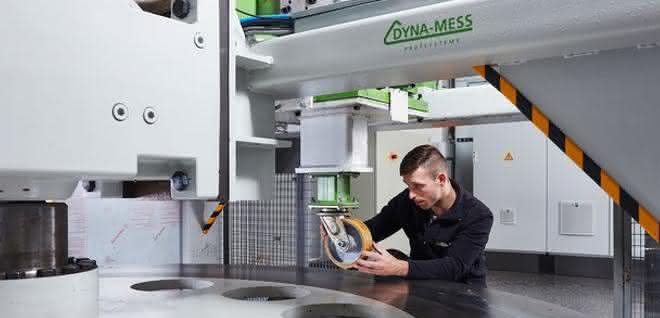
The safety of the wheels and castors is already of great importance during the development process. Using the finite element method, the designers simulate the overall behavior of the end product in use, taking various effects into account. In this way, they optimize the product in the early stages with regard to the planned area of application. The calculated load-bearing capacities are then put to the test using special procedures in the company's own test laboratory. "It is important to us that the products not only meet the DIN standards, but are also safe and resilient," says Timo Sieber, Product Manager at Blickle. "To achieve this, we have developed our own test procedures in which we expose our castors to extreme conditions. For example, we increase factors such as the test load, speed or number of sleeper crossings beyond the standard. As a result, our customers can rely on the fact that the castors are safe to use even under high loads."
Blickle has an electrically dissipative version in its range for almost all wheels and castors, especially for protection against electrostatic discharge. It protects the operator of a transport device from painful electrostatic discharge and sensitive electronic transport goods from damage. Blickle thus also supports manufacturers of electrical and mechanical equipment in complying with the European ATEX directive.
According to documents from Blickle / am


You might also be interested in
Protection against electrostatic discharge
StoFloor ESD KU 614 from StoCretec: dissipative flooring with the latest technology meets all ESD standards, is economical, extremely durable, mechanically and chemically resistant. The surface can be adjusted to be slip-resistant. The system is...
 read more...
Cables and wires from Helukabel
Food cultivation on a new level
Vertical farming - cultivation in multi-storey greenhouses - is considered one of the most exciting trends in food production. One of the pioneers in this field is the Romanian start-up Ultragreens. The company relies on solutions from Helukabel to...
read more...Further training for specialists to become security experts
With the "CESA - Certified Expert for Security in Automation" qualification, automation expert Pilz offers a two-day expert course designed to provide participants with compact security knowledge in line with the latest standards.
read more...Meaningful data on the service life of the seal
Seals prevent substances from penetrating or entering technical components. The intelligent seals from Freudenberg Sealing Technologies can significantly expand this core task in the future: the seal itself is also a sensor and becomes a "smart...
read more...Online stud configurator according to drawing
For standard bolts, with head, thread or hole
For standard bolts, with head, thread, bore or as a version with recess, mbo Osswald configurators map the standard specifications, are very easy to use, take a lot of work off the user's hands and save a lot of time.
read more...Safe palletizing with the Cobot
Verla-Pharm's medicinal products and food supplements have been available for decades. Ever-increasing throughputs result in ever-increasing logistics costs, whereby optimum utilization of the available production space is necessary.
read more...The tiger among processors
Since the move towards the Industrial Internet of Things (IIoT) and Industry 4.0 has picked up speed, processor boards and modules must be able to process exponentially growing amounts of data.
read more...VDWF publishes "Sustainability Compendium"
Nowadays, nobody can avoid "sustainability": In addition to a far-reaching presence in the media, it is also becoming increasingly important for companies in the tool and mold making industry to develop and implement appropriate concepts.
read more...More transparency and synergies with QM software
Weber, manufacturer of wood and metal sanding machines and extruders, has reorganized its quality management with ConSense IMS Professional. The software solution enables transparent documentation and more efficient processes.
read more...