

Protective work clothing
Textile protection in explosive environments
People working in potentially explosive atmospheres must be protected from electrostatic charge. This is because uncontrolled spark discharge can have devastating consequences wherever flammable substances are manufactured, processed or transported.
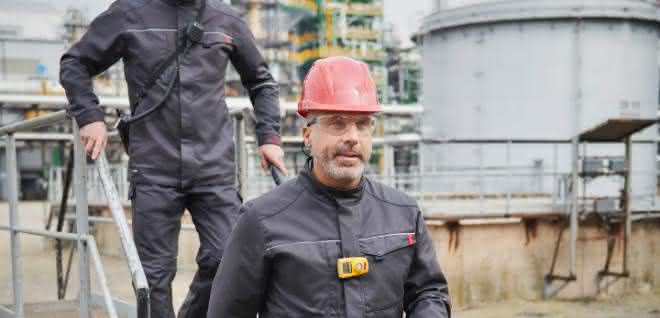
Walking, kneeling, shaking, handling plastics - many tasks generate frictional electricity simply through movement. If this energy is suddenly released, a flammable mixture of air and dust or gas can ignite and cause an explosion. According to the German Ordinance on Industrial Safety and Health (BetrSichV), the operator of a plant is responsible for protecting employees from this danger.
Employers have a duty
"Persons working in potentially explosive atmospheres must not be electrostatically charged in accordance with the Hazardous Substances Ordinance. In this case, the workwear is classified as PPE, i.e. personal protective equipment. It must therefore meet the general requirements for protective clothing in accordance with ISO 13688 and the antistatic function in accordance with the European standard EN 1149-5," explains Silvia Mertens, Head of Product Management Sales at Mewa. The majority of protective clothing collections offered in textile sharing now have an antistatic component in the fabric. The antistatic effect is created by a special thread in the fabric - usually a polyester-carbon composite - which can dissipate existing charges. Mertens emphasizes: "The protection of the woven-in antistatic function lasts as long as the clothing. It is not necessary to reapply it after washing."
Caution with "all-rounder" PPE
For effective protection against electrostatic charge, PPE must consist of a combination of jacket and trousers and must always be worn closed. Equally important are dissipative footwear and dissipative floors. In working environments with a particular risk of explosion, protective clothing must not be changed or put on and taken off. The Technical Rule for Hazardous Substances TRGS 727 "Avoidance of ignition hazards due to electrostatic charging" applies to create safe working conditions. Mertens says: "I recommend first precisely assessing the risks at a workplace via the risk assessment, then prioritizing them and then defining the criteria for the protective clothing accordingly. This allows you to select PPE that protects against exactly the hazards that actually exist in the workplace." Clothing that combines a large number of protective functions is often not as effective as the special version with regard to individual hazards.
Areas of application with fire hazard
Electrically conductive protective clothing that complies with the EN1149-5 standard is often required in companies that have to comply with the European explosion protection directive ATEX (Atmospheres Explosive). Mertens: "In order to meet the requirements of different industries and areas of application, we combine the anti-static function in the PPE lines with heat and flame protection, chemical protection or both protective functions. With functional cuts and different fiber substrates, this results in eight different Mewa PPE lines - for example for electricians and mechatronics engineers, tanker drivers or the chemical industry." Mewa offers its customers textile sharing for workwear and protective clothing. The PPE is delivered directly to the customer's premises, collected after use and professionally maintained. The service provider takes over the inspection and maintenance of the protective clothing so that the protective functions are still guaranteed upon delivery after the care process.
Visibly safe through the summer
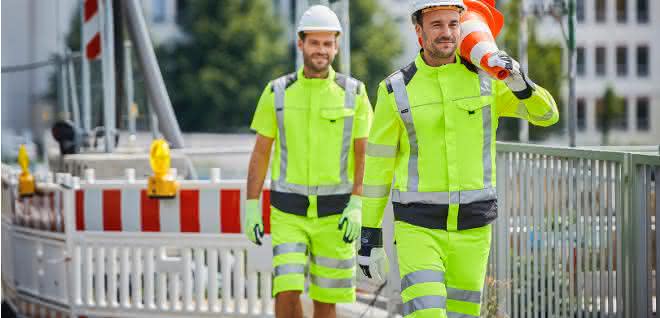
Mewa also offers clothing for completely different areas of work. Especially for the coming summer, people who work outdoors need special clothing. Anyone working in road construction, waste disposal or landscape maintenance needs safe high-visibility clothing - even when the thermometer rises. To ensure that employees' choice of summer clothing is not at the expense of their safety, Mewa offers high-visibility clothing that is airy and conforms to standards. In the hygienic rental system, the company has added shirts, shorts and vests to the "Dynamic Reflect" high-visibility collection.
The clothing is certified in accordance with the high-visibility standard EN ISO 20471 and ensures the visibility of its wearers, for example through horizontal and vertical reflective stripes on the shirts. The clothing was developed for people who are in action at work. Shirts and shorts adapt to your movements. This means that nothing pinches when bending and stretching, and the shirt stays tucked into the trousers. Vests and pants are equipped with plenty of pockets so that all work utensils are always to hand. Here too, Mewa offers clothing including care. The service provider takes care of the preparation and care, including collection and delivery service. Professional laundry also ensures that regulations and guidelines for occupational safety and hygiene are adhered to. The clothing is checked after each washing and drying. The company has currently developed an automated testing system for high-visibility clothing in collaboration with the Fraunhofer Institute.
According to documents from Mewa / am


You might also be interested in
Predictive maintenance in retrofit
Predictive maintenance pays off. This is because early detection of impending failures means that systems can be serviced in a targeted manner before production downtime occurs. But how complex is it to integrate such a maintenance concept into an...
 read more...
Maintenance instead of replacement
The circular economy starts with the machinery
Sustainability in industry starts with machines, says our guest author from Deguma: How maintenance, modernization and the 5R strategy save resources, energy and CO₂.
read more...3D printing for unplanned requirements
The material fails and the machine suddenly stops? Then you need to take the right measures to be able to resume production quickly. Material failure in the form of faulty components or material wear in the frame are a risk for any production.
read more...High demands in terms of safety, application and robustness
Demanding work in the electrical trade and energy supply as well as smooth processes in production require innovative and customized measurement technology that scores points for safety, ease of use and resilience.
read more...Car meets e-bike: riding with lubrication-free polymer bearings
Studies show that the proportion of pedestrian and bicycle traffic is increasing in urban areas. With the JetBike, JetBike GmbH from Braunschweig presents a mixture of e-bike and car and relies on lubrication-free polymer bearings from Igus.
read more...Hydraulic hub for more efficient servicing
Bosch Rexroth presents a digital toolbox for service and maintenance. With a comprehensive range of digital services, the Hydraulic Hub simplifies and accelerates the service and maintenance of hydraulic products and increases machine availability.
read more...Arnold Umformtechnik expands after-sales...
Faster help with VR glasses
Arnold Umformtechnik is expanding the after-sales service for its machines to include digital remote services. The focus is on data security, simple operation and clear processes.
read more...147,000 euros per hour: high costs for German companies due to unplanned downtime
According to the "Value of Reliability" study, 67% of industrial companies in Germany experience unplanned downtime at least once a month. This costs the German economy 147,000 euros per hour. Nevertheless, reactive maintenance concepts are not...
read more...Maintenance starts with a maintenance planner
Legal requirements stipulate that machines and systems must be serviced regularly. The maintenance work serves to ensure occupational safety and economic efficiency.
read more...