

Occupational safety
Optimize high-voltage testing and insulation measurement
A new high-voltage measuring device reduces the load on the tested components during tests.
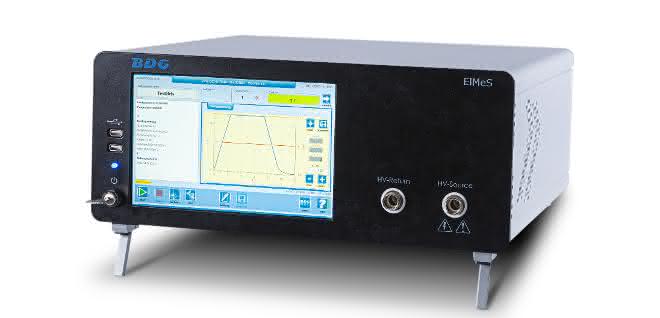
High-voltage testing and insulation measurement serve no other purpose than personal protection. Mandatory by law in the DVGU and VDE 100, no toaster, fan or computer power supply can avoid this test, in which - depending on the device and component - voltages of up to 2.5 kilovolts are applied for a good second. However, this high-voltage test is very stressful for components and devices, especially if the applied potential of the measuring devices overshoots, i.e. if the test voltage briefly rises above the set potential and only then levels out again to the desired level. Although this uncontrolled overvoltage on the device under test only lasts a fraction of a second, it can still contribute to premature wear and tear and to failures within the warranty period, which manufacturers want to avoid at all costs.
Voltage overshoot extremely reduced
Developer and engineer Dieter Schwarz, from BDG Automationstechnik in Künzelsau-Amrichshausen in Baden-Württemberg, was able to reduce the so-called overshoot to a minimum using sophisticated circuit technology. The latest result of his research is a series of DC high-voltage measuring devices of the ElMeS type: "There are a lot of details in the two device versions. Mainly in the measurement technology, control technology and power electronics. Coupled with intelligent control software, we were able to achieve these goals." The rest is a trade secret. ElMeS is suitable for both the completely manual test bench and for full automation, adds Schwarz.
Two years development time
Among other things, the integrated web interface makes commissioning, ongoing operation and servicing of the test systems much easier for the user. This means that the customer benefits from all the requirements for Industry 4.0, such as the connection to Ethernet and the http API, as well as numerous programming examples and libraries when it comes to operation. Digital interfaces for user I/0, such as lamps and buttons, as well as the PLC connection are included.
Thanks to the recorded insulation measurement data, the QA department is able to take countermeasures in production at an early stage if it detects creeping changes in the test object, for example, so that no series failures of the products or components occur. Based on the measurement results, the user can produce his products in such a way that he stays within the calculated budget on the one hand and optimizes quality on the other. BDG offers two device versions for HV and insulation measurement: a compact built-in device that can be integrated directly on the test bench or in the fully automated system. The desktop device with a width of 19 inches is suitable for use in the laboratory, where test engineers can test with the same high-voltage testing technology as in fully automated systems.


You might also be interested in
ebm-papst is growing again thanks to AI and data centers
ebm-papst returned to a growth trajectory in fiscal year 2025/26. Air Technology, data center applications, and artificial intelligence are driving revenue and investment.
 read more...
SPE on the Verge of a Market Breakthrough
Single Pair Ethernet (SPE) has moved beyond the conceptual phase and is increasingly being implemented in industrial settings. The focus here is not only on higher data rates and simplified cabling, but above all on the issue of system integration...
read more...More than 900 exhibitors already registered
Around six months before the start of the trade fair, more than 900 companies have registered for SPS 2026 in Nuremberg. The trade fair focuses on industrial AI, cyber security and digital transformation.
read more...Virtual PLCs in practice: How vPLCs make production systems more flexible and scalable
The increasing networking of IT and OT is fundamentally changing industrial automation. The IT/OT Integration Summit shows how modern technologies can make production environments more efficient, flexible and future-proof. The event will focus on...
read more...Sales growth in a turbulent market environment
Thanks to innovations and a focus on strategic industrial markets, Sick was able to moderately increase its sales in the 2025 financial year. In a turbulent market environment, the company was able to maintain its position and gain market share with...
read more...Siemens presents new AI agent
Siemens is launching 'Eigen Engineering Agent', an AI for automation technology. The solution is integrated into the TIA Portal, has been tested with over 100 companies and is designed to significantly accelerate engineering processes.
read more...Schaeffler keeps sales almost stable
Schaeffler generated revenue of EUR 23.5 billion in 2025 and increased EBIT before special items to EUR 936 million. At 266 million euros, free cash flow was significantly above the prior year and forecast. Net income remained negative due to high...
read more...Advancing artificial intelligence together
Helukabel is stepping up its activities in the field of artificial intelligence and is now a member of the IPAI. The innovation and collaboration platform for companies, research facilities, institutions and administration has set itself the goal of...
read more...New impetus for ifm sales
Two new positions were filled at ifm at the start of 2026: Markus Wolf becomes Managing Director Sales Germany, Sven Quant takes over the position of Central Managing Director in the Process Sensors division within the ifm Group.
read more...