
New Work in the industry
Digitizing work processes during the crisis
Since the start of the SARS-CoV-2 pandemic, people have been asked to keep their distance from one another. This has given rise to many digital (emergency) solutions that connect employees despite physical distancing. Also an opportunity for the future. By Ulrike Volejnik
Industry is not immune to this development either. Companies can see this time as an opportunity and digitize their working model as far as possible.
Audit assurance: a clean slate
In the long term, there are some opportunities to map production more strongly using digital tools. However, we are currently in an economic crisis that requires rapid action. Quality assurance measures deserve special attention in order to continue to meet audit requirements. Due to the pandemic, production is taking place under more difficult conditions and companies must ensure that their hygiene regulations are adhered to.
As a quick fix, employees can be divided into shifts to avoid direct contact as far as possible. Manufacturing companies go one step further when they fully automate the documentation of process sequences digitally, thereby reducing the time spent by employees. Robotic process automation can play an important role here. Instead of manually created reports, an algorithm takes over and simultaneously reduces the susceptibility to errors.
Cooperation despite distance
In addition, there are now many tools for collaboration so that employees, especially in the areas of administration and management, do not necessarily have to be gathered in one place. Instead of long email threads, colleagues can communicate via messengers such as Skype for Business or Microsoft Teams with integrated video chat.
Collaboration tools such as Office 365 are suitable for ensuring efficient and structured remote collaboration. When introducing such tools, it is essential to support employees, offer training and define important rules for use, netiquette and code of conduct. How exactly can and should people talk to each other? For which tasks is the chat suitable for coordination, when is a video call in a larger group necessary? Internal coordination and deadlines should be observed with the same seriousness as deadlines with customers and suppliers. With clear rules that apply to all colleagues, harmonious and efficient collaboration can be achieved even when there is physical separation.
I'm sure there's an app for that
Special employee apps can also do more than just optimize communication between colleagues. They are also important aids as information tools for supply chain optimization. Descriptions of process flows, background information and contact persons within the app can cover a large part of the communication requirements that arise. As an out-of-the-box version, companies can purchase and install the apps quickly. For individual requirements, there are usually additional, ready-made features available as an app-as-a-service that can be booked for a defined period of time. In the current exceptional situation, many of these offers are even available free of charge.
Maintenance via augmented reality
Of course, not all activities in the workplace can be mapped completely digitally. Machine maintenance plays a particularly important role in the industrial sector. Nevertheless, digital solutions from the Internet of Things (IoT) can simplify processes here too and minimize the need to be tied to a specific location. Schwan Cosmetics, for example, uses augmented reality for remote maintenance.
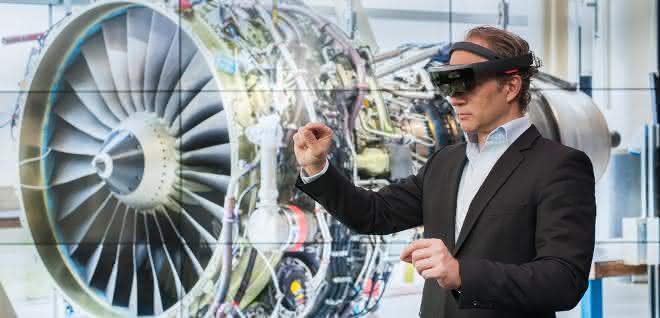
This technology allows experts to connect with machine operators and maintenance staff and provide support in the event of problems. Using a desktop app that runs on smart glasses such as the HoloLens, employees on site can have instructions transmitted directly into their field of vision. Experts and on-site employees can both see the same thing through the HoloLens and communicate accordingly. Even machine settings and notes can be displayed in the field of vision so that communication difficulties caused by different languages or dialects do not arise in the first place.
As many work processes migrate to the digital world, the obligation to be physically present is becoming increasingly obsolete. Companies ultimately benefit from this on several levels. On the one hand, it is easier to find qualified employees, as the question of location can be solved much more flexibly and individually. On the other hand, more and more processes can now be automated and digitized, which in turn frees up employee capacities that they can invest in the active further development of the company and business model. The current crisis is accelerating this process and can therefore be both a curse and a blessing - if companies use the time wisely.
Ulrike Volejnik, Member of the Management Board of T-Systems Multimedia Solutions GmbH


You might also be interested in
Predictive maintenance in retrofit
Predictive maintenance pays off. This is because early detection of impending failures means that systems can be serviced in a targeted manner before production downtime occurs. But how complex is it to integrate such a maintenance concept into an...
 read more...
Maintenance instead of replacement
The circular economy starts with the machinery
Sustainability in industry starts with machines, says our guest author from Deguma: How maintenance, modernization and the 5R strategy save resources, energy and CO₂.
read more...3D printing for unplanned requirements
The material fails and the machine suddenly stops? Then you need to take the right measures to be able to resume production quickly. Material failure in the form of faulty components or material wear in the frame are a risk for any production.
read more...High demands in terms of safety, application and robustness
Demanding work in the electrical trade and energy supply as well as smooth processes in production require innovative and customized measurement technology that scores points for safety, ease of use and resilience.
read more...Car meets e-bike: riding with lubrication-free polymer bearings
Studies show that the proportion of pedestrian and bicycle traffic is increasing in urban areas. With the JetBike, JetBike GmbH from Braunschweig presents a mixture of e-bike and car and relies on lubrication-free polymer bearings from Igus.
read more...Hydraulic hub for more efficient servicing
Bosch Rexroth presents a digital toolbox for service and maintenance. With a comprehensive range of digital services, the Hydraulic Hub simplifies and accelerates the service and maintenance of hydraulic products and increases machine availability.
read more...Arnold Umformtechnik expands after-sales...
Faster help with VR glasses
Arnold Umformtechnik is expanding the after-sales service for its machines to include digital remote services. The focus is on data security, simple operation and clear processes.
read more...147,000 euros per hour: high costs for German companies due to unplanned downtime
According to the "Value of Reliability" study, 67% of industrial companies in Germany experience unplanned downtime at least once a month. This costs the German economy 147,000 euros per hour. Nevertheless, reactive maintenance concepts are not...
read more...Maintenance starts with a maintenance planner
Legal requirements stipulate that machines and systems must be serviced regularly. The maintenance work serves to ensure occupational safety and economic efficiency.
read more...