
Predictive maintenance of pipes
Replace the cable before it breaks
The aim of predictive maintenance is to avoid unplanned downtime. But how can you predict when a cable will fail? An attractive solution is one that does not require any changes to the cable.
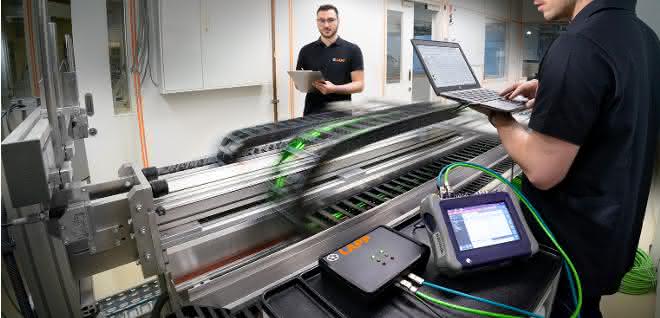
When people talk about digitalization in factories and Industry 4.0, the first thing that comes to mind is predictive maintenance. The hope is that parts are replaced before they give up the ghost and not just when the machine is already at a standstill. The basis for this is a large amount of sensor data that allows conclusions to be drawn about the ageing of the part. Up to now, cables have been less of a focus in this application because they usually last for many years and are comparatively inexpensive. Nevertheless, the importance of cabling should not be underestimated. A defective cable can bring an entire production line to a standstill and result in high follow-up costs. Highly dynamic, complex movements in particular place a heavy load on the connection systems. "That's why we wanted to offer a solution that alerts us before a cable fails," says Guido Ege, Head of Product Development and Management at Lapp.
At the start of the project, Guido Ege's team focused on Ethernet cables because industrial data communication is playing an increasingly important role in systems and machine networking. Ethernet cables have a complex structure and have to meet demanding high-frequency characteristics. Broken shielding leads to increased EMC interference. If strands break, the attenuation increases and the data rate drops. If a wire breaks completely, communication fails completely.
The team has set itself the goal of predicting the ageing behavior of a cable and the optimal time to replace it so that production is disrupted as little as possible. To this end, the transmission properties of data cables and their changes are monitored, which allows the expected service life to be calculated. Ethernet cables are just the first step, says Ege. The next step will also involve monitoring live cables. "We want to help make factories smarter, more reliable and more transparent, and predictive maintenance is key to this."
No sacrificial vein necessary
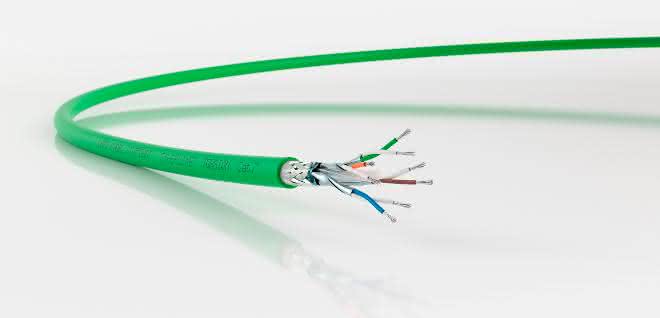
The requirement during development was that the system should work without changing the cable structure, i.e. without additional measuring or sacrificial wires in the cable. These additional wires require more effort during installation. With the solution from Lapp, a protocol and a special algorithm should suffice. This means that standard Ethernet cables and standard connectors such as RJ45 or M12 can be used. The installer connects the cables as usual and does not have to connect any additional sacrificial wires. This approach also has the advantage that existing systems can be retrofitted.
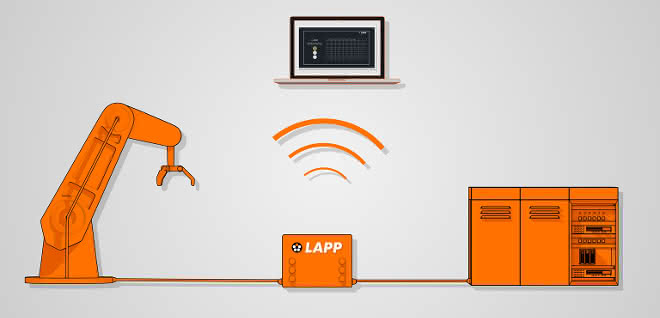
With this solution, the measurement takes place in the so-called Predictive Maintenance Box, or PMBx for short. It has two Ethernet ports and is simply inserted at the beginning of the line to be monitored. The data packets are transmitted transparently and almost without delay from one Ethernet port to the other. The PMBx is therefore not visible to a connected PLC and has no influence on data transmission or the function of the control system. It is therefore also suitable for existing systems without the need for changes to the PLC software.
The decisive parameter for failure prediction is the "Lapp Predictive Indicator", which is based on several transmission-relevant parameters. This also enables plausibility checks to prevent misinterpretation of measured values. In its in-house test center, Lapp has collected measured values for its energy chain cables using a big data approach and then analyzed them using mathematical algorithms. The company analyzes the data during the development process in the PMBx, but this can also be done later in the cloud, depending on customer requirements. The more data there is, including from the customer's operations, the more accurate the prediction becomes. Following the initial test runs in its own logistics center, Lapp is examining the use of machine learning approaches to improve the prediction quality of the algorithm. In the future, it should be possible to calculate a remaining service life that is dependent on the movement profile of the cable. This is because the same type of cable can last for different lengths of time in different applications. This allows the appropriate replacement time to be planned and a period to be used when the system is at a standstill anyway, for example during a conversion or at the same time as other maintenance processes.
Testing new technical solutions in specific applications
"We are in talks with a number of interested parties and pilot customers with whom we want to integrate our solution into specific applications and tailor it to the customer," says Ege. "This also includes a suitable business model, which we then want to develop."
A new innovation process called "Innovation for Future" guaranteed success. With this, the company also wants to enable radical and disruptive innovations for which a classic stage-gate process is unsuitable, for example. Innovation for Future has three requirements: You have to have a technical solution, you have to talk to at least one potential customer and you have to create a business model canvas. Guido Ege is optimistic that Lapp will undergo profound change as a result. "Innovation for Future creates the scope for us to evolve from a provider of physical products to a provider of system solutions."
Bernd Müller, freelance journalist / am


You might also be interested in
ebm-papst is growing again thanks to AI and data centers
ebm-papst returned to a growth trajectory in fiscal year 2025/26. Air Technology, data center applications, and artificial intelligence are driving revenue and investment.
 read more...
SPE on the Verge of a Market Breakthrough
Single Pair Ethernet (SPE) has moved beyond the conceptual phase and is increasingly being implemented in industrial settings. The focus here is not only on higher data rates and simplified cabling, but above all on the issue of system integration...
read more...More than 900 exhibitors already registered
Around six months before the start of the trade fair, more than 900 companies have registered for SPS 2026 in Nuremberg. The trade fair focuses on industrial AI, cyber security and digital transformation.
read more...Virtual PLCs in practice: How vPLCs make production systems more flexible and scalable
The increasing networking of IT and OT is fundamentally changing industrial automation. The IT/OT Integration Summit shows how modern technologies can make production environments more efficient, flexible and future-proof. The event will focus on...
read more...Sales growth in a turbulent market environment
Thanks to innovations and a focus on strategic industrial markets, Sick was able to moderately increase its sales in the 2025 financial year. In a turbulent market environment, the company was able to maintain its position and gain market share with...
read more...Siemens presents new AI agent
Siemens is launching 'Eigen Engineering Agent', an AI for automation technology. The solution is integrated into the TIA Portal, has been tested with over 100 companies and is designed to significantly accelerate engineering processes.
read more...Schaeffler keeps sales almost stable
Schaeffler generated revenue of EUR 23.5 billion in 2025 and increased EBIT before special items to EUR 936 million. At 266 million euros, free cash flow was significantly above the prior year and forecast. Net income remained negative due to high...
read more...Advancing artificial intelligence together
Helukabel is stepping up its activities in the field of artificial intelligence and is now a member of the IPAI. The innovation and collaboration platform for companies, research facilities, institutions and administration has set itself the goal of...
read more...New impetus for ifm sales
Two new positions were filled at ifm at the start of 2026: Markus Wolf becomes Managing Director Sales Germany, Sven Quant takes over the position of Central Managing Director in the Process Sensors division within the ifm Group.
read more...