
Image data from ongoing operation
AI monitors wear on ball screws
The maintenance and timely replacement of defective components in machine tools is an important part of the production process. Researchers at the Karlsruhe Institute of Technology (KIT) have developed a system that takes over the fully automatic monitoring of ball screws in machine tools.
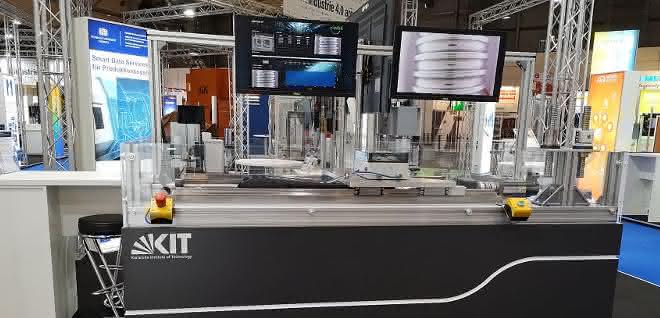
A camera integrated directly into the nut of the ball screw drive is used for this. Based on the image data generated, artificial intelligence continuously monitors the wear and thus reduces machine downtime.
In ball screw drives, such as those used in lathes for precision guidance in the manufacture of cylindrical components, wear has so far been detected manually. "Maintenance is therefore associated with assembly work. The machine then comes to a standstill," says Professor Jürgen Fleischer from the Institute of Production Engineering (wbk) at KIT. "Our approach, on the other hand, is based on the integration of an intelligent camera system directly into the ball screw drive. This allows a user to continuously monitor the condition of the spindle. If there is a need for action, he is informed automatically."
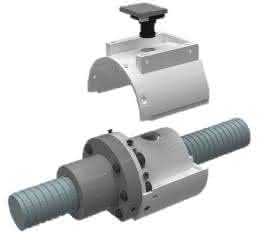
The new system consists of a camera with lighting attached to the nut of the ball screw drive, which is combined with artificial intelligence to evaluate the image data. As the nut moves on the screw, it takes individual images of each section of the screw. This allows the entire surface of the screw to be analyzed.
The combination of image data from ongoing operations with machine learning methods enables users of the system to directly assess the condition of the spindle surface. "We have trained our algorithm with thousands of images so that it can now confidently distinguish between spindles with and without defects," says Tobias Schlagenhauf from wbk, who was involved in the development of the system. "By further evaluating the image data, the wear can also be precisely quantified and interpreted. This allows us to differentiate whether a discoloration is simply dirt or harmful pitting." When training the AI, all conceivable forms of visually visible degeneration were taken into account and the functionality of the algorithm was validated with new image data that the model had never seen before. The algorithm is suitable for all applications in which image-based defects on the surface of a spindle are to be identified and can also be transferred to other applications.
At Hannover Messe 2020 from April 20 to 24, KIT will be demonstrating what is possible with intelligent spindle monitoring in ball screw drives at booth C14 in hall 25.


You might also be interested in
Basler acquires 76% of Indian image processor
Basler, supplier of image processing components for computer vision solutions, has acquired 76% of the Indian sales partner Alpha TechSys Automation.
 read more...
Process monitoring and fault detection
Cameras ensure quality during laser melting
Powder bed-based laser melting (PBF-LB/M) opens up new possibilities in additive manufacturing. Modern camera systems provide crucial process data to further increase quality and efficiency.
read more...Vision Sensor is three times faster than its predecessor
The 'CS-62' vision sensor from di-soric is around three times faster than its predecessor, the 'CS-60'. In combination with the 'nVision-i 25.1' software, it enables image processing solutions that were previously reserved for smart cameras.
read more...Thermal imaging cameras for quality control
Automated thermal imaging cameras are often suitable for quality control applications where temperature plays a role. However, while there are various solutions on the market for slow processes, it is challenging to select a camera that reliably...
read more...Easy entry into industrial VGA thermography
Reliable temperature measurement is a prerequisite for the success of many industrial processes. Berlin-based manufacturer Optris presents the Xi 640 infrared camera, a new member of its Compact Line, which enables non-contact temperature...
read more...Powder bed-based laser melting optimized
Aconity3D has set itself the goal of optimizing the stability of the manufacturing method of powder bed-based laser melting and thereby promoting its use in a wide range of industries. By using high-speed industrial cameras from SVS-Vistek, the...
read more...INDUSTRIAL Production Products of the year...
2nd place, category handling, assembly and production logistics: SICK
safeVisionary2 is the first 3D time-of-flight camera with Performance Level c safety certification. It enables safe three-dimensional environmental detection and won 2nd place in the competition for Product of the Year 2024 in the handling, assembly...
read more...Nomination Products of the Year 2024
SICK: Camera systems safeVisionary2
safeVisionary2 is the first 3D time-of-flight camera with Performance Level c safety certification. It enables safe three-dimensional environmental detection and has been nominated in the 2024 Product of the Year competition in the handling,...
read more...AI vision brings additional opportunities
The seamless integration of AI into the consumer sector has helped to improve our quality of life and make interactions with technology more efficient. In industry, AI vision with machine learning opens up new possibilities that are not covered by...
read more...