
Electromobility in the model
Wear-resistant gear wheels in the gearbox
Electromobility is a key topic for the future. To ensure that Germany is at the forefront, it is important to inspire young minds for scientific and engineering professions. This is why the JET Challenge takes place every year at the IdeenExpo in Hanover.
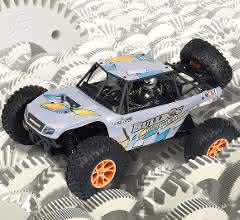
Students have the task of building a fast, robust and energy-efficient racing car from a standard remote-controlled car with a limited budget. Wear-resistant 3D-printed gear wheels from Igus made from the high-performance plastic Iglidur I6 help with this.
Building a fast, energy-saving racing car from a normal, remote-controlled car and overtaking all other teams in a competition - that is the aim of the "Jugend entdeckt Technik" (JET) challenge, which was launched by the Association of German Engineers (VDI) and Hanover University of Applied Sciences and Arts (HSH) in 2007. As with the great role models, the key factor is not speed alone, but also energy efficiency.
In June 2019, visitors to the IdeenExpo can experience the JET Challenge in action at the HSH stand. 25 teams will compete for victory with their 1:10 scale racing cars on a 20 meter long race track. The rules are strict: each team only has a budget of 50 euros at its disposal. Apart from the battery, motor and speed controller, all components must be purchased, developed or built by the teams themselves.
Save money with 3D printing service
The teams are currently preparing for the next IdeenExpo. Students from the Eugen-Reintjes vocational school opted for a wear-resistant and robust gearbox to improve their racing car. The biggest difficulty with this gearbox was procuring the gears: due to the tight budget, the students could not afford to make any big leaps. They finally found what they were looking for at Igus in Cologne: Low-cost, low-wear gears from the SLS printer. After a simple online configuration, the gears were printed from Iglidur I6 and made available.
High-performance plastic makes racing cars robust
Laboratory tests prove that the material I6 is more robust than other plastics. In a test in the in-house test laboratory, the engineers ran gears made of polyoxymethylene (POM) and Iglidur I6 at 12 revolutions per minute and loaded them with 5 Nm. A milled gear wheel made of POM failed after just 621,000 revolutions, while I6 was still in very good condition after one million revolutions. This means that the team does not have to worry about potential failures. The gears in the racing car have already successfully completed an initial test run. The car is energy-efficient and still reaches a top speed of 60 km/h.
Young Engineers Support promotes innovative projects
Igus supports innovative projects such as the racing car gears for the JET Challenge as part of the Young Engineers Support (yes) program. The initiative supports young pupils, students and inventors in the development and implementation of their technical projects.


You might also be interested in
Electromechanical spindle drives made to measure
Stabilus now also offers "Industrial Powerise Actuators" of type IPR40 as a customer-specific solution from batch size 1. Design engineers can individually configure forces, stroke lengths and speeds.
 read more...
Motors, gearboxes and encoders: Faulhaber expands Ø 16 mm portfolio
Faulhaber is expanding its portfolio with new DC motors from the SXR and GXR family, a 16 mm planetary gearbox and the IEX3 magnetic encoder for compact drive solutions.
read more...Gear technology for angular gearboxes
Customized gearing solutions for high-performance drives
Framo Morat presents the "speeroX gearing", a concept for high-ratio angular gears. The article explains the structure, functional principle, fields of application and material options of the technology.
read more...Low-noise gearbox models from Faulhaber
Faulhaber is expanding the GPT family with two high-performance models that impress with their whisper-quiet operation: the "22GPT LN" and the "32GPT LN".
read more...Compact printed matter
Producing complexly shaped bodies of consistent quality from ceramic bodies is a science. A special machine manufacturer produces high-performance extruders for this purpose. The company is now using new, space-saving planetary gear units from...
read more...Automation and industrial robotics
Customized gearbox solutions
At Automatica, SPN Schwaben Präzision will be showcasing various gearbox solutions from the fields of robotics and automation.
read more...Drive technology 2025
Drive technology is the heart of every production process. Nothing moves without it, and no machine can do without drive technology components. From frequency converters, electric motors and gearboxes to clutches and brakes. Who offers which...
read more...New drive solutions for industrial automation and robotics
Faulhaber presents drive solutions with the new GXR and SXR motor family, which offer high efficiency and flexibility in combination with powerful gearboxes and encoders. These optimized components open up new possibilities for applications in...
read more...Drive technology 2024
Drive technology is the heart of every production process. Nothing moves without it, and no machine can do without drive technology components. From frequency inverters, electric motors and gearboxes to clutches and brakes. Who offers which...
read more...