

Basic contribution
Plastics processing in the industry
Plastics have become an integral part of our everyday lives. Due to the numerous starting materials and their properties as well as the very different end products, there are correspondingly different processes for the industrial processing of polymer materials.
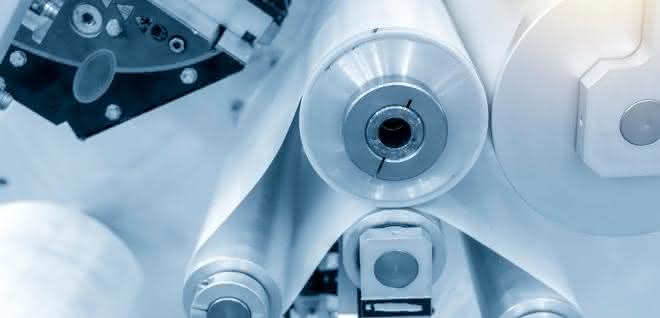
Plastics in a wide variety of forms are used as hoses, films, shock-absorbing molded parts and foams, electrical insulation or as semi-finished products such as pipes and profiles. Depending on the type of plastic, processing is carried out using different techniques. The processing of plastics varies depending on the type of plastic. Polymers can be divided into thermosets, elastomers and thermoplastics.
The three plastic classes
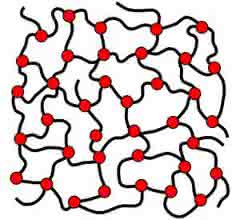
Thermosets are hard plastics that can only be shaped before they have hardened - they cannot be reshaped afterwards. They owe this property to the strong cross-linking of the polymers. For this reason, they must be machined; bonding is generally suitable. Melamine phenolic resins and epoxy resins, for example, are thermosets. At the beginning of the 20th century, the Belgian chemist Leo Hendrik Baekeland developed a thermosetting plastic, the phenol-formaldehyde resin "Bakelite", named after him.

The second category, elastomers, are, as the name suggests, elastic materials. They owe this property to the fact that they are less strongly cross-linked than thermosets. They are malleable, but return to their original shape on their own. At the same time, they have a lower temperature stability than thermosets. One representative of this type is silicone rubber, for example.

Thermoplastics, on the other hand, are plastics that deform or melt when heated. When they cool down, these materials become solid again. They owe this property to the fact that the polymers are not held together by electron pair bonds, but by cross-molecular dipole bonds. These so-called van der Waals bonds are relatively weak and dissolve very quickly when the molecules move thermally. This is why thermoplastics are easy to shape when heated.
Injection molding and extrusion
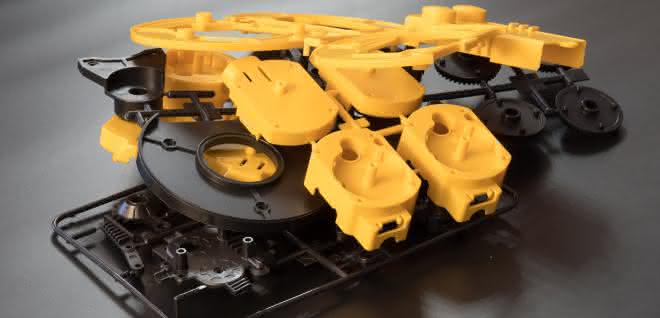
The main processes used for plastics processing are injection molding and extrusion. All three classes of plastic mentioned can be processed by injection molding. In injection molding, the raw materials are fed to the injection unit via a hopper. This is essentially a heated screw pump with a nozzle at the end. The heated plastic is malleable and can therefore be injected into a mold under high pressure. Once the material has cooled, it can be removed from the mold. This means that even complex parts can be produced in large quantities.
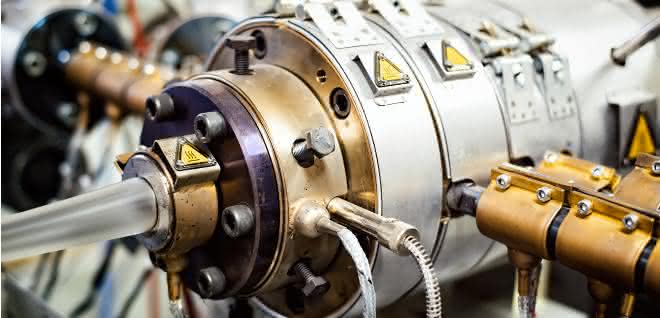
Hoses and pipes are manufactured using the extrusion process
The principle of extrusion is similar. However, here the injection molding is continuous - for example, long pipes can be produced. In contrast to the classic injection molding process, however, extrusion is only useful for thermoplastics. A screw pump presses the molten material through a nozzle to form an endless strand. Semi-finished products such as pipes, hoses or profiles with more complicated geometries, as well as films, can be produced using this process.
Calendering and blow molding
Calendering and blow molding are other processes frequently used in plastics processing. Blow molding is also an extrusion technique. It is mainly used to produce bottles or other containers. Primarily thermoplastics such as polyethylene terephthalate (PET), polypropylene (PP), polyamide (PA) or polyethylene (PE) are processed. A heated tubular blank is inflated with compressed air, whereby the material is pressed against the inside of the mold, giving it the corresponding profile.
Rotational molding is used to produce larger hollow bodies. The mold itself rotates and the molten material is deposited on the inside of the mold due to the centrifugal force. The process is repeated several times and several layers are deposited. This allows seamless, thick-walled and stress-free hollow bodies to be produced, such as fuel tanks, waste containers and barrels.
Sheets and films are produced using the calendering technique. This is also suitable for coating with plastics. The material is melted between heated rollers and can then be rolled into sheets or films or applied to another material under pressure. In contrast to blow molding, the calendering process can be used to produce much thicker films, such as pond or other insulating films.
To protect metal surfaces from corrosion, they can be coated with a thermoplastic material using the fluidized bed process. Swirled thermoplastic powder is deposited on the metal, which is heated to between 200 and 400 °C. It melts and forms a closed, non-porous plastic layer. There it melts and forms a closed, non-porous plastic layer. Plastics such as polyamide, polyethylene, polyester and thermoplastic fluoropolymers, such as ethylene chlorotrifluoroethylene, are used in fluidized bed sintering. The process is a more economical alternative to spray coating.
Foamed plastics
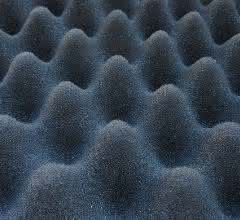
Due to their structure, foamed plastics are very suitable as thermal insulating materials. With a very low dead weight, they also have very good sound and vibration damping properties. A distinction is made between closed-cell and open-cell foams. However, the materials are usually mixed-cell, i.e. they contain open and closed cells, the proportions of which are variable and thus determine the properties of the material.
Thermosets as well as elastomers and thermoplastics are generally suitable for the production of foams. Thermosets and many thermoplastics are used to produce rigid foams, while elastomers are suitable for the production of flexible foams. Polystyrene (PS) and polyurethane (PUR), among others, can be processed into commercially viable materials. Depending on the reaction conditions, polyurethane can be processed into both flexible foam, such as sponge rubber, and rigid foam. Foamed plastics can be found in countless products in the form of sheets or profiles as well as specially manufactured molded parts and packaging materials.
The different types of plastic sometimes require very specialized processing methods. The basic options known as primary molding processes for processing plastics into semi-finished or finished parts allow for the variety of plastic products that accompany us in everyday life.
Dr. Karl-Heinz Heise, Editor-in-Chief, Reichelt Chemietechnik / am


You might also be interested in
Smooth cleaning
The K900 industrial robot cleans floors autonomously, without preparation time or programming effort - even where it is dangerous or even impossible for humans to do so. Lubricant-free linear guides, shafts, plain and flange bearings from Igus also...
 read more...
New pallet roller for the warehouse
Conveyor technology specialist Rulmeca is expanding its range of conveyor rollers for pallets and other heavy goods with the XPS series.
read more...ACE structural and crash dampers: Safety on the road 7
The seventh axis is used in manufacturing and production systems to make robots more agile and increase their reach. As an additional traversing axis, this linear axis brings robots quickly into the workspace or guides them precisely to parallel...
read more...Torwegge presents FlexO rollers
Visitors to the FMB - Supplier Fair for Mechanical Engineering can once again look forward to a new product at the Torwegge stand this year: the FlexO rollers.
read more...Koenig's discipline
AMF clamping technology pulverizes production times at the world's oldest printing press manufacturer Koenig & Bauer in Würzburg
read more...No damage on axis 7
The seventh axis not only makes robots in many production plants more agile, but also increases their reach. To prevent accidents from ruining this increase in productivity, Expert-Tünkers has been working with ACE shock absorber components for...
read more...Moving heavy loads easily
For a manufacturer of lift tables, the collaboration with Blickle has paid off in full. The wheel and castor specialist supplied castor solutions with the ErgoMove electric drive system.
read more...Support with the construction of a hot water tank
With the Hezinger BendingLine MG4R round bending machine, Hezinger Maschinen is supporting the construction of the hot water storage tank for the Rostock public utility company.
read more...When the spark ignites
The surface of car body parts in automotive engineering must be perfect. The basis for this are high-precision textured rollers that prepare the sheet metal parts for processing. Texturing machines process the rollers with high precision using...
read more...