
Materials for ball bearings
Noise-damping lubricating greases
Chemie-Technik in Vöhringen / Baden-Württemberg is responding to the trend towards noise specifications for ball bearings with the development of noise-damping special greases.

Ball bearings, which are used in fans, electric motors or tool spindles, for example, must increasingly have a low noise level in addition to a long service life, as running noise is perceived as annoying by the end customer and this has an impact on the market: According to a major bearing manufacturer, around 2/3 of its bearings already have to meet special requirements in terms of noise levels. Know-how in the production of quiet bearings pays off for manufacturers.
Dr. Frank Schulz, Head of Research/Development at Chemie-Technik, is responsible for the development of Elkalub high-performance lubricants. According to his findings, there are a number of parameters that can influence the noise level of a bearing. In addition to the cage material, bearing size, material and processing, the lubricant used also plays a particularly important role. Dr. Frank Schulz comments: "By developing noise-damping bearing greases in our laboratory, we can give bearing manufacturers a relevant competitive edge."
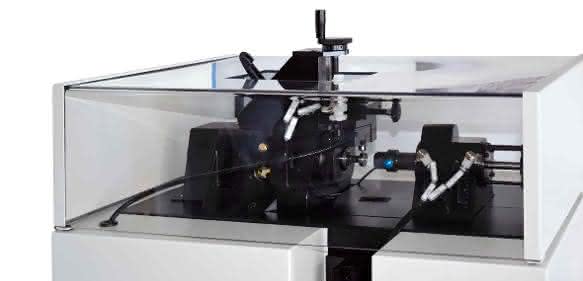
In order to be able to develop noise-damping Elkalub specialty lubricants even better in the future, Chemie-Technik has now equipped its laboratory with a testing device that can be used to objectively and reproducibly measure the noise behavior of a bearing. The measuring principle is based on the outer ring of the test bearing being held in place with a defined force applied via a cylinder and the inner ring being rotated at a defined speed. The resulting vibrations are recorded via a sensor on the outer ring and converted into an electrical value. The measuring device therefore directly records the noise and vibrations of a complete ball bearing. During evaluation, a distinction is made between three frequency bands (low, medium and high frequency) covering a range from 50 to 10,000 Hz. Noise events in the respective frequency bands can be assigned to the various properties and components of the bearing (roundness, rolling elements, raceway).
In the measurements, which are carried out by Chemie Technik using a BeQuiet+ device and evaluated with the MoreQuiet software, the noise behavior of five preserved bearings is first measured in an ungreased state. In the second step, these bearings are greased with the grease to be tested and then measured again. The software then calculates the noise class of the grease from the two measurements. Depending on the noise level, the greases are then assigned to a noise class between I/1 (very low noise) and >IV (loud). In applications such as those described above, greases in noise class I/1 or II/1 (low noise) are preferred.
"With the purchase of the noise tester, we have expanded our testing options with an extremely important and sensitive test bench. This allows us to shorten the time it takes to release a low-noise grease, develop new, low-noise greases and thus meet increased customer requirements even better," says Dr. Frank Schulz.
Bearing manufacturers whose customers impose special requirements for smooth running are therefore well advised to equip their bearings with optimally low-noise Elkalub high-performance lubricants for the first time. A suitable product may already be found in the existing extensive portfolio of specialty lubricants. Equipped with its own measuring device, Chemie-Technik GmbH is also in an even better position to develop low-noise greases for individual applications. These include, above all, applications in food processing, beverage filling and the packaging industry, as the Elkalub range also includes a wide range of H1-certified high-performance lubricants. am


You might also be interested in
Cooling and temperature control units
Hygienic packaging sells safely
In few industries are the requirements for hygiene in the production process as strict as in the food sector - the health of consumers has top priority. This results in enormous challenges for all machines and components involved, especially in...
 read more...
Simple tool change in seconds
With the CMS, Schunk is launching a user-friendly, manual change system for quick component replacement. In addition to its simple and convenient operation, the CMS also stands out with its extensive range of optional modules and complementary end...
read more...Customized machining solutions
Custom-fit solutions for hydraulic valve housings from Mapal
The production of valve housings is the supreme discipline in the world of fluid technology. As a technology partner, Mapal provides support and designs the optimum machining strategy in dialog with the customer.
read more...LEF and LEY series with additional size
Solutions often need to be developed for tight spaces or compact machine designs. To meet such requirements even better, SMC has now added size 16 to its LEY series electric cylinders and LEF series electric spindle drives.
read more...The same locking system around the globe
Orca Industriemontagen builds machines and systems worldwide and now only needs a single locking system to effectively protect all construction sites. The eCliq electronic locking system from Assa Abloy secures the containers during transportation...
read more...Plug-and-produce with smart subsystem
The mechanical engineering company KMS Automation standardizes pressing and joining applications with the Smart Function Kit from Bosch Rexroth. The mechatronic subsystem simplifies machine design, increases process quality and shortens...
read more...Designing transport systems for high flexibility
Factories need flexibility to further increase productivity and introduce new products. Manufacturers must continuously adapt in order to increase productivity and production output.
read more...Twelve new variants for professional users
Kärcher is revamping its range of super-class cold water high-pressure cleaners with twelve new products. With the HD 9/20-4 S, HD 10/21-4 S, HD 10/25-4 S and HD 13/18-4 S, there are four different product classes, each available in three different...
read more...Norelem supports VDI Racing Camp
Mastering the challenges of e-mobility
Promoting young talent has been a priority at Norelem for many years: the company supports young talents with components and the necessary know-how and provides schools with illustrative material.
read more...