
Drive source for factory vehicles
Which battery for which forklift truck?
The efficient use of electric warehouse and factory vehicles depends on the batteries and chargers. There are several factors that influence the choice of battery.
Vehicles such as forklift trucks, pallet trucks and passenger transport vehicles are increasingly being powered by electricity. This means that the efficient use of their potential depends on the traction batteries and chargers used. Operators must therefore take important factors into account when purchasing or modernizing vehicle batteries. Manufacturers of such vehicles should also consider these factors to ensure that their product offering includes the best available battery solutions that meet the high demands of their customers. Key factors include the choice between lead-acid and lithium-ion technologies and their different variants, as well as the overall cost.
Lead-acid battery technologies
An innovative new lead-acid battery using a technology known as Thin Plate Pure Lead (TPPL) offers OEMs and end users a practical and cost-effective alternative to both conventional lead-acid and Li-ion batteries. TPPL technology overcomes many of the disadvantages of lead-acid batteries and enables users to achieve the productivity, economy and safety that are essential in today's competitive market environment.
There are four basic types of lead-acid batteries: Wet lead-acid batteries (lead-antimony), valve-regulated lead-acid (VRLA) gel batteries (lead-calcium), VRLA non-woven (AGM) batteries (lead-calcium) and pure lead batteries (TPPL) (pure lead - VRLA - AGM).
Lead-acid wet batteries offer a good cycle life, but have certain disadvantages due to their design. For example, the charging process is not optimal, as these batteries typically require charging times of eight to twelve hours and an overcharge of around ten to 20 percent to create a sufficient acid mixture and minimize stratification. In addition, water must be topped up regularly. Fast charging is possible in principle, but requires special chargers equipped for battery and charging algorithms.
Commercially available VRLA batteries, both gel and AGM batteries, offer an improvement here. However, they have a limited charging capacity and therefore require a longer charging time of eight to ten hours. With current gel batteries, fast charging with high-current charging programs is difficult.
Advantages of TPPL technology
The pure lead battery is a further development compared to other lead-acid batteries, which is based on two core concepts: Thin plates and pure lead.
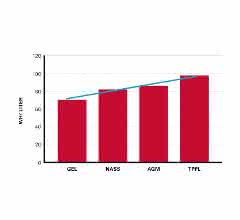
Thin plates: The positive and negative electrodes of a TPPL battery are only one millimeter thin, compared to nine millimeters in conventional lead-acid batteries. This means that significantly more electrodes can be accommodated in the same space, which increases the capacity and boosts the power density. The space required for the same capacity can be reduced by around 30 percent compared to an AGM battery.
Pure lead: AGM VRLA batteries use a lead-calcium alloy for the positive and negative plates. TPPL batteries use high-purity lead in combination with high-purity sulphuric acid. This makes the chemical behavior of the batteries much more stable, resulting in advantages in terms of charging properties and service life. In addition, the plates are far less susceptible to corrosion due to the grain structure of the pure lead.
Like the previous VRLA products, the TPPL batteries are also encapsulated types with minimal outgassing, which do not require topping up with water. Their design results in a very low internal impedance of the batteries and enables both a high discharge rate and fast, efficient charge absorption. This makes partial charging, also known as intermediate charging, possible. Operators therefore have the opportunity to recharge the discharged batteries with high currents in a short time during shift changes or lunch breaks. At the weekend, the battery can then undergo a full charge followed by an equalization charge to restore the maximum state of charge.
The batteries can be charged in the range from 0.4 K5 to 0.7 K5, two to four times the normal charging rates of AGM and gel batteries. Fast charging algorithms for cyclic applications are available for fast and safe charging. Partial charging is possible without negative memory effect. MartinWalsh/as


You might also be interested in
Electric multidirectional sideloader
Moving long goods inside and outside
With the Maxx 60, Hubtex is adding another series to its Maxx range. The focus here is on combined indoor and outdoor use in long goods handling with a load capacity of between five and six tons.
 read more...
Vehicles and systems for production logistics 2023
A wide variety of vehicles are used in production logistics: from transport robots and industrial trucks to conveyor belts, cranes and distribution systems.
read more...Good visibility, smooth running
The G generation of 3/2/1 pallet forks from Meyer enables optimized visibility in the loading situation when picking up pallets, while the synchronous synchronization of the forks and the fast opening and closing speeds also enable efficient and...
read more...Seifert tests Linde Safety Guard
Pilot project at the automotive site in Leipzig: Seifert Logistics has tested the Linde Safety Guard in collaboration with Schöler Fördertechnik. The assistance system warns of potential obstacles to protect people, forklift trucks and warehouse...
read more...Safer than forklift trucks?
Accidents with and caused by pedestrian-controlled forklifts in the workplace often result in serious injuries, sometimes even fatalities. The causes are often restricted visibility due to the load, carelessness or moments of surprise.
read more...Compact version up to 600 kilos
Still has renewed its EXV-CB high lift pallet truck with counterweight and cantilever forks and expanded the series. Thanks to adjustable forks, all load carriers can be picked up and transported, for example closed plastic pallets as well as...
read more...Room for delicacies
A combination of forklift trucks and narrow aisle widths has led to better utilization of the storage space at the Arzberg site of Rudolf and Robert Houdek. The company, headquartered in Starnberg, is one of the 20 largest meat processing companies...
read more...Conveyor technology in use at glass...
Step by step to an automated material flow
Bottles, packaging glass, hexagonal glass, wire hanger glass or various special glasses: Noelle + von Campe has more than 600 glass shapes in its range. Since the 1990s, the company has been expanding its production and logistics lines with...
read more...Driver assistance system reacts to reflective clothing
The Swedish start-up Retenua has developed the first fully integrated driver assistance system for detecting people on mobile machines and forklift trucks based on an embedded camera from Vision Components. It is trained on reflective warning...
read more...