

Transportation systems
Standardized in design, flexible in use
Automated guided vehicles are increasingly in demand in production and logistics as they automate processes efficiently - but in addition to the vehicle, the right peripherals are also crucial for safe operation. A new solution consisting of a standardized base trolley and individually configurable attachments now meets the manufacturer's specifications for the first time while also enabling flexible applications.
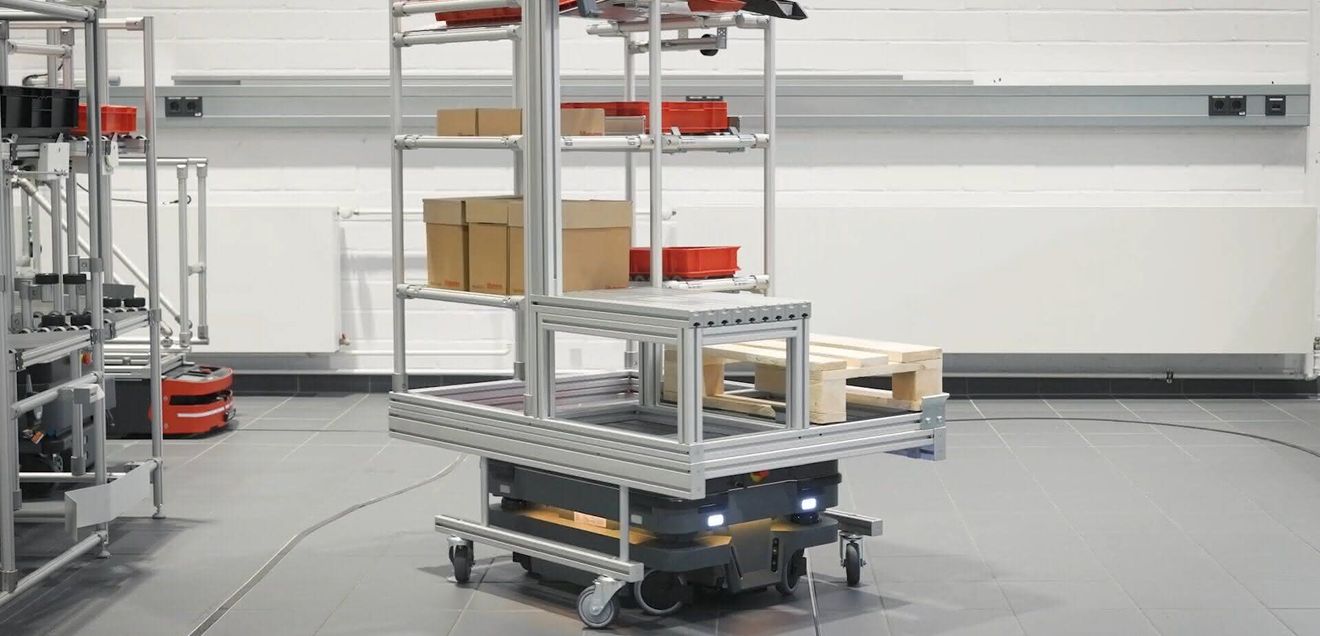
Automated guided vehicles are now an integral part of numerous production and logistics processes. There are many vehicle manufacturers on the market whose concepts differ in terms of software architecture, intended tasks, safety aspects and the size and shape of the robots. Anyone who wants to automate their logistics or transportation task is therefore faced with the major challenge of choosing the right provider.
If companies want to automate transportation tasks, the first step is to determine what is to be transported. Are the workpieces small or large? Will small load carriers (SLCs) with little or a lot of weight be used and how many are to be transported with one vehicle? The hall layout also plays a role. How big can the robot be so that it fits through existing aisles and has sufficient space for maneuvering? Do you need a track-guided vehicle or one that navigates autonomously with the help of cameras, lasers or radio waves, for example? With automated transportation, the possible interaction with employees must be taken into account. Could there be collisions or are the employees working in a completely different area? Another decisive factor is whether the source and sink in logistics should be integrated into the process.
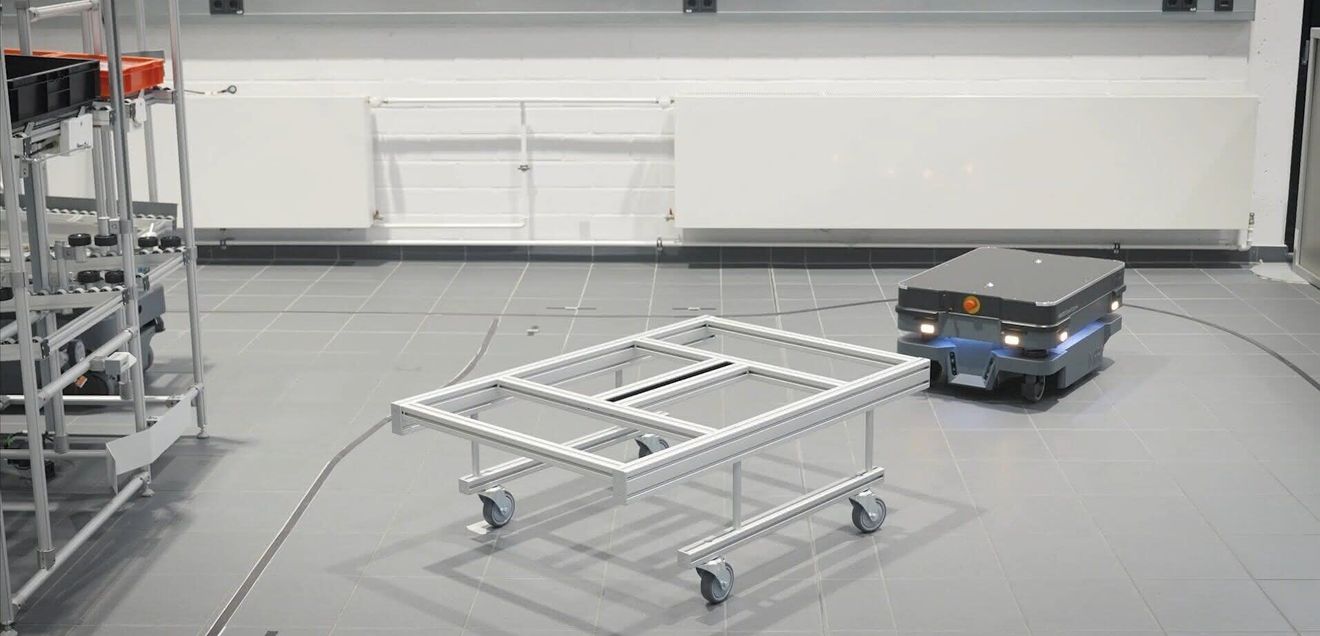
"When planning, it is important to clarify whether transfer stations need to be approached with high precision or whether the transported goods are simply parked and the positioning accuracy is of secondary importance," says Hannes Fröhlich, Product Manager for Robotics at Item Industrietechnik in Solingen. "We also need to consider whether the vehicles need to interact with other systems and whether they need to be compatible - the keyword here is interoperability." In summary, planning is complex and extensive and project planning is time-consuming. On the one hand, all aspects must be taken into consideration and processes must be considered from start to finish, but on the other hand, it is important not to get too bogged down in details so that the cost of implementation is no longer in proportion to the benefits.
Flexibility is key
Even if projects are planned in detail, there are often changes or adjustments to the processes. The transport systems should therefore have a certain degree of flexibility. This applies in particular to the equipment used to transport products or components safely and reliably from A to B. Pallets, pallet cages, racks or other superstructures must be stable and suitable for the transported goods. The entire system must also comply with the technical specifications of the AGV manufacturer. Rigid, welded transport racks are less suitable as aids, as they cannot be adapted to changes. For example, if the transported goods change, a new frame must be welded. If an automated guided vehicle (AGV) from another manufacturer is used, the welded system can also no longer be used, as it most likely does not meet the specifications of the new vehicle manufacturer. A modular system with components that are compatible with each other offers advantages.
"The mobile robots differ not only in terms of their sensors, their dimensions or their docking mechanism, but also in terms of their function and their area of application - sometimes they are used for order picking, sometimes for transportation," explains Hannes Fröhlich. "We have looked at this issue in detail and developed a transport solution that consists of a standardized base cart and perfectly matched, variably configurable top modules."
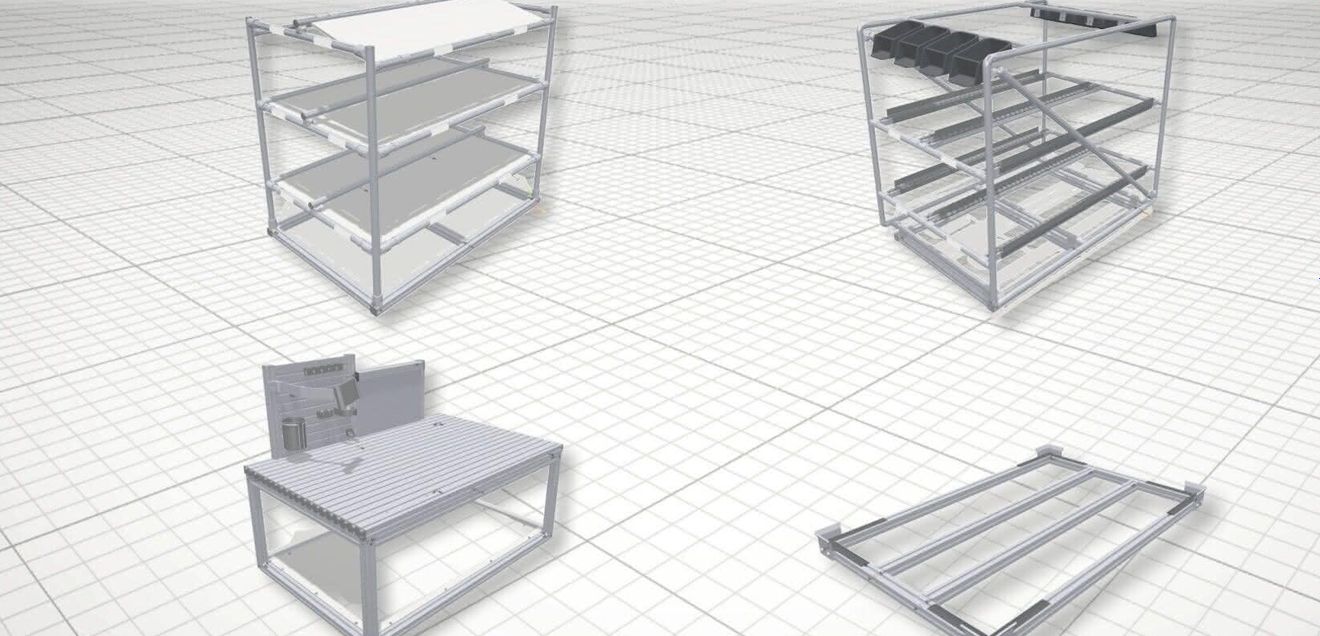
The base carts are basic carts that are compatible with various vehicle models from different manufacturers. These base carts are available in different designs and variants that optimally meet the vehicle manufacturer's specifications. The design is adapted to the dimensions of Euro pallets and offers a standard interface to the so-called top modules.
In future, these superstructures will be available as prefabricated sample solutions for different areas of application. They all have the dimensions of the Euro pallet as a base area and therefore fit perfectly with the basic trolley. If the attachments are to be permanently connected to the transport robot, Item also offers a solution for this. For example, picking racks with several levels, transport devices for small load carriers and complete assembly attachments are available as attachments. However, users can also configure the superstructures individually and draw from Item's extensive modular system. "This means we not only offer a standardized basic trolley, but also maximum flexibility," explains Fröhlich. "The customer can ideally adapt the superstructures to their requirements and modify them quickly and easily if necessary."
High process reliability and simple configuration
The designs meet all specifications and DIN standards. It is also possible to use transport robots from different manufacturers at the same transfer station. Whether it's the simple transportation of pallets or more complex systems for shooting KLT, Item supports users with pre-designed solutions that can be ordered directly or further processed in the Item engineering tool. The cloud-based configuration tool enables simple and user-friendly configuration. The systems can thus be adapted to individual circumstances and requirements. The pre-configured sample solutions thus serve as an inspiration aid. As a result, users quickly receive a solution for their driverless transport systems. "We want to provide our customers with the best possible support in implementing their automation task," emphasizes Hannes Fröhlich. "With the standardized Base Cart, we are creating a foundation that, in combination with individually configurable Top Modules, opens up numerous areas of application."


You might also be interested in
AI is shaping logistics worldwide, supply chains are being restructured
The Agility Emerging Markets Logistics Index 2026 shows that artificial intelligence is being used almost everywhere in the logistics industry. At the same time, geopolitical uncertainties, tariffs and production relocations continue to drive the...
 read more...
Dr. Tobias Harzer becomes Chief Automation Officer
The Supervisory Board of Jungheinrich has appointed Dr. Tobias Harzer (50) as the Group's new Board of Management member for Automation & Warehouse Equipment with effect from February 1, 2026. The appointment is for a period of three years.
read more...ISO 14644-certified lifting and conveying system
Expresso Deutschland GmbH presents the "lift2move cleanroom", a mobile lifting and transport system that is certified in accordance with ISO 14644. This makes the German company one of a small group of manufacturers that can implement...
read more...Automated material flow in production
Autonomous transport vehicles (AGVs) are now part of Sigmatek's intralogistics. 'Sisi' and 'Franz' reliably deliver the loaded PCB magazines and boxes to the desired location in all shifts, thus relieving the strain on employees.
read more...AGV instead of hand cart in e-axle assembly
Motion Technology Company Schaeffler has automated material transportation between the assembly lines for e-axles at its Herzogenaurach site. Mobile transport robots from Safelog are now optimizing intralogistics.
read more...Interview: Products of the year
Growing complexity in product development
In December, INDUSTRIAL Production presents the nominees for the products of the year. Wiferion has also submitted a product.
read more...Automated optimization of storage space
Toyota Material Handling offers the Swarm Automation Storage solution for companies that want to optimize their storage space and counteract the shortage of skilled workers.
read more...Precise work on the special transport system
WDW develops customized solutions for weighing and dosing technology, sampling and special machine construction. The components, machines and systems are primarily used in the bulk materials industry.
read more...Flexible transportation with modular systems
At Logimat 2024, Item presented a system for the safe transportation of materials using driverless transport systems, its new overhead conveyor system and a versatile conveyor belt system.
read more...